
Right Elbow in the Downswing – Illusions meets Observations
If you’ve read my article on Harvey Penick’s Magic Move, you know that much of modern golf instruction revolves around the position of the right elbow in the downswing.
A common teaching is to have the right elbow in front of the body at impact, with the idea that this positioning starts in the downswing. This often leads golfers to feel like they need to push their arms toward the target in an effort to “control” the strike.
But is that really what the greats of the past did?
And how does the modern, more baseball-like swing approach this concept?
Right Elbow in the Downswing – Ben Hogan Example
Ben Hogan definitely got his right elbow moving toward his right pocket in the early downswing, positioning it in a fairly externally rotated state within the shoulder socket. However, just before impact, the arm stops its forward movement and instead rotates, allowing for a full centrifugal release.
This full-arm rotation is one of the key reasons Hogan could generate so much power despite having a relatively compact swing. As you can see in images of his motion, the elbow doesn’t continue moving over the body—instead, it halts while the humerus bone rotates within the shoulder socket.
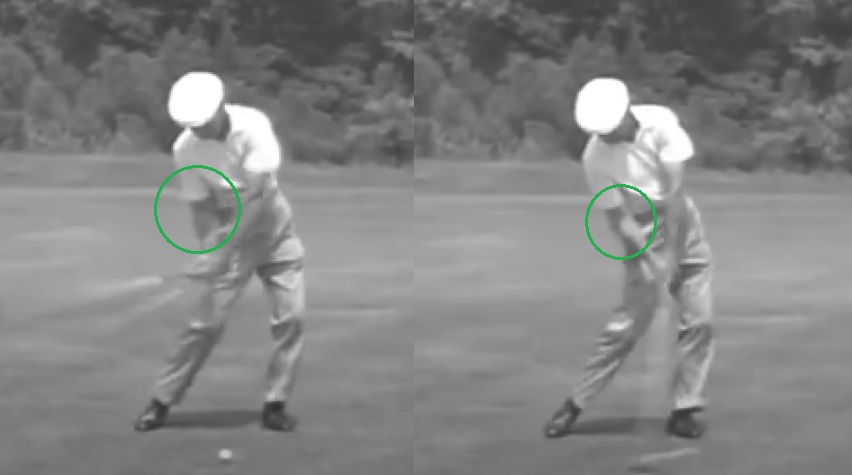
In my opinion, Hogan’s swing was more complex than, say, Jack Nicklaus’s, largely due to the excessively open clubface just before impact. This required him to put in countless extra hours of training to master the motion. Luckily, that kind of dedication was his passion.
Easier Variation – Jack Nicklaus Example
Winning 18 majors is likely the result of being history’s best clutch putter and possessing an unmatched winning spirit—but it’s hard not to credit Jack Nicklaus’s golf swing as a major factor in his success.
Nicklaus was an absolute power monster in his prime, and I believe his right elbow action played a huge role in allowing him to unleash that power.
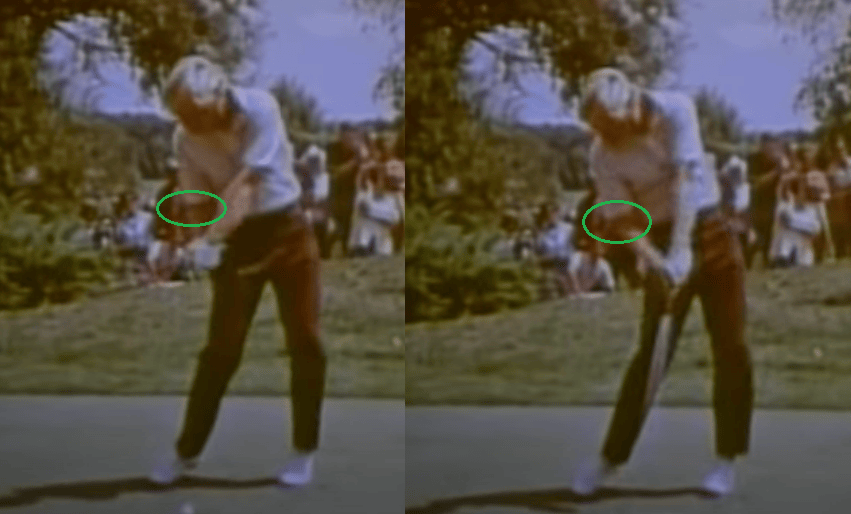
As seen in images of his swing, he wasn’t as externally rotated before impact as someone like Ben Hogan. Instead, his right arm halted and acted as a pivot point, allowing the forces in the shaft to release freely.
I believe that closing the clubface with the full arm early enough is one of the keys to a simple, effective golf swing. It might sound crazy since, from a visual perspective, it seems impossible—but that perspective doesn’t account for the natural forces at play. More on that later.
Modern Baseball Inspired Variation – Right Elbow in the Downswing
You can swing in many different ways and in the more modern style of motion, represented by Dustin Johnson here, the right arm is externally rotated (but with different wrist conditions) and more pushed over the body together with much more intentional full body rotation.
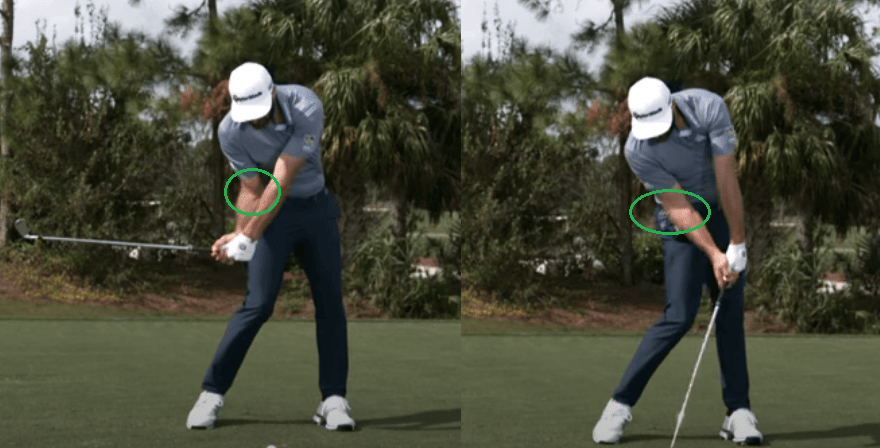
This is a completely different power system. It’s not about manually stimulating the centrifugal force and being in complete connection with the golf shot but a more sling like power system is used where the club action becomes secondary to your body movement.
If you go down this route you can push your right elbow over your body but you then need to lean to the right heavily since the right arm doesn’t extend like for e.g. Nicklaus.
It’s a solution that fits the athletically gifted with experience from similar sports. For us normies its harder to accomplish.

The Easier Way – Nicklaus Style described by Malaska
What you do in golf is often hidden behind natural forces like gravity, twists, momentum, and centrifugal force. Relative to the ball, your clubface is actually opening in the downswing (unless you’re using a more modern, baseball-style swing). Most golfers fail to close the clubface soon enough, leaving them too open too late—forcing a last-second “rescue mission” to square the face at impact.
However, if you recognize the need to shut the clubface down earlier—something Mike Malaska teaches—you can counteract this tendency and create a much simpler, more powerful move toward the ball. Watch Mr Malaska explain it here as a guest on the great channel of Be Better Golf.
At first, rotating your arm this way might feel strange, since it’s technically a steepening move—and we’re always told the downswing should be shallowing, right? But remember, gravity and momentum work in your favor. The steepening effect of this motion is naturally balanced by the ability to release the club centrifugally.
And what about the right elbow? Doesn’t it shoot away from the body? Actually, no. The momentum and force of the club pull it into place, keeping it in line with the motion.
Early Square Up = Free Highway for Natural Release
Ever thought about the flying elbows of Jack Nicklaus or even Fred Couples? This position is particularly interesting because it makes the process of squaring or shutting down the clubface much easier.
In other words, when you start the intentional journey of closing the clubface sooner, it’s like taking your own handbrakes off—freeing up the swing rather than forcing a last-second correction.
This concept aligns closely with what Brian Manzella has been teaching in the golf world for the last decades. Or, as Nicklaus himself put it: “I release as early as possible.” That statement was directly related to his effort to shut the clubface down early enough for a more efficient and repeatable strike.
The FMM’s take on the Right Elbow in the Downswing
If you’ve read my other articles on golf swing timing and shallowing, you know I emphasize starting movements early to unlock effortless power.
I haven’t directly incorporated Mike Malaska’s findings into my own research, but I’ve arrived at the same conclusion regarding early clubface closure in the downswing. The difference—if any—is that I have a slightly different focus on what happens after impact, particularly in relation to how the old greats approached it.
I actually teach three patterns in the golf swing that all origin from more old school release styles. Why? Since they are fundamentally achievable and they live inside most top tier golfers today. What you “do” is very different from what you “see” on a slow motion video. Check out the FMM Swing Academy here.
START THE JOURney – FIND YOUR OLD SChool PATTERN
Your inspirations and your subconscious view of the golf swing matter more than anything when it comes to making a lasting swing change. The goal is to find the pattern that fits you best. Take the quiz and check out the best choice for you below:
FMM EDUCATIONAL PATTERN PAGES
-
Trail Power Hitter Pattern: The Invisible Vertical Power
THE GOLF SWING IS INVISIBLE You can’t see what I really do. I…
-
Aggressive Fluid Release Pattern: Cracking the Hogan Enigma
Cracking THE IMPOSSIBLE ENIGMA? First attempt: seven years ago. There I failed with…
-
Big Arc Swinger Pattern: From Nicklaus to Woods to Scheffler
What’s a big arc golfer? You see that person with a swing that…



Swing Knowledge and Flaws Articles
-
Releasing the Golf Club vs Holding Lag – Which is Better?
If you use your swing arc as your main power source, you are ultimately balancing the relationship between releasing the…
-
Why You Slice – The Fundamental Reason Behind It
If you google why you slice the the first article (check it out here) will list ten reasons that are…
-
Bad Back from Golf – Lower Back Pain and Pelvic Issues
Suffering from a bad back from golf has been a major driving force behind my ten-year study of the golf…



Major Swing Change Article Series
-
Asking Successful Swing Change Questions – Where to Go?
You’ve probably figured out by now that I’m not someone who promotes “quick fixes.” Instead, I focus on the deeper foundations of swing change efforts. In all honesty, there’s no other way to make…
-
Understanding your Golf Swing DNA – Where You Are Now
Understanding who you are as a golfer—your current swing, habits, and the motivations behind them—is the foundation of any meaningful swing change. Without this self-awareness, you have no solid ground to build upon. You…
-
Basic Swing Change Tips: Small Advice with Big Potential
Making a swing change can be challenging and requires more than most golfers realize. To successfully change any part of your swing, you typically need between 3,000 to 5,000 repetitions (based on my experience)….



Some General Swing Tech Posts (with Videos)
-
Why I Don’t Chase Positions — Forces Puts You There
Why I Don’t Chase Positions There’s a position in the golf swing many golfers chase. A clean, organized delivery.The kind you see in slow motion and think: “That’s what I need.” I used to…
-
Antidote Concept — When a Good Swing Feel Turns Bad
Antidote Concept — When a Good Swing Feel Turns Bad You know that feeling. You find something simple in your swing and suddenly everything works. You’re striking it pure.You’re confident.The game feels easy. And…
-
Jack Nicklaus’s Swing – The Inner Layer of his Motion
Jack Nicklaus’s Swing – The Inner Layer of his Motion Golf history is full of great swings, but few have stood the test of time like Jack Nicklaus’s. His technique wasn’t just effective —…


The FMM Swing Articles
-
Most Golf Swings Are Misunderstandings — Perception Problems
What’s the difference between a good ball striker and a struggling golfer? Is it some kind of unique skill set reserved for the most athletic or talented? Heck no. It’s all about how we…
-
Clubface Closure – How to Square Up for an Effortless Swing
The golf swing can in its raw form be described as a challenge of balancing power output and clubface closure. Failing to conquer this challenge lies behind most swing faults in golf. I’ll walk…
-
The Golf Swing Arc: The Leader Behind Your Motion
The highest level of swing technique is to be able to simplify the motion. Over the years I’ve been able to understand what matters and maybe even more importantly, what doesn’t matter, in a…