
Releasing the Golf Club vs Holding Lag – Which is Better?
If you use your swing arc as your main power source, you are ultimately balancing the relationship between releasing the golf club and holding your lag. You’ve probably experienced those thin heel strikes and almost-fat toe shots, right?
Narrowed Simplified Scope = Ad Hoc Analysis Instrument
Just to be clear, I fully acknowledge that this is a theoretical article and that your intended body movements also influence the relationship between the hands and the club.
This article is meant to provide a framework—something tangible to consider when analyzing your own ball striking.
In fact, I use this as a go-to tool for understanding my ball striking while playing. It’s simple enough to generate quick, ad hoc answers. When you’re out on the course playing some half-assed golf, you can’t go into full “swing remake mode”—you need to rely on simpler concepts. This approach makes mid-round adjustments much easier.
Releasing the Golf Club vs Holding Lag – The Spectrum Explained
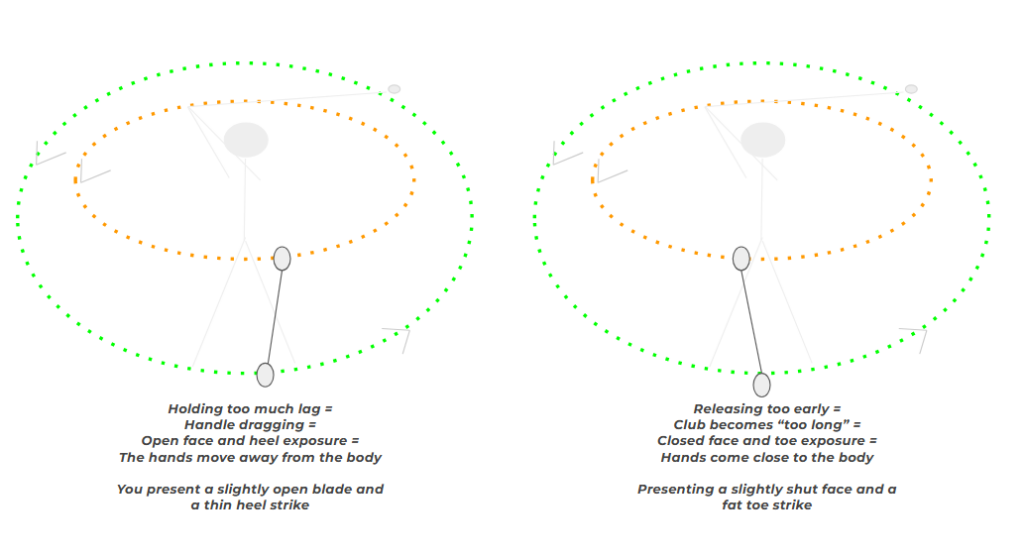
So, the hand path is represented by the orange circle, and the clubhead path by the green circle.
Whenever you hold too much lag or fail to release the golf club, your hands move slightly more toward the ball, shifting the path slightly to the left (out to in). This results in a semi-compressed pull fade, fade, or push fade. In extreme cases, over-holding lag can even lead to shanks.
On the other hand, when you successfully get the centrifugal force working more than balanced in the club, you’ll often come close to fatting the shot with a more toe-biased strike. The path moves more from the inside, and as a counter-reaction to the force outlet, the hands work their way closer to the body.
Again, this applies to swings that rely on the swing arc.
Outside the Spectrum – the Weak Heel Draw
Obviously, all kinds of crazy things can happen in a golf swing, but I’m only going to cover one here—the shut-face heel strike, which falls outside the typical spectrum.
This issue usually stems from holding too much lag while simultaneously applying excessive grip pressure, which causes the hands to rise. This upward movement contributes to a slightly shut clubface, and when combined with a heel strike, it further exaggerates the blade’s effect on the shot.
Equipment Helps you Find Your Balance
So, this concept is pretty straightforward, right? I use it entirely to dial in my equipment.
When I rely on the swing arc as my power engine, I develop a go-to sensation—an abstract feel—that drives my motion. Once I find something that suits me, it becomes repeatable. I never want to change this feel because this is my consistency.
This is where equipment comes into play. How do you find the right balance between grip size, shaft style, shaft weight, and clubhead to fine-tune your release vs. hold-the-lag dynamic?
For me, the holy grail is midsize grips, standard True Temper X100 (or S3-400) shafts, and a relatively heavy clubhead. If something feels off, I adjust with lead tape (for more club release) or counterweights (for more automatic hand speed = holding more lag). Lead tape and counterweights are excellent tools for finding your ideal balance.
Summary – Releasing the Golf Club vs Holding the Lag
This simple theoretical concept has helped me many times on the course, turning a rough ball-striking streak into something much better.
Test it out and see how it works for you—it might just be a great tool.
Cheers!
Swing Knowledge and Flaws Articles
-
Bad Back from Golf – Lower Back Pain and Pelvic Issues
Suffering from a bad back from golf has been a major driving force behind my ten-year study…
-
A Shallow Golf Swing – Which Move Creates the Magic?
How is it that many tour pros don’t visibly shallow their golf club early in the downswing,…
-
Right Elbow in the Downswing – Illusions meets Observations
If you’ve read my article on Harvey Penick’s Magic Move, you know that much of modern golf…



The Major Swing Change Article Series
-
Simplified Swing Change Plan – PDF Download
Use this entire website to fill out the blank spots in the Simplified Swing Change Plan. The plan itself is a very simple resource that you download, print and then adapt to your own…
-
Basic Swing Change Tips: Small Advice with Big Potential
Making a swing change can be challenging and requires more than most golfers realize. To successfully change any part of your swing, you typically need between 3,000 to 5,000 repetitions (based on my experience)….
-
Must Haves & Pitfalls of Major Swing Change – The Big Picture
A major swing change is far from easy—but it doesn’t have to be insanely difficult either. I’m not talking about a minor tweak, like adjusting your grip slightly, but rather a complete rebuild of…



Some General Swing Tech Posts (with Videos)
-
Shot Shaping Old School Style – Setup Advantages
Shot Shaping Old School Style – Setup Advantages One of the biggest advantages of using the swing arc as your engine is the ability to perform shot shaping through setup adjustments. By simply tweaking…
-
FMM Swing Technique Blog | Posts – My Top Picks | Posts – Popular Drivers | Posts – Trail Power Hitter
The Trap Draw – A Pretty Awesome Base Shot
The Trap Draw — A Controlled Weapon The trap draw is one of the most satisfying shots in golf. It launches lower, curves gently, and feels compressed — like the ball never had a…
-
Make the Club Work: The Forgotten Secret to Better Golf Swings
Make the Club Work: The Forgotten Secret to Better Golf Swings One of the biggest mistakes in modern golf instruction is where we place our attention. Most golfers spend years trying to make their…



The FMM Swing Articles
-
The Obstacles of Your Golf Swing – Why Swings Get Limited
Why don’t you swing as well as you want to? What’s in the way? I call the gap between your current state and your desired motion the obstacles of your golf swing. My conclusions…
-
Perform Your Backswing in Front of Yourself – The Vertical Lift
The backswing might be the most difficult part of golf. Do it right, and while there are no guarantees of a perfect result, do it wrong and you’ve almost certainly ruined your chances of…
-
Power & Control in the Golf Swing – A Matter of Balance
Our golf swings — and our attitude toward them — are often a reflection of who we are at our core. Much of our motivation comes from a deep-seated need for control, and the…