
The Lateral Slide in Golf – Why It’s a Game Changer
There are different styles of golf swings that you can perform, but if you are into using the swing arc as your engine (like most golfers do), then you need to use the lateral slide in golf to your advantage.
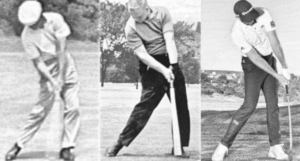
80% of all modern tour players and close to 100% of all historic great golfers have had a lateral slide of somewhere between 5–20 cm from the end of the backswing to somewhere in the beginning of the downswing. It doesn’t really matter if you’re into The Golfing Machine, Stack and Tilt, MORAD, or more traditional swing arc techniques (like what I’m teaching)—basically, all protocols require that you move onto your lead side.
The only real exception is the centered, more baseball-like sling motion used by some modern players. If that’s your style, then this article may be less relevant to you. In that case, I’d recommend this great article by Kelvin Miyahira here.
By the way, you’ve probably heard that you should “hit from the ground up,” and as vague as this statement is, lateral motion actually makes it possible.
Let’s dig in.
Loading the Power System with Momentum
When you intentionally move toward the target, you supercharge the system with passive momentum. In other words, you generate more power effortlessly, without actively trying to do so.
And it gets even better.
Lateral Slide Secures Low Point and Improves….
One of the biggest challenges in golf is naturally bottoming out your club too early. This leads to various faulty behaviors, such as pushing the hands toward the target and being forced to stand up out of the shot. Failing to control the low point also creates a more subtle disadvantage—you instinctively take “off speed” because you subconsciously fear hitting the ball fat.
By incorporating a lateral slide, you shift your low point (where your club bottoms out) closer to the target, essentially reversing the issues mentioned above.
Also think about this. If you move your entire body towards the target you have opened up space for the arms to act. What do you think this means for the path? It creates natural inside properties.
….Impact Conditions through added Steepness & Inside Properties
All else being equal, a more lateral slide position gives you slightly more steepness in the strike and encourages a path that comes more from the inside.
But the body naturally reacts to this by allowing more space for your arms together with the ability to release more centrifugal force, which efficiently shallows out the path while still coming from the inside.
Being shallow and from the inside is ideal because it opens the door to golf’s most sought-after trait—rotation. Rotation adds consistency, helps bring the path slightly more from the outside, and introduces just the right amount of steepness.
Pretty awesome marriage, right?
Potential for Different Swing Patterns
My favorite style of golf swing to teach is the one where you get awesome amounts of power with adequate amounts of control packaged in an ACHIEVABLE wrapper.
This is what the Big Arc Swinger style I teach is about (the core of Nicklaus, Watson, early Woods, early Rory etc). The lateral slide will open up possibilities for powering up the downswing and then taking all of that speed and accelerating it all the way to the finish.
The club post impact exit, from an intentional perspective, is in it’s base form basically straight upwards and inside to the body. Sounds nuts? Nope, that’s just swing arc physics.
Just think about Bubba Watson for a second—you can see the concept in action. Hands reaching toward the sky while still delivering the club 10 degrees from the inside with a wedge or shaping a 40-yard slice with shallow impact conditions.
In another golf swing pattern, utilized by e.g. Trevino, Thompson, Knudsen and the inner layers of Hogan, you use a later lateral slide in unison with another downswing intention to take the backside to a delayed release. Awesome stuff right?
Read more at FMM Swing Academy here.
Too Much Lateral Slide?
As with everything in golf, balance is key to performing proper, solid swings. The lateral slide, if done excessively, can actually lock your lead hip socket and make it impossible to use your hips effectively through the ball. This occurs when your hips are in a trail side pelvic tilt, which is problematic because it restricts your follow-through rotation. If you ever feel that your follow-through is limited, it’s likely because you’ve shifted too much laterally or tilted the pelvis slightly.
Hitting from the Ground Up – Possible through Lateral Slide
As mentioned at the beginning of this article, you can start utilizing the ground much more effectively by incorporating lateral movement. I’ve never intentionally “hit from the ground up” in my life, but I’ve felt countless times that having a solid foundation is far better than losing connection with your feet.
In other words, the lateral slide builds pressure into your feet, which you then use to stand up and extend out of the shot. And to tie it all together—extension is what allows you to rotate naturally, without having to consciously think about it.
If you incorporate the right amount of lateral slide, time it right and match it towards your achievable release style it becomes a GAME CHANGER for your ball striking.
Swing Knowledge and Flaws Articles
-
Deciphering Swing Styles – The Best Component of Golf Development?
Why is it a good thing to decipher different golf swing styles? How can deeper understanding help your own development?…
-
Minor Swing Fix: Intentions Makes AND Breaks Your Swing
Most golfers manipulate their motion in one way or another, which eventually leads to the need for minor swing fix….
-
Releasing the Golf Club vs Holding Lag – Which is Better?
If you use your swing arc as your main power source, you are ultimately balancing the relationship between releasing the…


Major Swing Change Article Series
-
Must Haves & Pitfalls of Major Swing Change – The Big Picture
A major swing change is far from easy—but it doesn’t have to be insanely difficult either. I’m not talking about a minor tweak, like adjusting your grip slightly, but rather a complete rebuild of…
-
Basic Swing Change Tips: Small Advice with Big Potential
Making a swing change can be challenging and requires more than most golfers realize. To successfully change any part of your swing, you typically need between 3,000 to 5,000 repetitions (based on my experience)….
-
Asking Successful Swing Change Questions – Where to Go?
You’ve probably figured out by now that I’m not someone who promotes “quick fixes.” Instead, I focus on the deeper foundations of swing change efforts. In all honesty, there’s no other way to make…



Some General Swing Tech Posts (with Videos)
-
Antidote Concept — When a Good Swing Feel Turns Bad
Antidote Concept — When a Good Swing Feel Turns Bad You know that feeling. You find something simple in your swing and suddenly everything works. You’re striking it pure.You’re confident.The game feels easy. And…
-
Let the Club do the Work! How to accomplish Smoothness
Let the Club do the Work! How to accomplish Smoothness I teach a motion where the golf club does the work for you. Where you don’t need to hit the gym every other day,…
-
Natural Golf Swing Movement: Centered Look a Byproduct of Moving?
Natural Golf Swing Movement – Paves the Way for an Effortless Feel At first glance, my golf swing may look centered, but my real focus is on natural golf swing movement, almost like dancing…



The FMM Swing Articles
-
Functional Swing Technique: What a Good Swing Achieves
When it comes to the golf motion, there’s one ultimate goal—and it isn’t perfect form or carrying the driver 320 yards. It’s achieving a functional swing technique. To bring clarity to what functional swing…
-
A Transition Free Golf Swing – Is this Possible?
The transition part of the golf swing can be tough to master since it happens relatively quickly and it has such big effects on your striking. To answer the question directly: No, you need…
-
Impact in Golf Explained: A Product of Swing Thoughts
Let’s talk about impact in golf and how your golf swing can influence it. After all, it’s the absolute decider of your shot’s potency. Some golfers think about impact as something they need to…