Cracking THE IMPOSSIBLE ENIGMA?
First attempt: seven years ago. There I failed with the power protocol. I followed conventional coaching rules, and it didn’t work.
Four years ago, I went after it again with better knowledge and a more intention-based approach. Almost, but not fully understood.
Now finally, 12 years into the FMM project and seven years into Hogan, I’ve cracked big chunks of the code.
Mr. Hogan wasn’t a sharer. His books, intentionally or not, didn’t tell the full story. He left out the most important factors.
And for those who believe Five Lessons is a bad book for non-professionals: you know nothing.
who is it for?
You likely enjoy swinging more around yourself.
You love releasing the golf club and making it work.
You love feeling like a player.
Quite frankly, you love those beautiful flat swings.
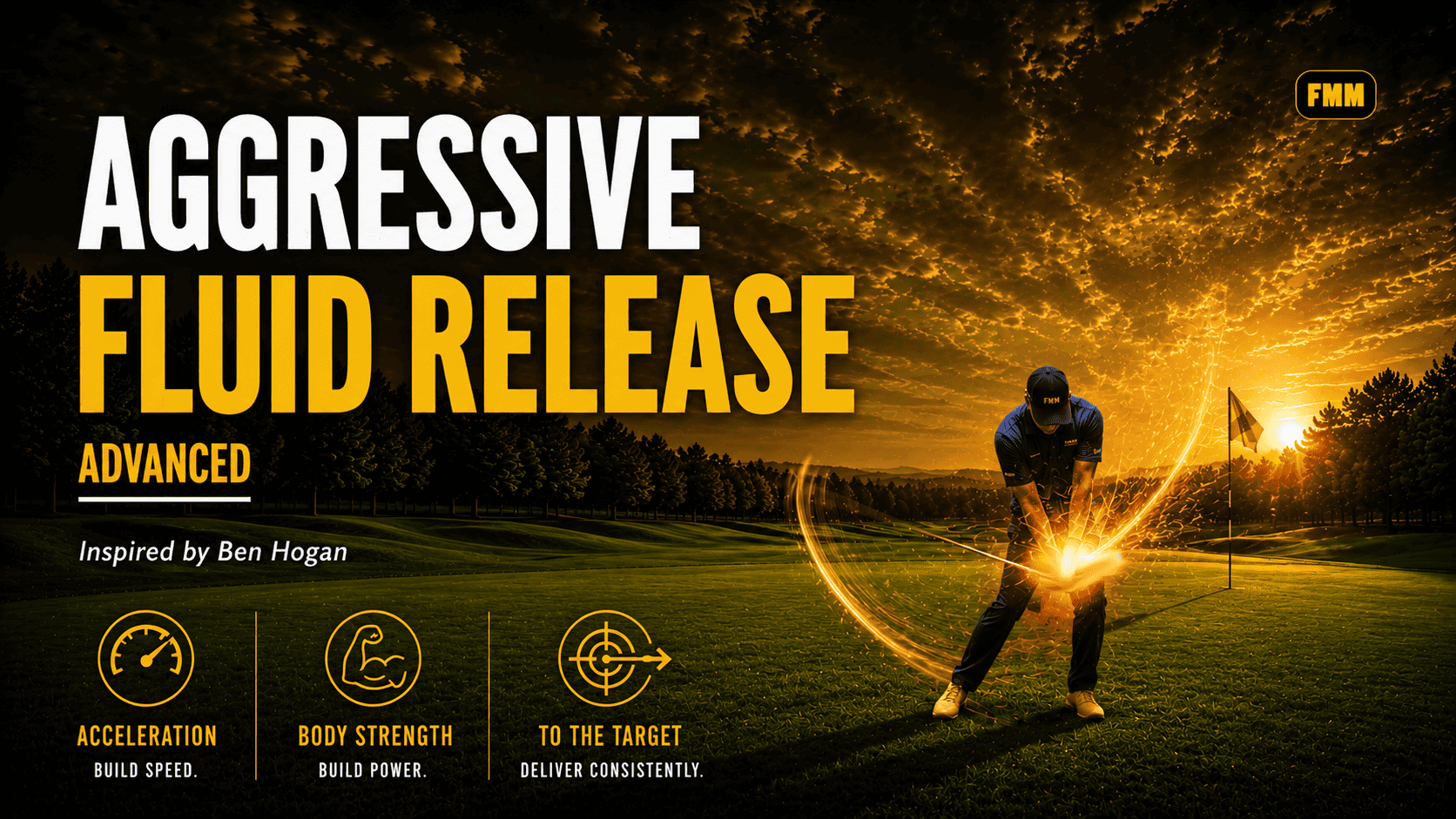
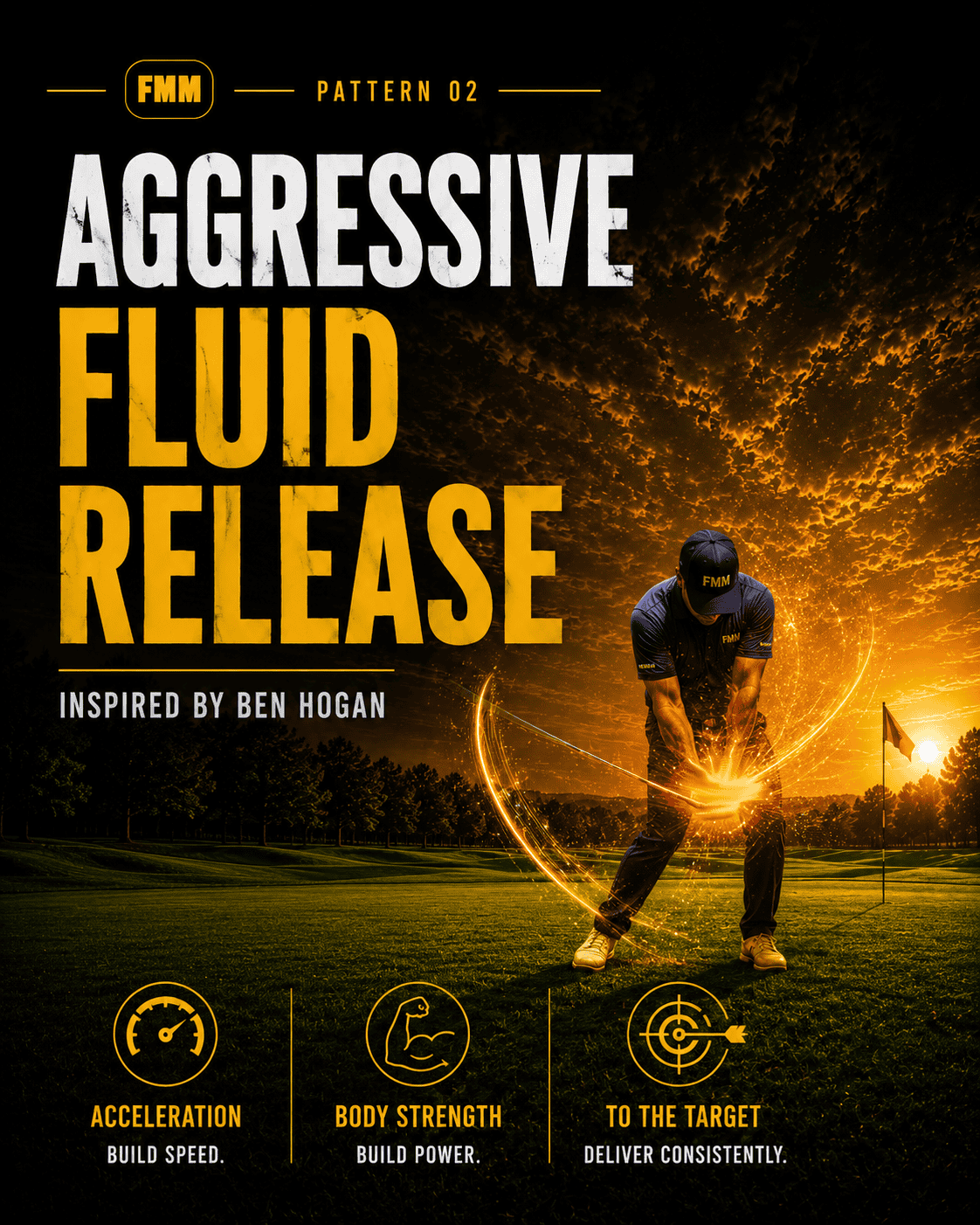
VIDEO ABOUT THE AFR HOGAN PATTERN
PATTERN KEY PRINCIPLES?
The flat swing takes you more from the inside, but we are far from done there. The balance points, body posture, grip dynamics, and backswing blade opening bring you to the flattest, most shallow downswing plane in golf.
And read this carefully now. The shallowness DOESN’T come from a special move. Rather, it lives in the swing style.
The power protocol isn’t a downswing and a follow-through. Nope. It’s much easier. It’s a FORWARD swing. Backswing, and then a forward swing. Not that hard, right?
The inherent body strength you get from proper balance points, posture positions, and how you work your feet in the swing (remember that Hogan had an extra spike on his trail-foot shoe?) builds immense lower-body awareness and strength. On top of that, dynamic grip action (dynamic = you actually do things with the grip) connects your arms and shoulders into the power profile.
Long story short: you feel your body. You feel your swing.
On top of this strength, you can now apply as much or as little acceleration as you want.
Fully released for the win.
Hogan style.
HOGAN SWING DEVELOPMENT & KEY TAKE AWAYS
In the ’30s, Mr. Hogan played with a long left thumb in a strong lead-hand grip, battled an overswing, and had consistency issues.
After the war, he started using better grip dynamics and a more potent power protocol to gain control. This resulted in immense success before the big injury.
Post-injury, he developed even further, improving his balance points, grip dynamics, and ultimately creating what is possibly the best swing of all time. He basically won everything.
The key takeaways are the grip, the balance points, and the internal strength recruitment. The things you can’t see, but can certainly feel—and that show up in improved consistency.
Or as the announcer said on the match vs. Sam Snead in the ’60s on Shell’s Wonderful World of Golf: “So Mr Hogan, you’ve hit all fairways and all greens today.”
My own Analysis – no cheat watching
I don’t look at other coaches. I don’t read other publications about Mr. Hogan. I don’t cheat.
I have the utmost respect for the efforts of others, but I also truly believe that the only way forward with swings like this is through self-experimentation and guinea pig testing.
That’s what I’ve done.
So likely my terminology doesn’t sound like everyone else’s.
HOW DOES IT APPLY TO SWING FAULTS?
I would argue that this is the best swing of all time, and that the input value is a working swinging motion (Hogan in the ’30s).
For an over-the-topper? This swing is the complete opposite. If you wish to embark on this mission, then do this: take a picture of your old swing and send it halfway to Siberia. It’s not meant to come back. It’s over. It’s done. Welcome to your swing, and give it a month of practice.
For hookers? That’s the point of Mr. Hogan’s protocol. You take that hook and simply make it go straight through very smart dynamics.
For early extension? The forward swing means you’re in balance. There’s no reason to early extend, right? Early extension is a counterbalance problem caused by an undefined power protocol (often vertical and left + early extension to regain balance). The forward swing benefits from power in both feet.
Early extension becomes a non-problem.
EDUCATIONAL COURSES = PEACE OF MIND.
I hate it when someone sits on all the knowledge and drip-feeds it like some kind of money leech. Unfortunately, the golf industry is full of that. So let’s do something different, shall we?
I’ve produced all the base knowledge in educational courses. The biggest benefit of going through a course is that you understand how and why things happen. It doesn’t mean you’ll become a pro overnight, but it gives you something real to work on.
In the AFR pattern, it’s all about working on that setup position for a mind-blowingly long time (grip perfection), then starting to unleash your best power protocol. Forward and full hook mode. Then we step into fixing just that.
The best of the best didn’t do something hard. They did something very simple so they could reproduce it under pressure.
HOW TO START TRAINING?
- Go to Youtube and become a member on my channel. I have both light and advanced version but I ALWAYS recommend the advanced since Knowledge first leads to Simplicity second. Join for 1 or 2 months to see if it’s your style. 29$ per month. Click here to enter my Youtube Channel.
- On Skillest (coaching app) you can purchase it as a course one time payment. 99$ for the advanced version Click here to come to my Skillest Coaching Profile
.Or of course you can just send me an email on: forgottenmastermoves@gmail.com.
STUDENT STORIES
Fraser started golf eight years ago and quickly got down to a 4 handicap. Then something happened, and the search for his old—or perhaps an even better—swing began.
Three years of mechanical prison followed, without any real progress. We started working together and got him back to his old motion—and beyond.
Hone in on your strengths rather than trying to make your weaknesses “okay.” It’s a far better way to develop.
Oskar is a super-motivated junior who got derailed by modern BS coaching. He was the most promising player at his club but got caught in the mechanical net. He almost left the game (!).
Together, we got him back on track. From finding his base power to working toward his inspirations, and finally to building a complete bag with a stock shot for every club.
Score development? From 82–83-ish to a personal best of -2. That’s pretty damn impressive.
William is a natural talent who had somewhat lost his game. The culprit? Not being allowed to do what came naturally to him. Instead, he was taught to follow modern “rules.”
Seriously? He basically has the swing of Phil Mickelson, and you’re supposed to change that? I don’t think so. Let’s harness it instead.
William reacted instantly to the changes and is quickly learning to own his own motion. A big win for him (and for me).
Fabien never had the luxury of learning the game as a kid. Instead, he stepped into all the common pitfalls and eventually quit golf altogether.
After a long, long break, he came back two years ago. We met 4–5 months ago, and at the time he was shooting scores in the 100s.
Now he understands his power and regularly shoots in the low 80s, with scratch firmly set as his future target. Dedication and development that deserve real respect.
Josh is a long-time golfer whose life simply got in the way. When he came back to the game, he suffered so much from back injuries that he could hardly play or practice with any enjoyment.
We started working together, and I’m happy to report that he’s now rediscovered the joy of the game. Not “needing” to chase all the positions has really freed up his swing.
And most importantly: fewer injuries.
Ever heard the expression that the perfect student is a stupid person framed like a barn door?
Meet the opposite. Eduardo started golf later in life after a career in senior positions at several esteemed companies. Too much brain for golf, if you will.
FMM helped Eduardo make sense of the golf jungle, and slowly we’re getting him below 85. A real pleasure to work with!
HOGAN INSPIRED VIDEO ARTICLES




AFR HOGAN ARTICLES – TEXT BASED ARTICLES