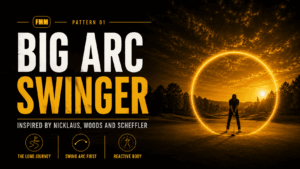
Big Arc Swing Pattern: Nicklaus, Woods & Scheffler
There are certain golf swings that immediately stand out.
Jack Nicklaus.
Tiger Woods.
Scottie Scheffler.
Different eras. Different personalities. Yet they all share something remarkably similar.
A golf swing built around a big arc.
Not because they copied one another, but because they developed an athletic motion that allows the club to accelerate over a long, flowing journey.
That idea became the foundation of what I call the Big Arc Swing Pattern.
Looking Beyond Positions
For years I searched for the common denominators behind these players.
Not the positions.
Not the checkpoints.
The motion.
What creates that harmony?
Why does the swing look so fluid while producing tremendous speed?
The answer, in my experience, isn’t a collection of positions.
It’s a collection of intentions.
A Long Power Journey
One of the defining characteristics of the Big Arc Swing Pattern is that power is never treated as a single event.
It isn’t a violent hit at the golf ball.
It isn’t a whip.
Instead, the golfer creates a long, accelerating power journey.
The movement begins at the top of the backswing and continues all the way into the finish.
Impact simply happens along the way.
The longer the journey, the easier it becomes to produce effortless speed.
Connecting With the Club
Another important concept is learning to connect with the golf club itself.
Rather than dragging the club through the downswing, you begin sending energy into it.
The club starts working for you.
Its weight becomes something you feel.
Its momentum becomes something you trust.
This connection transforms the golf swing from a sequence of body movements into an athletic motion.
Training Motion Instead of Positions
This is also how I teach the pattern.
I don’t believe golfers perform their best by thinking about isolated body positions.
Instead, I focus on giving the brain movement tasks.
Simple intentions.
Athletic objectives.
The body is remarkably good at organising itself when the club has a meaningful task to perform.
Instead of chasing positions, you replace them with motion.
The Two Swooshes
One of the simplest ways to train the pattern is through what I call the two swooshes.
The first creates input speed.
It teaches the club to gather momentum.
The second directs where that momentum should travel.
For the stock shot, that journey continues above the lead shoulder, producing the large, flowing swing arc that gives the pattern its name.
Eventually, changing the second swoosh allows you to shape trajectories and shot patterns while keeping the same fundamental motion.
Replacing Swing Faults
One philosophy has shaped Forgotten Master Moves from the beginning:
Don’t fix swing faults. Replace them.
When golfers are given a better movement pattern, many common faults begin disappearing naturally.
Over-the-top swings often stem from unclear power intentions.
Steep downswings become shallower because the club is travelling on a different journey.
Early extension frequently disappears because the body no longer has to compensate.
Rather than fighting symptoms, you replace the movement that created them.
Why It Works for Every Handicap
The pattern offers different benefits depending on your level.
For higher handicaps, it creates clarity.
The golf swing begins making sense, and speed becomes easier to produce.
For mid-handicap golfers, it provides a simpler transition.
Instead of trying to manufacture difficult positions, the focus shifts toward creating better movement.
For lower handicaps, the value lies in understanding the system.
Shot shaping, trajectory control and performance become increasingly predictable because every variation grows from the same athletic foundation.
A Swing Built for the Long Term
Perhaps my favourite aspect of the Big Arc Swing Pattern is its longevity.
The motion encourages shallowness, freedom and mobility.
Instead of forcing the body into restrictive positions, it allows athletic movement to create the mechanics.
That not only improves performance but also creates a swing that can be repeated—and enjoyed—for years to come.
Final Thoughts
The Big Arc Swing Pattern isn’t an attempt to copy Jack Nicklaus, Tiger Woods or Scottie Scheffler.
It’s an attempt to understand the athletic principles their swings have in common.
Long acceleration.
Freedom.
Connection to the club.
Movement over positions.
That’s the philosophy behind Forgotten Master Moves.
Knowledge first. Simplicity second. Performance follows.
START THE JOURney – FIND YOUR OLD SChool PATTERN
Your inspirations and your subconscious view of the golf swing matter more than anything when it comes to making a lasting swing change. The goal is to find the pattern that fits you best. Take the quiz and check out the best choice for you below:
FMM EDUCATIONAL PATTERN PAGES
-
Trail Power Hitter Pattern: The Invisible Vertical Power
THE GOLF SWING IS INVISIBLE You can’t see what I really do. I…
-
Aggressive Fluid Release Pattern: Cracking the Hogan Enigma
Cracking THE IMPOSSIBLE ENIGMA? First attempt: seven years ago. There I failed with…
-
Big Arc Swinger Pattern: From Nicklaus to Woods to Scheffler
What’s a big arc golfer? You see that person with a swing that…


Main Website Pages
-
FMM Video Articles — See It. Read It. Understand It.
In early 2025, I started my YouTube channel (find it here), and the format has really grown on me. It allows me to explain, demonstrate, and cover things that text simply can’t. The real…
-
All Articles Library – All Creations in One Place
Everything I’ve created over the years. You have different filterings according to the list below. Wish to watch Youtube videos instead? Then click here to open Wish to visit my Skillest Profile (coach app)?…
-
FMM Academy – Which Pattern Fits You?
Golf instruction has never suffered from a lack of information. It has suffered from a lack of understanding. The FMM Academy was built to help golfers understand why great swings work, how different players…
-
Swing Styles Articles – Explaining Old School Variations
I categorize golf swings into different styles for the sake of clarity and understanding. No golfer fits perfectly into a single swing style, but without a structured framework, you’re essentially shooting in the dark….



Old School General Articles
-
Ben Hogan vs Jack Nicklaus Grip: What’s the Real Difference?
All the old-timers cared about one thing first and foremost. Almost as if it were the gatekeeper to their swing worlds. The grip. Why is it so important? Because it directly connects to how…
-
How Lee Trevino Built One of Golf’s Most Accurate Swings
Most golfers trying to hack the golf swing just ruin it, and some, like Lee Trevino, win six majors. From an accuracy perspective, I would say that his motion is the most efficient I’ve…
-
Why Jack Nicklaus Swing Work – Free of Modern “Rules”
Most people have Ben Hogan as their swing god, and sure, he’s awesome, but my personal favorite will always be Jack Nicklaus Swing. The Golden Bear. It’s the simplicity and effortless feel of it…
More FMM Project Articles
-
The Swinging Protocol – In the Core of all Great Golfers?
I have a special interest in the golf world, and that is to understand what actually built the best swings of all time. Not just how they look, but what truly built them. What…
-
A Powerful Golf Swing Clips It – Stop Chasing Divots
We are all performing golf swings based on inner images, muscle memory, and athleticism. These different subconscious images will shape how we perform our motion. A powerful golf swing clips it in a shallow,…
-
Perform Your Backswing in Front of Yourself – The Vertical Lift
The backswing might be the most difficult part of golf. Do it right, and while there are no guarantees of a perfect result, do it wrong and you’ve almost certainly ruined your chances of…