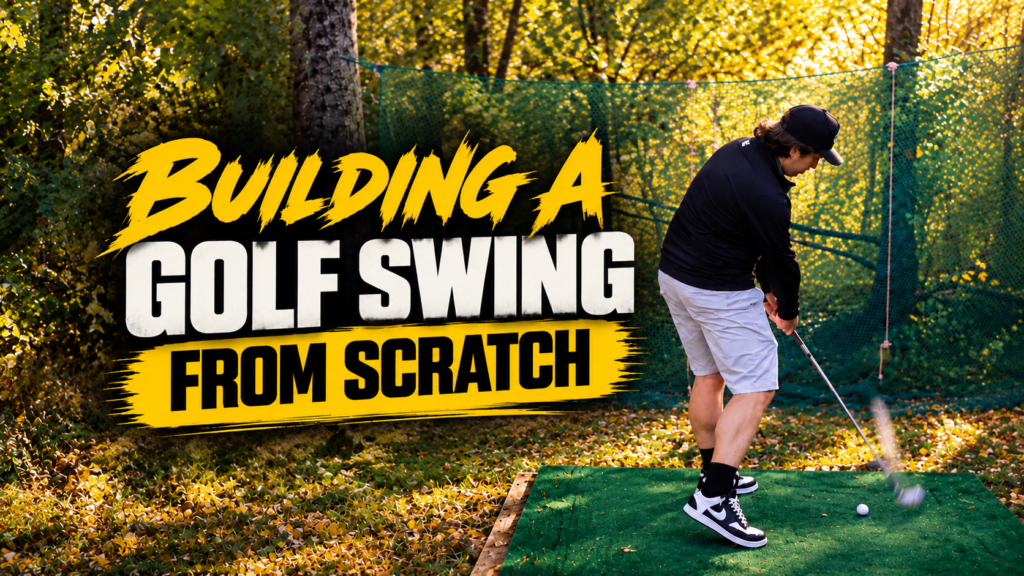
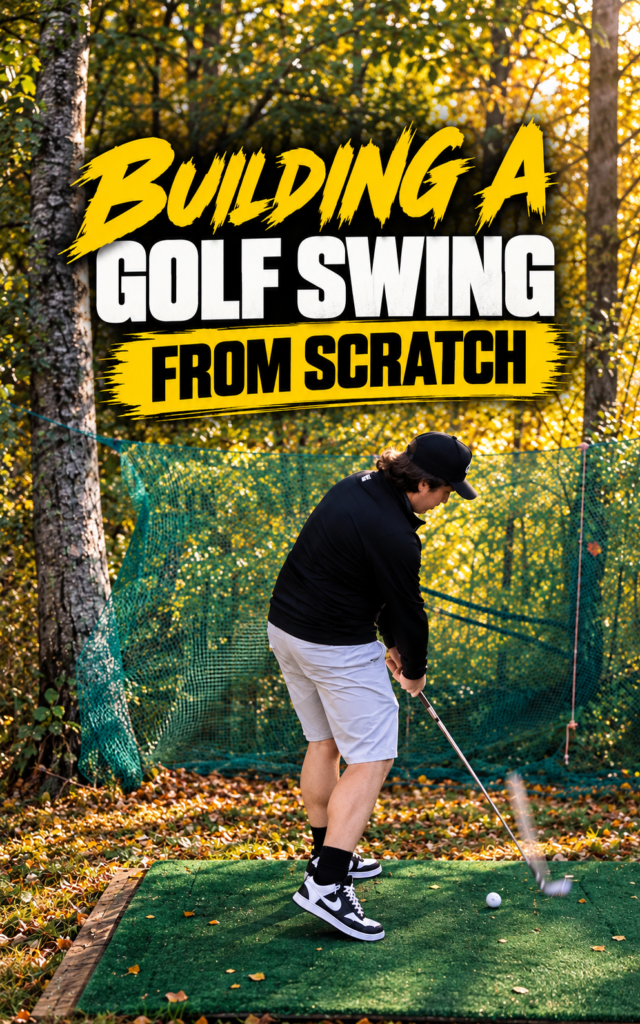
Building a Golf Swing from Scratch
Building a golf swing from scratch is one of the subjects I find most interesting in golf. There are countless variables involved: the wrists and forearms, the arms and shoulders, the pelvis and hips, posture, balance, pressure, grip, clubface, backswing, forward swing, release, alignment and timing. Beyond those individual components, there are also larger forces that organise them. There are different ways of generating power, different ways of perceiving the motion, and different intentions that can cause the body and club to organise themselves in very different ways.
This is also why golf instruction can become unnecessarily complicated. We can describe almost every movement in anatomical detail, divide the swing into a sequence of positions and analyse every frame of a video, but that does not necessarily tell us what the golfer should actually do. My approach in this series is therefore to begin with as much complexity as necessary, understand the individual pieces and the relationships between them, and then gradually simplify the picture. The objective is not to produce another list of positions to memorise, but to understand what actually drives the motion and how the different parts of the swing fit together.
And for you that are much more into video, then just click here to come to the youtube playlist.
The Variables Are Not the Swing
There are many anatomical movements involved in a golf swing. The wrists move through radial and ulnar deviation, flexion and extension. The forearms pronate and supinate, the upper arms rotate, the shoulders move through internal and external rotation, and the hips and pelvis move through flexion, extension, rotation and tilt. The thoracic spine contributes its own movements, and all of these elements interact throughout the swing.
It is useful to understand that these movements exist, particularly if you want to analyse a golfer. What I do not believe is that the golfer should attempt to consciously operate all of them. A player who is told to rotate the pelvis, maintain a certain amount of thoracic rotation, externally rotate the trail shoulder, maintain a particular wrist condition and then release the club at precisely the correct moment has been given a great deal of information, but not necessarily a better way of swinging.
The body is capable of organising an extraordinary amount of movement when it is given a meaningful task. The more useful question is therefore not simply what is moving? but what is causing it to move? Some movements are important drivers. Others are consequences of those drivers. Confusing the two is one of the easiest ways to make the golf swing unnecessarily complicated.
The same distinction applies to the chronological description of the swing. Modern analysis often uses systems such as P1 through P10, dividing the motion into a large number of positions. As an analytical language, this can be extremely useful. When studying a player in slow motion, it gives us reference points that allow us to describe what happened. But I do not believe that the human mind works particularly well when it tries to perform a golf swing as a sequence of ten separate positions.
The older description of a backswing and a forward swing has something very useful about it. It describes the motion rather than asking the golfer to reproduce a series of photographs. The positions are observations of what happened. They are not necessarily the instructions that created the movement.
That distinction becomes increasingly important as we move from describing a golf swing toward actually building one.
The Grip Establishes the Relationship With the Club
The grip is perhaps the clearest example of why different swing patterns require different solutions. There is no single way of placing the hands on a golf club that makes every possible swing work equally well. The grip determines how the hands relate to the club, how freely they can move and how readily the clubface can respond to the forces being applied to it. In that sense, the grip is not simply a neutral connection between the golfer and the club. It is part of the power package.
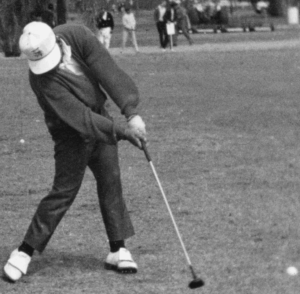
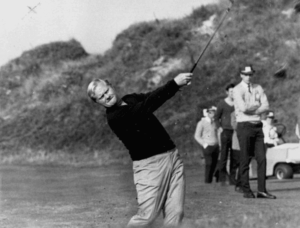
Ben Hogan and Jack Nicklaus provide useful examples. Hogan’s lead hand was positioned more into the fingers, giving him greater mobility, while Nicklaus used the lead hand more as a supporting power hand and therefore had a somewhat more palm-oriented relationship with the club. The trail hand was different again because the two players were trying to solve different problems with their releases. Nicklaus could allow considerably more trail-hand freedom because of the nature of his release, while Hogan was more concerned with controlling excessive trail-hand activity.
The same principle can be seen in the difference between an interlocking grip, an overlapping grip and a ten-finger grip. The ten-finger grip, for example, can be a very useful way of increasing wrist activity when the golfer is learning to release the club more freely. Grip strength also changes the problem. A strong lead-hand grip tends to encourage the clubface to close more readily through a traditional release, while a weak grip gives the hands a different set of possibilities.
This is why I am generally suspicious of universal grip rules. A particular grip can be technically sound and still be completely inappropriate for the movement a golfer is trying to create. A reasonably neutral grip is often a very good starting point because it gives the golfer access to both sides of the ball flight, but ultimately the grip needs to make sense in relation to the intended release. If the purpose of the swing is to release the club aggressively, the hands need enough freedom to do so. If the golfer is trying to contain certain movements, the grip may need to provide a different kind of control.
The important point is not whether Hogan’s grip or Nicklaus’s grip is objectively better. The important point is that the grip belongs to the swing pattern. It is one of the first places where the golfer establishes the relationship between intention and movement.
Posture Should Create Mobility, Not Imitate Athleticism
Posture is another area where golf instruction can become unnecessarily prescriptive. The modern golfer is often encouraged to look athletic, with a wide stance, substantial knee flex and a pronounced forward inclination, as though preparing to jump, tackle or react explosively. That may create an athletic appearance, but appearance and function are not necessarily the same thing.
If you stand upright with your feet together, you can move in almost any direction with considerable freedom. As you widen the stance, increase the amount of flexion and create more forward inclination, that freedom changes. The golf swing obviously requires some inclination toward the ball, but I do not see the value in making the golfer unnecessarily rigid before the club has even started moving.
My preference is for a relatively natural posture in which the arms can hang, the feet feel connected to the ground and the body remains available to react. I also prefer a slight bias toward the heels. This is an old-school preference, but it is connected to the way I want the body to respond to the golf club. I am not trying to create a static athletic position from which the body must then execute a complicated sequence. I want the body to remain mobile and reactive.
That becomes particularly important when we begin talking about power. If I have to think about rotating my hips, turning my chest, shifting my pressure and moving my arms independently, I have already created too many instructions. I would much rather have something simple in my mind about the club and the power, and allow the body to organise itself around that intention.
The Backswing Begins With the Club
One of my preferred ways of understanding the backswing comes from Jack Nicklaus’s description of creating a large, wide triangle with the arms and hands. I find this useful because it gives the golfer a clear organising idea without requiring conscious manipulation of every joint.
The triangle becomes the initial driving element, while the wrists and forearms respond naturally as the club travels through space. This is also why I do not particularly like the instruction to consciously set the wrists. If the backswing is moving correctly, the club has mass, the arms are moving, the forearms are rotating and the body is turning, so the wrists are going to respond to those forces. There is certainly a wrist position at the top of the backswing, and that position matters, but I would rather understand it as part of the result of the movement than make it the primary task.
The same principle applies to the rotation of the body. When the arms lift, the chest rotates. The golfer does not necessarily need to consciously manufacture every degree of thoracic rotation. Likewise, the hips can rotate freely rather than being artificially restricted. Approximately 45 degrees of hip rotation is a useful analytical reference, but I would never want a golfer standing over the ball thinking about achieving exactly 45 degrees. The number helps us understand the movement; it is not the swing thought.
For me, the useful distinction is therefore between what the golfer deliberately does and what the body does in response. The initial backswing driver can be the triangle. The lifting element contributes to the thoracic rotation. The hips rotate. The wrists set themselves. Once that relationship is understood, the backswing becomes much easier to describe without turning it into a collection of mechanical instructions.
From Backswing to Forward Swing
I have also become increasingly sceptical of the need to think of the downswing as a separate event. Certainly, there are different variations of what we traditionally call the downswing, and they can be useful to analyse or drill. A golfer with a shut clubface may need a very different transition from someone with an open clubface. A modern, delayed-release pattern may require a very different sequence from an older, more immediate release.
But I find the older description of backswing and forward swing more useful as a general model. The important event is not necessarily what happens during an isolated downswing position. The important event is what happens as the golfer enters and exits the release.
The impact area is influenced by everything that happened before it, including the backswing and the top position, but it is also influenced by what happens immediately after the ball. The way the club enters the release and the way it exits the release are part of the same event.
This is where the old concept of L-to-L becomes useful. The club moves from one leveraged position into another, and the centrifugal forces generated by the moving club and body eventually express themselves outward into the shaft and clubhead. Rather than trying to prevent that release, I prefer to understand and actively use it.
For me, the word flipping is not a negative term. A golf club is supposed to rotate. The hands are supposed to release. The clubhead is supposed to accelerate past the golfer. There are different ways of achieving that, but I do not see value in pretending that the release should somehow disappear.
The Clubface Changes the Entire Problem
The clubface is one of the most important influencers in the entire swing because it changes the problem the golfer has to solve.
Take a backswing with a significantly shut blade. That clubface condition changes the path and geometry that become possible on the way down. The golfer may then need to reroute the club, change the body action or introduce compensations simply to make the original clubface position work.
Open the blade and the situation changes. A more open clubface can make a shallower approach possible and can alter the relationship between the arms, hands and body during the forward swing.
This is why I have never been particularly interested in treating the clubface as though it should simply remain square throughout the motion. The clubface rotates. The question is how the golfer uses that rotation.
The greatest players in history have not avoided clubface rotation. They have learned to deal with it. An open blade in the backswing can create a very different set of possibilities from a shut blade, and the release then becomes part of the solution.
One variable can therefore become the cause of another. That is what makes certain variables influencers rather than simply isolated positions.
The Advanced Influencers
Once the basic variables are understood, the next question becomes more interesting: which variables have the greatest influence over the rest of the motion?
Balance is one of them. Where you balance changes what the body wants to do. Modern instruction often places considerable emphasis on the balls of the feet, while many old-school players, including Hogan, were much more heel-oriented. I prefer that relationship with the ground because it gives me greater freedom to allow the club to influence the body rather than forcing the body to control the club.
The same principle applies to wrist set and clubface. The grip influences the wrist conditions, the wrist conditions influence the blade, and the blade influences the forward swing. A shut clubface can require one type of response, while an open clubface permits another. That is why taking a wrist position from a professional golfer and copying it in isolation can be misleading. The position belongs to a larger system.
Backswing width and depth are also significant influencers. A wide backswing can make it more difficult for the trail arm to become trapped behind the body, while a very deep backswing can create a situation in which the golfer needs to make compensations simply to return the club to the ball. Again, the useful question is not simply whether a position looks good. It is what that position makes possible later.
Rotation is similarly dependent on the power package. If the golfer does not understand what they are trying to do with the club, they can easily make the chest or pelvis the primary engine of the swing. In another pattern, substantial rotation may be perfectly appropriate. Hogan’s motion is a good example of how significant lower-body movement can belong to a coherent power system.
This is why instructions such as “rotate more” or “don’t rotate” are incomplete. The more useful question is what the rotation is actually doing for the power definition.
Space is another influencer. A golfer who starts excessively flexed and forward on the toes may need to move toward balance during the swing, producing what is commonly described as early extension. Rather than simply treating that movement as the fault, I would rather ask why the body needed to make it. Change the setup, the balance and the relationship with the ground, and the resulting movement may change as well.
Pressure and resistance belong to the same discussion. Different swing patterns create different relationships with the ground. Nicklaus’s movement toward the lead side is part of his power application, while Hogan’s pattern involves an earlier movement toward the lead side and a significant relationship with resistance from the trail foot. I am less interested in memorising a pressure trace than understanding why the pressure is being used.
Alignment and eye dominance can also have a surprisingly large effect. A right-handed golfer may perceive the target differently depending on their visual dominance, and many golfers consistently aim much farther to the right than they realise. Alignment therefore becomes part of the swing problem because where you aim determines where the brain believes it is safe and appropriate to send the club.
These influences matter because they are not independent. They interact. A change in one can remove the need for a compensation somewhere else.
The Pitfalls
At this point, we have enough information to start building a swing, but this is also where many golfers immediately make their biggest mistake: they begin collecting rules.
Keep your head still. Keep the lead arm straight. Do not cup the wrist. Keep the club inside. Keep the club outside. Stand athletic. Do not stand athletic. Rotate the hips. Do not rotate the hips. Shallow the club. Hold the lag. Do not flip.
The problem is not that every one of these statements is necessarily meaningless. The problem is that observations from particular players and particular swing patterns are constantly turned into universal instructions. The greatest players in history routinely contradict one another. If we turn every useful observation into a rule, we eventually end up with a golf swing in which the golfer is trying to obey a hundred instructions at once.
I have spent years doing exactly that myself. Eventually, I found that abandoning many of those rules made the swing considerably easier.
I do not believe that golfers need hundreds of rules. The instructor is a tool. The golfer remains at the top of the hierarchy and ultimately has to decide which information is useful for their own development.
There are, however, some rules I consider worthwhile. Not getting injured is a good one. Properly releasing the golf club is another.
Those rules relate directly to the purpose of the swing.
Don’t Perform the Observation
Video analysis is extremely useful. Slow-motion analysis can also be one of the most dangerous things available to a golfer.
The problem is that slow motion shows you effects.
You see the club in a particular position. You see the body in another position. You see a certain wrist condition at impact. It is then very tempting to reproduce the picture you have seen.
But you are performing the observation rather than the cause.
The golf swing cannot be completely seen from the outside. You cannot see exactly what the golfer is doing with their fingers, what they are feeling in the club or what their intention is. You see the outcome of those things.
This is why I prefer to focus on the cause. If the golfer understands what they are actually trying to do with the club, many of the positions that we see on video will organise themselves.
This is closely related to the old idea of paralysis by analysis. The golf swing is not a collection of still pictures. It is a motion. It is very easy to miss the forest because we are studying every individual tree.
For me, the golf club is the clearest leader. It is the tool. What you do with that tool creates an interaction between the club and the body, and that interaction can explain a remarkable amount of the movement pattern.
Fix the major fault in how the golfer is using the tool, and several secondary faults may disappear with it.
The Result Trap
Another major pitfall is becoming excessively result-oriented.
Golfers can begin to believe that they should hit the perfect trajectory on every shot, produce the perfect draw or fade every time and shoot the score they expect on every round. Even highly talented golfers can put enormous pressure on themselves in this way.
I do not think that pressure is necessary.
The goal of a golf round should be to perform the motion properly on each shot and accept the result that follows. Even the best players in the world cannot control trajectory perfectly every time. What they can do is create a repeatable intention and respond intelligently when the result is different from what they wanted.
That distinction has been important in my own golf. When I stopped putting so much pressure on myself to produce perfect results and instead concentrated on making good swings and enjoying the process, my scoring improved significantly.
The golfer therefore needs to learn to understand misses rather than simply fear them.
A miss is information.
It tells you something about what happened.
The Goal of the Golf Swing
Once the pitfalls have been removed, we can ask the most important question in the entire process: what are we actually trying to accomplish?
For me, the primary goal is to properly send the available power into the golf club and have the centrifugal force culminate just after the golf ball. In practical terms, I want to fully release the golf club just after the ball, with the greatest concentration of useful speed and force occurring in the clubhead after impact.
That is the central goal.
When that happens properly, the result can be a strong, descending strike with useful compression and speed. I am not trying to hold the club back through impact or deliberately prevent the clubhead from releasing. I want the release to happen.
The secondary goal concerns trajectory. I do not expect to hit a perfect draw, perfect fade or perfectly straight shot every time. I want to hit the ball reasonably close to the way I intended to hit it. That is a much more realistic objective, and it keeps the swing technique separate from game strategy.
The swing should therefore be built around the release rather than around the demand for a perfect result.
The Requirements
The goal itself is not enough. We also need requirements for the way that goal is achieved.
The first requirement is achievability. The movement needs to be understandable from the mind’s eye. If a golfer has to drill a complicated sequence for tens of thousands of repetitions simply to make the movement possible, I question whether that is a good foundation for an ordinary golfer. The body should be allowed to react to a meaningful intention rather than being forced through an endless collection of conscious positions.
The second requirement is less injury-inducing movement. No golf swing can be guaranteed to be injury-free, because people have different bodies and different histories, but I see no reason to deliberately choose unnecessary physical demands when a simpler solution is available. If a technique requires extreme spinal compression, excessive wrist loading or other physical demands simply to make the swing function, I have to question whether it satisfies the purpose of the exercise.
These two requirements narrow the field considerably. The swing has to work, it needs to be achievable, and it should make reasonable physical sense.
This is also where my preference for old-school fundamentals becomes important. I do not reject modern players or modern coaches simply because they are modern. There are excellent golfers and coaches working with modern concepts. But many of the movements I see being presented as modern solutions do not satisfy my requirements for achievability and a freely released club.
For my purposes, the old-school material provides a better foundation.
Driving Forces, Perception and Intention
Once the goal and requirements are established, we can finally look underneath the swing and ask what actually drives it.
This is where power definitions become important.
The way you perceive the golf swing influences the way you move. Your intention then determines where you place your attention within that perception.
Perception is the big picture. Intention is the focus.
If, for example, you perceive the golf swing as a huge wheel and your intention is to make the speed culminate around the bottom of that wheel, you have created a very different movement problem from someone who perceives the swing as a compact throwing motion.
This is not simply semantics. The image you hold in your mind changes what your body tries to accomplish.
That is why I am interested in power definitions. They give the golfer a meaningful perception of what the swing actually is.
Different Power Definitions
One of the least useful power definitions is simply chopping vertically at the golf ball. The golfer sees the ball in front of them and tries to strike down at it. Without a larger swing concept, this can easily produce an outside-to-in movement because there is no meaningful organisation of the motion around the club.
A more developed version is the side chop, in which the golfer has a swing as a base layer but then applies power more like a hammer or axe into the ball. This can be a very effective protocol and is associated with certain old-school and modern teaching systems. It often produces a contained, powerful movement, but it is not my preferred way of expressing the club.
Another approach places the lead leg at the centre of the power application. The golfer moves onto the lead leg and uses it as an anchor from which the body and arms can whip. This can produce enormous speed, but I find the achievability questionable. I have used similar concepts myself and know that they can produce tremendous shots, but I also know how difficult they can be to reproduce consistently.
Then there is the sling.
The sling is a fascinating power definition because it uses separation between the body and arms to create stored energy and then releases that energy through the sequence. It can produce extraordinarily athletic golf swings, and I have considerable respect for coaches and players who can execute it properly. I simply do not find it sufficiently achievable for my own requirements.
These approaches all have merit within their respective systems. My point is not that they cannot work. My point is that they do not fit the requirements I have established for the golf swing I want to build.
That brings us to the two power definitions that do.
Swinging the Shaft
The first is what I call swinging the shaft.
This is the foundation of the Big Arc Swinger.
The perception is of a large arc, something like a Ferris wheel in front of the golfer. Jack Nicklaus is the clearest influence here, with Tom Watson providing another useful reference. The golfer feels the forces moving through the shaft and out toward the clubhead rather than simply trying to throw the clubhead directly at the ball.
This is why the large backswing matters. The triangle between the arms and hands becomes an important organising element. The blade can open, the wrists can set themselves and the golfer can establish the lead side before applying the full power of the swing.
The interesting part is that I see the power application in two stages. There is an initial forward-swing power and then a second stage of follow-through power.
That second part is extremely important.
A golfer can make a decent backswing, move into the lead side and produce considerable speed, yet still feel that the swing is incomplete. When the follow-through power is added, the movement becomes freer and more connected to the target.
More importantly, that follow-through power can be influenced. If I want to hit a hook, I can direct the energy differently. If I want a fade, I can direct it differently again. The same applies to trajectory. I do not simply allow the release to happen and then hope for the desired result. I want to inspire, understand and manipulate the release.
That is where the performance side of the pattern begins.
Jack Nicklaus’s idea that you can release as early as possible once you have reached the lead side fits naturally into this power definition. The golfer establishes the large backswing, moves to the lead side and then allows the shaft to be swung with considerable freedom.
There is no need to consciously manufacture a long list of body rotations. The body is mobile, the golfer has established the correct relationship with the ground and the power definition provides the instruction.
The movement organises itself around the intention.
Swinging the Clubhead
The second power definition is different.
Instead of primarily feeling that you are swinging the shaft through a large arc, you are sending the club. You are sending the arms. You are actively releasing the clubhead.
This is much closer to the Hogan side of the spectrum and forms the foundation of what I call the Aggressive Fluid Release, or AFR.
The perception changes from the Ferris wheel to something more like a merry-go-round. The motion feels more around the body, and the power is concentrated into a shorter and more efficient arc.
This is why Hogan’s motion can look so different from Nicklaus’s while still achieving the same fundamental objective. The power definition is different.
The Big Arc Swinger uses the larger arc to its advantage.
The AFR uses a shorter arc with a more concentrated release.
The grip therefore changes as well. Hogan’s grip is more finger-oriented in the lead hand and allows considerable mobility. The lead wrist can also be more cupped in the backswing. That position reduces the leverage relationship with the club and helps delay the culmination of the release until just after the ball.
Again, these are not positions that exist independently. They make sense because they belong to the power package.
The posture remains heel-oriented and mobile. The club stays in front of the golfer rather than becoming trapped behind the body. There can be a slight lateral movement in the backswing and an earlier movement toward the lead side than in the Big Arc pattern. The trail foot provides resistance against the ground.
But the central instruction remains remarkably simple.
Send the club.
Send the arms. Release the club aggressively. Flip it. Do it with speed, but do it with fluidity.
That is the essence of the Aggressive Fluid Release.
Two Patterns, One Fundamental Goal
The Big Arc Swinger and the Aggressive Fluid Release are therefore not simply two collections of different positions. They are two different solutions to the same underlying problem.
Both are built around the same fundamental goal: fully release the golf club just after the ball and produce a reasonably useful trajectory. Both are intended to be achievable from the mind’s eye and to place reasonable demands on the body.
What changes is the way the golfer perceives and powers the movement.
The Big Arc Swinger has more of a Ferris-wheel perception and is built around swinging the shaft. The backswing is large, the triangle is important, the movement uses a substantial arc and the follow-through becomes an important part of the power.
The AFR has more of a merry-go-round perception and is built around sending the club and arms. The arc is shorter, the release is more concentrated and the intention is more directly connected to the clubhead.
The grips support those differences. The backswing structures support them. The balance and pressure patterns support them. Most importantly, the intentions support them.
This is why I do not believe in simply taking a grip from Hogan, a backswing from Nicklaus and a downswing from a modern player and combining them. Everything belongs to something else. A grip belongs to a release. A wrist condition belongs to a clubface. A backswing belongs to a forward swing. A body movement belongs to a power definition.
The swing is a system.
Understanding the Miss
Eventually, every swing breaks down. That is not evidence that the method has failed. It is simply golf.
The golfer will hit hooks, slices, pushes, pulls, toe strikes and heel strikes. The important skill is not eliminating every possible miss. It is understanding what the miss is telling you.
A closed face with a toe-heavy strike tells you something different from an open face with a heel-heavy strike. A release that occurs too early gives you different information from one that occurs too late. If you understand those relationships, you can make a correction without destroying the underlying motion.
This becomes particularly important when a new swing is taken to the golf course.
A golfer can spend weeks developing a new motion in a controlled environment and then immediately become confused when the ball behaves differently on the course. Alignment is often part of that confusion. A right-handed golfer may feel that aiming slightly left is absurdly far left, when in reality the visual perception of the target is simply misleading them.
The progression can therefore be uncomfortable.
You make the swing change, take it to the course, establish a more appropriate alignment and commit to the release. The first shots may go significantly left because the release is happening earlier than expected. The natural reaction is to abandon the release.
I would rather delay it.
Continue releasing the club, but delay the release slightly.
That distinction is extremely important. The answer to an early release is not necessarily to stop releasing.
From Complexity to Simplicity
This brings the entire process back to where it began.
We started with an enormous amount of complexity: wrists, forearms, grip, posture, clubface, width, depth, balance, pressure, rotation, space, release, alignment, power, perception and intention.
It would be very easy to conclude that the golfer therefore needs to think about all of those things while swinging.
I believe the opposite.
The purpose of understanding complexity is eventually to remove it from conscious thought.
A golfer should not stand over the ball thinking about fifteen different movements. The purpose of all this analysis is to understand the system deeply enough that one or two meaningful intentions can organise the motion.
For the Big Arc Swinger, that may ultimately be the feeling of a large Ferris wheel and the intention of swinging the shaft. For the AFR, it may be the feeling of a merry-go-round and the intention of sending the club and arms.
Those are simple thoughts, but they are not simplistic thoughts.
That distinction matters.
Oversimplification removes information before it has been understood. True simplicity comes from understanding the information so well that most of it no longer needs to be consciously expressed.
This is ultimately what I mean by building a golf swing from scratch. We begin with the variables, but we do not become prisoners of them. We study the influencers, but we do not turn them into universal rules. We identify the pitfalls, define the goal, establish the requirements and then search for the driving forces that can actually produce the motion.
The goal is to fully release the golf club just after the ball, with useful speed and a reasonably useful trajectory. The requirements are that the movement should be achievable from the mind’s eye and that it should place reasonable demands on the body. From there, the power definition gives the golfer a meaningful way of organising the movement.
For me, that ultimately leads to two possibilities.
Swing the shaft, a little more Nicklaus.
Or send the club, a little more Hogan.
Either way, the objective is not to hold the golf club in place, protect a position or survive a sequence of mechanical instructions. The objective is to understand the movement well enough that you can release the club with conviction, observe what happens, understand the result and continue refining the pattern.
Knowledge first leads to simplicity second.
And perhaps that is the most useful way to think about building a golf swing from scratch: not as the search for the perfect position, but as the gradual discovery of a movement that has a clear purpose, a coherent driving force and a solution that the golfer can actually make their own.
THE ARTICLE IN VIDEO FORM
Here’s the Youtube Playlist. Click this link.
FMM EDUCATIONAL PATTERN PAGES
-
Trail Power Hitter Pattern: The Invisible Vertical Power
THE GOLF SWING IS INVISIBLE You can’t see what I really do. I…
-
Aggressive Fluid Release Pattern: Cracking the Hogan Enigma
Cracking THE IMPOSSIBLE ENIGMA? First attempt: seven years ago. There I failed with…
-
Big Arc Swinger Pattern: From Nicklaus to Woods to Scheffler
What’s a big arc golfer? You see that person with a swing that…



Closely Related Articles
-
Ben Hogan vs Jack Nicklaus Grip: What’s the Real Difference?
All the old-timers cared about one thing first and foremost. Almost as if it were the gatekeeper to their swing worlds. The grip. Why is it so important? Because it directly connects to how…
-
How Lee Trevino Built One of Golf’s Most Accurate Swings
Most golfers trying to hack the golf swing just ruin it, and some, like Lee Trevino, win six majors. From an accuracy perspective, I would say that his motion is the most efficient I’ve…
-
Why Jack Nicklaus Swing Work – Free of Modern “Rules”
Most people have Ben Hogan as their swing god, and sure, he’s awesome, but my personal favorite will always be Jack Nicklaus Swing. The Golden Bear. It’s the simplicity and effortless feel of it…
Some General Swing Tech Posts (with Videos)
-
FMM Swing Technique Blog | Posts – Popular Drivers | Posts – Swing Tech & Patterns | Posts – Trail Power Hitter
Low Hands In Golf Relationship to Lie Angles, Power and Accuracy
Low Hands In Golf Relationship to Lie Angles, Power and Accuracy Having your hands relatively lower at impact is a major success factor for reliant and efficient golf. It’s influenced by your equipment and…
-
Power Layers of the Golf Swing — Build the Engine
Power Layers of the Golf Swing — Build the Engine Most golfers try to fix their swing. But swing faults don’t appear out of nowhere.They come from misapplied forces. If the power is wrong,…
-
Over the Top Isn’t the Problem — It’s the Symptom
Over the top is one of the most common swing faults in golf. It’s also one of the most misunderstood. Most advice treats over the top as something to fix. In reality, it’s usually…



FMM Project Articles
-
Clubface Closure – How to Square Up for an Effortless Swing
The golf swing can in its raw form be described as a challenge of balancing power output and clubface closure. Failing to conquer this challenge lies behind most swing faults in golf. I’ll walk…
-
The Golf Swing Timing – Allowing Natural Forces To Shine?
When you’ve played your best golf, it probably felt like nothing. Your golf swing timing was so on point that you could simply play the game without overthinking. You’ve likely hit 5–10 shots in…
-
Grip Pressure in Golf Warning – Keep the Baby Bird Alive!
Old-timers had a huge advantage over us playing golf in the 2020s. Their heavy, unforgiving equipment forced them to swing with natural power dynamics. Ever tried swinging an extra-heavy club? Ever considered how grip…