A Shallow Golf Swing – Which Move Creates the Magic?
How is it that many tour pros don’t visibly shallow their golf club early in the downswing, yet still deliver world-class impact conditions? How do they achieve such a naturally shallow golf swing?
Could it be that they move their arms and club completely differently than you do?
This article explores the movement of the club in relation to the body. It’s meant to be informational rather than instructional—but chances are, you’ll pick up something valuable along the way.
Instrument for a Shallow Golf Swing – The Body or Club?
Most skilled golfers operate under the premise that you shouldn’t let the club flip but rather control the clubface. Many swing methodologies, such as MORAD and the modern baseball-style golf swing, are built on this idea. While these are highly functional movements, they’re not necessarily my preferred approach.
If you’re more inclined toward utilizing the full potential of the swing arc and prefer a sense of effortless motion, I’d direct your attention to what was happening between the 1940s and the 1970s (and partly into the 1980s). Back then, without today’s wealth of information, equipment, and coaching, golfers relied more on natural forces to shape their swings.
Interestingly, the same club movements that dominated that era still exist in about half of all modern tour pros (though not an exact figure). Some learned it intuitively as kids, while others were taught it.
For example, most tour golfers don’t create a pronounced shallowing move like Sergio Garcia, yet they still produce world-class impact conditions.
So what’s their secret?
They focus their intentions on the club’s action both before and after impact. Instead of shallowing early, they do it much later—arguably in a way that’s more efficient for performance and consistency, making it easier to repeat under pressure.
Take Bubba Watson as an example. His hands work toward the sky, he slides toward the target, and yet he can still hit a driver off the deck. While his body extension and shoulder angles contribute to his shallowness, most of it comes from his intended club action.
Low and Left or Straight Upwards?
In the MORAD 90s protocol, you execute a manual trail arm extension while maintaining lag. In the CP (Centripetal fade biased) pattern, your pivot drives the covering of the ball. I suspect this is where the whole “low and left” movement in golf originated.
Essentially, the early downswing starts from a deep hand position, and you intentionally come “over the top” with trail arm extension. If the hands didn’t drop and centrifugal force didn’t allow the club to release outward, this move would be extremely steep. No surprise that this creates a fade-biased motion with an intentional downward strike—big divots were part of the game.
In this protocol, low and left isn’t just an option; it’s a necessity for a functional shot. The motion is then completed with a rehinge to protect the body.
But what if you don’t want to play this way? What if you prefer a less mechanical approach that maximizes the natural arc of the downswing without excessive lag manipulation?
If you aim to get the club moving upward much earlier, you enter the realm of shallowing closer to impact. And for those well-versed in golf mechanics, I’m not talking about Mac O’Grady’s late rehinge—I’m referring to a motion that starts several positions earlier.
This concept might seem counterintuitive since slow-motion snapshots often make the club appear to be moving left. But this is just the visual effect of the shaft being left-aligned due to body rotation.
You can’t truly see a player’s club intentions in still images—only in rehearsals or slow-motion swings.
Take a look at Tom Watson here. Where does his club go after impact in the rehearsal? And, more importantly, when was that motion likely intended?
To highlight an interesting contrast between classic and modern swings, let’s do a small case study. I’ll use Mac O’Grady for Case 1 and Ian Woosnam for Case 2.
To keep it digestible, I’ll narrow the focus and leave out discussions on shoulder planes and other complexities.
Let’s dive in.
Case 1 – MORAD 90s Protocol – Steep Club Movement and Shallow Body
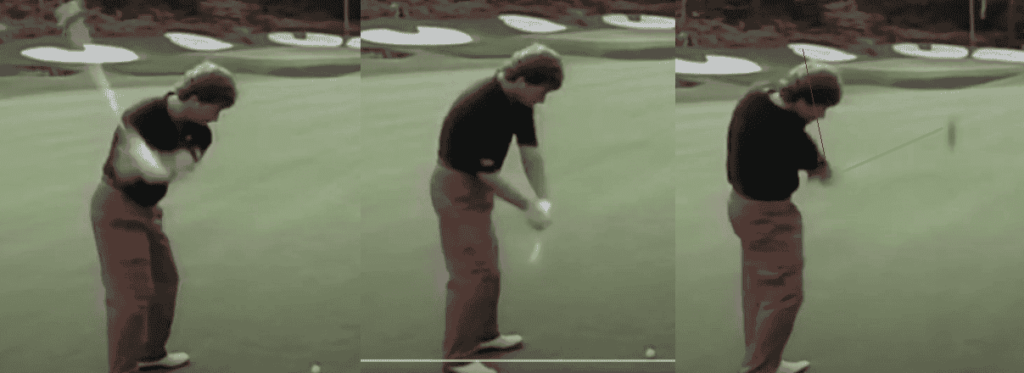
So, the intended motion here is a trail arm extension after impact, followed by a rehinge to protect the body. This deliberate move is very much downward, as reflected in the post-impact hand and club position. The result? A steep club action.
To make this work, the body needs to counterbalance. That’s where the heavy right tilt comes in—it helps match everything up. The irony is that while the club action is steep, the body itself plays it shallow, especially in terms of secondary axis tilt.
This creates a fascinating contrast: the club is moving down aggressively, but the body is working in a way that prevents an outright crash into the turf.
Case 2 – Club Usage – Steep body and Shallow Club
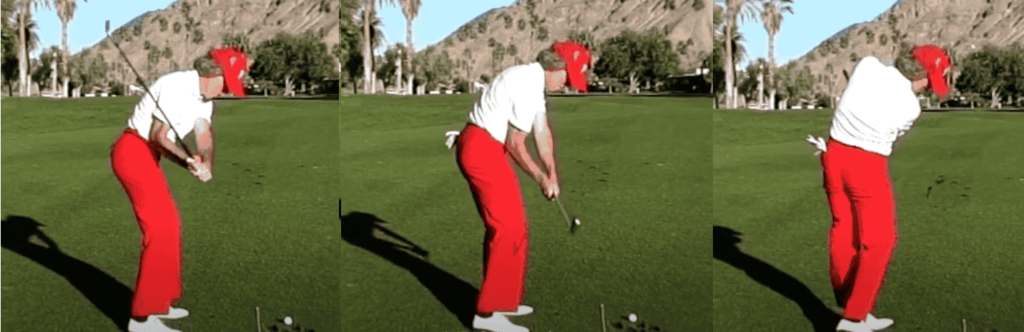
Ian Woosnam doesn’t need that heavy right tilt because his club is naturally shallowing for him. His club exits much more upward compared to Mac O’Grady, which leads to a much smoother, more flowing motion from a swinging perspective.
Instead of relying on extreme body adjustments to manage steepness, Woosnam’s swing intention allows the club to work with natural forces. This reduces the need for manipulations, making his move more intuitive and effortless. The left line in the follow through is “roughly” where Mr O’Grady’s club would have been in the motion.
In other words, Mr Woosnam uses what he calls “hitting the wheat of the shaft” as his release style which is fundamentally shallowing the strike for him.
Comparison Learnings
Obviously the comparison is massively simplified (probably too simplified) but it paints a somewhat decent picture.
It all depends on what you wish to accomplish in your motion and if you’re into mechanics or more abstract execution methods. In Case 1 it was a fade shot that was hit in a low trajectory with the highly mechanical systemization. Mr Woosnam hit a high soft draw where the abstract feel (in his own words) is hitting the wheat of a shaft.
The low and left represented by the MORAD swing is definitely viable but also forces you to tilt your body to offset the “steep” club. And if he wanted a draw shot he probably needs to double the tilt.
Utilizing the club as an impact zone shallower is something that has been around forever. It’s by far my preferred method of shallowing since it’s built into the motion rather simply.
The FMM Swing Example – A Shallow Golf Swing
I teach two key components related to how you intend the golf club in the swing arc. This makes up about 90% of everything I teach. It creates super shallow impact conditions, which in turn require a steeper body to accommodate them.
The advantage of these shallow impact conditions—and their aftereffects—is that rather than obstructing natural forces, you work with them. This leads to automatic body rotation and plenty of other benefits.
This article aims to highlight that there are multiple ways to perform a shallow golf swing—and that many tour pros are doing something completely different from most amateur golfers.
Something much easier.
Swing Knowledge and Flaws Articles
-
Bad Back from Golf – Lower Back Pain and Pelvic Issues
Suffering from a bad back from golf has been a major driving force behind my ten-year study of the golf…
-
Harvey Penick Magic Move – In Different Variations
The original Harvey Penick Magic Move refers to a simple gravitational drop of the arms toward your pocket, combined with…
-
Why You Slice – The Fundamental Reason Behind It
If you google why you slice the the first article (check it out here) will list ten reasons that are…


Major Swing Change Article Series
-
Asking Successful Swing Change Questions – Where to Go?
You’ve probably figured out by now that I’m not someone who promotes “quick fixes.” Instead, I focus on the deeper foundations of swing change efforts. In all honesty, there’s no other way to make…
-
Basic Swing Change Tips: Small Advice with Big Potential
Making a swing change can be challenging and requires more than most golfers realize. To successfully change any part of your swing, you typically need between 3,000 to 5,000 repetitions (based on my experience)….
-
Understanding your Golf Swing DNA – Where You Are Now
Understanding who you are as a golfer—your current swing, habits, and the motivations behind them—is the foundation of any meaningful swing change. Without this self-awareness, you have no solid ground to build upon. You…



Some General Swing Tech Posts (with Videos)
-
Using the Waggle in Golf? A training for Backswing Mechanics
Using the Waggle in Golf? A Training for Backswing Mechanics There’s a direct link between how you perform the backswing and how well you can let the club work for you. If you waggle…
-
4 Styles of Golf Swing POWER Discussed – Jungle Guidance
4 Styles of Golf Swing POWER Discussed – Jungle Guidance Golf swing power — and the different styles of generating it — is both fascinating and confusing. Over the past 10 years, I’ve dabbled…
-
FMM Swing Technique Blog | Posts – Aggressive Fluid Release (Hogan) | Posts – My Top Picks | Posts – Popular Drivers | Posts – Swing Tech & Patterns
Ben Hogan Swing: 7 Coin Drops That Made Me Understand It
Ben Hogan Swing: 7 Coin Drops That Made Me Understand It Few golfers have inspired as much discussion as Ben Hogan. For decades, golfers have tried to decode his swing, searching for the one…



The FMM Swing Articles
-
Perform Your Backswing in Front of Yourself – The Vertical Lift
The backswing might be the most difficult part of golf. Do it right, and while there are no guarantees of a perfect result, do it wrong and you’ve almost certainly ruined your chances of…
-
Relationship to Power – Key Variations for Better Golf
Power in the golf swing might just be the most important topic. Different swing style have a different relationship to power. I educate about and teach three different swing patterns in the FMM Swing…
-
The Swinging Protocol – In the Core of all Great Golfers?
I have a special interest in the golf world, and that is to understand what actually built the best swings of all time. Not just how they look, but what truly built them. What…