
Why You Slice – The Fundamental Reason Behind It
If you google why you slice the the first article (check it out here) will list ten reasons that are all pretty darn valid. BUT I actually believe there is a fundamental piece that is left out.
This article is much more holistic than most advice about slicing and it offers a much different perspective. It mostly connects to the Big Arc Swinger style that I teach (the core of Nicklaus, Watson, early Woods, early Rory, some of Scheffler etc).
When I teach a “slicer” the first statement I make is this:
We are not performing the same task. You are doing everything correct in relation to what you are trying to achieve.
I’m usually met with a pretty curious look by then. Let’s dig in.
Slicing is Absolutely Natural since you Basically “Cheat”
I’ve taught around 1000 grown up beginners in golf back in my training facilities days.
If I go ahead with the normal instruction (get the grip, stance and posture right) and tell them to perform half swings (kind of a normal “not so effective way” of teaching golf) 90% will extend their bodies in the backswing (raising up their posture) and 90% will also chop across the ball.
It’s the most natural thing to do. The problem is that most slicers are “too strong” which means that they can “cheat” in the golf swing.
Teaching Kids – a much Simpler Task?
I’ve worked with loads of younger players as well. If I take the same scenario as above the outcome is completely different. 90% ish will actually come from the inside after hitting 100 balls or something.
How is this possible? Well, if they chop across it and “cheat” they hit it half the distance as if they actually go ahead and use the whole swing arc instead.
Comparing the two and their Swing Outcomes
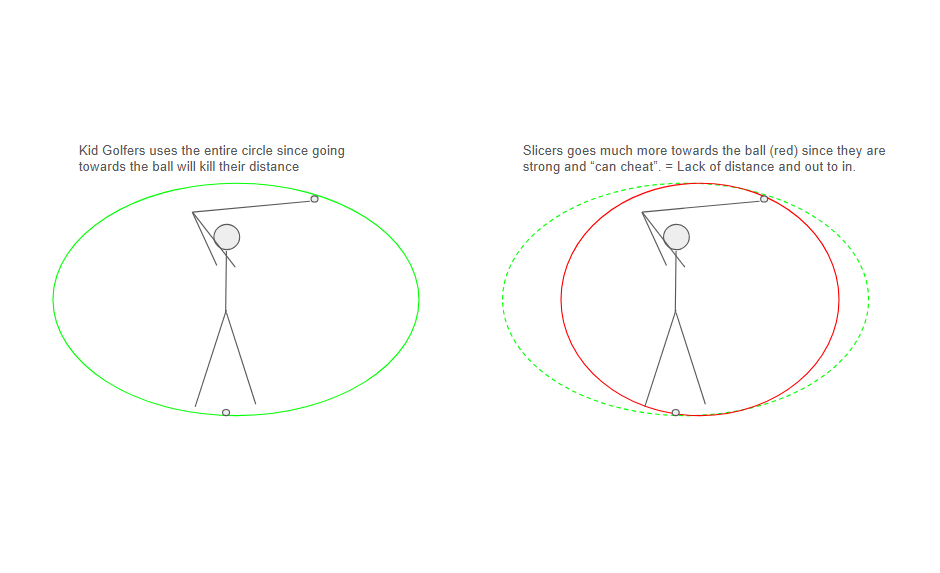
When you take the long journey like the kids do they actually create four advantageous characteristics for better striking:
- More speed since the travel distance of the club is longer
- More naturally from the inside (or straight from behind) instead of out to in
- A longer, more relaxed motion since the task of performing something bigger also forces you to not stiffen up.
- Naturally shallow towards the strike since the downswing arc is used = it creates shallowness.
From the other perspective, the grown up slicer that cheats has the following disadvantages:
- The speed suffers because of the reduced swing arc length
- The path instantly moves out to in since this also recruits a chest opening pretty much from the top backswing position
- The blade is most of the time open just before impact which leads to wrist breakdown caused by athleticism
- The angle of attack becomes too steep which will create high spin low distance shots
My Preferred Solution – A Longer Swing Journey and Engine Rebuild
Close your eyes and imagine that your entire swing is a circle. Imagine a huge circle. Imagine that you wish to utilize the entire circle and make the club be active all the way from the top backswing position to the follow through position.
You wish to add speed into the hands and the club early and then accelerate it all the way to the top.
The ball is just a check point on this very long journey.
Perform 100 swings like this without a ball (a giant circle around it and you use every inch of it). Close your eyes for half of them.
That’s a 90% correct golf swing task you’ve given yourself.
What you’re actually doing here is that you’re replacing the “engine” of your swing. Since you didn’t “know” what to do the subconscious engine that you created for yourself with your “straight towards the ball motion” was a combination of a too early chest recruitment (leading to out to in) and a very high grip pressure to deal with the “crisis of hitting the ball” and this resulted in speed loss and inconsistency.
You need to understand that the engine of a golf swing is the club travelling on the entire arc. The bigger the arc the more speed you get (and yes, I can go into great detail here but I’ll just leave it at that for now). If you just create this image of a longer big circle swing journey you will bypass all of your mechanical issues and come out on the other side with an engine that holds much more power potential.
It takes 3-5000 repetitions for a grown up person to change this overall feel. That’s a lot of swings but it’s worth it. This is fundamentally the entry point to my FMM Swing that I teach.
Summary – Why You Slice
You can keep your “short journey” if you go ahead and shallow the golf club in the transition but it’s in my opinion not treating the real underlying reason why you move like you move (and it’s a lot more difficult than just using the downswing arc for width).
Think outside the box. Think like a kid with no strength. Make the biggest active swing arc you can and you might just be on the way to a much more pleasant golf experience.
Best of luck!
START THE JOURney – FIND YOUR OLD SChool PATTERN
Your inspirations and your subconscious view of the golf swing matter more than anything when it comes to making a lasting swing change. The goal is to find the pattern that fits you best. Take the quiz and check out the best choice for you below:
FMM EDUCATIONAL PATTERN PAGES
-
Trail Power Hitter Pattern: The Invisible Vertical Power
THE GOLF SWING IS INVISIBLE You can’t see what I really do. I…
-
Aggressive Fluid Release Pattern: Cracking the Hogan Enigma
Cracking THE IMPOSSIBLE ENIGMA? First attempt: seven years ago. There I failed with…
-
Big Arc Swinger Pattern: From Nicklaus to Woods to Scheffler
What’s a big arc golfer? You see that person with a swing that…



Swing Knowledge and Flaws Articles
-
A Shallow Golf Swing – Which Move Creates the Magic?
How is it that many tour pros don’t visibly shallow their golf club early in the downswing,…
-
The Lateral Slide in Golf – Why It’s a Game Changer
There are different styles of golf swings that you can perform, but if you are into using…
-
Releasing the Golf Club vs Holding Lag – Which is Better?
If you use your swing arc as your main power source, you are ultimately balancing the relationship…



The Major Swing Change Article Series
-
Understanding your Golf Swing DNA – Where You Are Now
Understanding who you are as a golfer—your current swing, habits, and the motivations behind them—is the foundation of any meaningful swing change. Without this self-awareness, you have no solid ground to build upon. You…
-
Asking Successful Swing Change Questions – Where to Go?
You’ve probably figured out by now that I’m not someone who promotes “quick fixes.” Instead, I focus on the deeper foundations of swing change efforts. In all honesty, there’s no other way to make…
-
Must Haves & Pitfalls of Major Swing Change – The Big Picture
A major swing change is far from easy—but it doesn’t have to be insanely difficult either. I’m not talking about a minor tweak, like adjusting your grip slightly, but rather a complete rebuild of…



Some General Swing Tech Posts (with Videos)
-
Over the Top Isn’t the Problem — It’s the Symptom
Over the top is one of the most common swing faults in golf. It’s also one of the most misunderstood. Most advice treats over the top as something to fix. In reality, it’s usually…
-
Mechanical vs Athletic Drilling — When the Centipede Fell Down
Mechanical vs Athletic Drilling — When the Centipede Fell Down When the Centipede Fell Down “A centipede was happy quite,Until someone asked which leg goes after which…” The moment it started thinking about mechanics,…
-
Golf Swing Squaring Fails – How we React to the Clubface
Golf Swing Squaring Fails – How we React to the Clubface In a typical round, I might hit 5–6 shots that are pretty great — the rest are just minor errors. We just make…



The FMM Swing Articles
-
Flipping in the Golf Swing? Understand and Utilize the Dynamics
“I flipped it, that was a crap shot” has to be in the hall of fame for the most commonly heard phrases on any golf course. Understanding flipping in the golf swing — what…
-
Understanding Hand Dominance Advantage – Magic for Your Golf
Are you right or left hand dominant? Are you swinging from the right or the left? Hand dominance in the golf swing is extremely important yet it has almost zero space in the golf…
-
Your Golf Brain Is Stupid — It Demands Simple Coordinates
I’ve played golf for 35+ years and have been deeply researching the golf swing for at least 12–13 years at this point. One of the few statements I can make with absolute certainty is…