The Best Story in Golf Teaching – Mac O’Grady Event Timeline
I’ve never met Mac O’Grady.
In all honesty I’m happy I haven’t because these types of personalities deeply intrigues me. Meeting him and climbing to deep down the rabbit hole of MORAD would have taken me off course in my own ambitions to simplify and teach the inner movements of the old greats. In the golfing instructional world I have no other person I respect more even though I basically don’t agree/fit with many parts of the system outcomes.
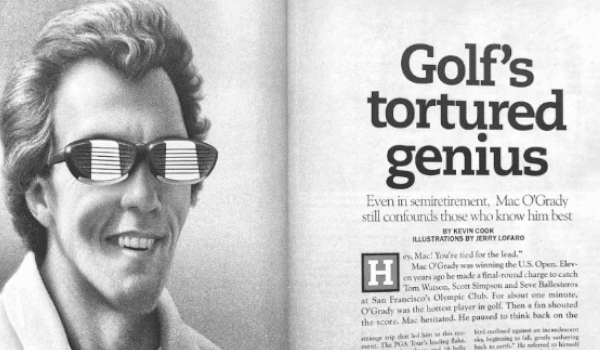
I won’t go on a deep personal level in this article since I’m not in the position to do so. I highly recommend this amazing article instead.
What I write in this article is basically what I’ve found out and picked up the years. It’s likely not 100% factual correct but paints a decent picture.
Starting with Nicklaus’ Swing and Struggling
Mac O’Grady’s early golf career was anything but smooth. He tried to achieve the motion of the old greats and also was tutored (I can’t find who taught him) in a manner that not only produced unsatisfactory scoring but such poor mechanics that he would carry his driver a merely 200-210 yards. Despite all his efforts, Mac struggled to compete at a high level, often shooting above 80s during tournaments (check this video between 45-50 minutes). These scores weren’t just disappointing—they were demoralizing. For many golfers, this kind of struggle might signal a natural limit. But for Mac, it was fuel. Instead of giving up, he became obsessed with uncovering what was holding him back and how the golf swing could be optimized for anyone willing to put in the work.
Mac O’Grady meeting Homer Kelley
In the late 1970s, Mac stumbled across The Golfing Machine by Homer Kelley, a book that many considered the most detailed exploration of the golf swing ever written. While the book’s technical language left many readers bewildered, it intrigued Mac. He saw in its pages a blueprint for solving the mysteries of the swing. Determined to learn directly from the source, Mac tracked down Kelley and began asking questions. Their meeting was transformative. Kelley’s scientific approach to the swing – focused on geometry, physics, and leverage – resonated deeply with Mac’s analytical mind. But Mac wasn’t satisfied with merely understanding Kelley’s ideas. He wanted to push them further, testing their limits and finding new applications. This sparked a relationship built on mutual respect, with Mac emerging as both a student and a challenger of Kelley’s teachings.
Creating the ‘86 Swing and Starting MORAD
Inspired by Kelley but unwilling to stop at the concepts in The Golfing Machine, Mac set out to develop his own unique swing model. He broke down every element of the swing, experimenting with movements, positions, and pressures to find what he believed was the most efficient way to strike a golf ball. The result was the ‘86 swing, a method that emphasized a precise takeaway, controlled lag, and a powerful use of ground forces.The ‘86 swing wasn’t just another theory; it was the foundation of MORAD (Mac O’Grady Research and Development), a system Mac created to study and improve the golf swing through rigorous experimentation. MORAD combined the scientific rigor of The Golfing Machine with Mac’s own insights, focusing on biomechanics, physics, and the natural movements of the human body. The ‘86 swing became a benchmark for modern swing mechanics, influencing not only Mac’s game but also the careers of countless players who sought his expertise. Please go into this article if you are more into swing styles than a history lesson.
Teaching Tour Pros While Still Winning
Even as Mac developed MORAD, he remained a competitive force on the PGA Tour. Joining the tour in the late 1970s, Mac achieved two victories in the 1980s, proving that his theories worked under the highest levels of pressure. These wins were particularly remarkable because they came during a time when Mac was also establishing himself as a teacher to other professionals. Players on the tour sought him out for advice, drawn by his deep understanding of the swing and his ability to communicate complex ideas in practical ways.
Balancing the roles of competitor and coach was no small feat. Mac’s days were filled with the demands of tournament play, while his evenings were often spent analyzing swings and offering guidance to his peers. His success in both areas made him a rarity in the golf world and further cemented his reputation as a groundbreaking thinker and practitioner.
Leaving the Tour and Going All Coach
By the early 1990s, Mac’s priorities began to shift. Frustrated by the politics and constant grind of life on tour, he decided to step away from competitive golf to focus fully on teaching and research. This decision wasn’t easy, but it allowed Mac to dedicate himself entirely to MORAD. He poured his energy into studying every detail of the swing, exploring new technologies like high-speed cameras and 3D motion analysis to refine his methods.
As a teacher, Mac’s reputation soared. He became a sought-after mentor for elite players, offering insights that could transform their games. His ability to break down the swing into its smallest components and then rebuild it into something powerful and efficient was unmatched. Though his methods were complex, those who embraced them often saw dramatic improvements, making Mac one of the most respected figures in the game.
Taking MORAD Straight Into the Future
MORAD evolved into much more than just a swing system; it became a comprehensive philosophy of golf. Mac’s research delved into biomechanics, studying how different body types influenced swing mechanics. He explored ground reaction forces, learning how players could use the ground to generate more power and stability. He also embraced cutting-edge tools like 3D motion capture to better understand the intricacies of movement.
This relentless pursuit of knowledge made MORAD a gold standard for serious golfers. However, its complexity often left outsiders bewildered. Mac’s teachings required intense focus and a willingness to dive into the science behind the game. For those who committed to the process, the rewards were undeniable. MORAD became a bridge between art and science, blending the beauty of the golf swing with the precision of engineering.
Morphing back to The Golfing Machine
Even as Mac expanded MORAD, he remained rooted in the principles of The Golfing Machine. Kelley’s ideas about geometry, leverage, and physics continued to influence Mac’s later swing models. But Mac wasn’t content to simply follow Kelley’s blueprint; he used it as a foundation to build upon. His later work incorporated modern insights into human movement, balance, and adaptability, ensuring that MORAD stayed relevant in an ever-evolving game.
Mac’s ability to honor Kelley’s legacy while pushing the boundaries of what was possible highlighted his unique genius. He showed that even the most timeless ideas could evolve, inspiring players and coaches to think differently about the swing.
Personal take on the Development
My very subjective interpretation of the events is this. Starting out with MORAD as a philantropic project and not enjoying the attitudes / goals of co competitors and the tour made Mr O’Grady slowly change his mindset. Instead of going down the “help the game of golf at all costs attitude” he was demoralized by the vulture side of the industry and morphed into something, very understandably, different. The early work is the purest for golf performance that I’ve ever come across and the later work is honorable but in another direction.
START THE JOURney – FIND YOUR OLD SChool PATTERN
Your inspirations and your subconscious view of the golf swing matter more than anything when it comes to making a lasting swing change. The goal is to find the pattern that fits you best. Take the quiz and check out the best choice for you below:
FMM EDUCATIONAL PATTERN PAGES
-
Trail Power Hitter Pattern: The Invisible Vertical Power
THE GOLF SWING IS INVISIBLE You can’t see what I really do. I…
-
Aggressive Fluid Release Pattern: Cracking the Hogan Enigma
Cracking THE IMPOSSIBLE ENIGMA? First attempt: seven years ago. There I failed with…
-
Big Arc Swinger Pattern: From Nicklaus to Woods to Scheffler
What’s a big arc golfer? You see that person with a swing that…



Closely Related Articles
-
3 MORAD Swing Eras – My Take on the Genius’s Patterns
So Mr. O’Grady was less than pleased with his golf swing. Coming from a failed Nicklaus pattern, he worked very closely with Homer Kelley (the founder of The Golfing Machine) to understand why his…
-
Contemporary MORAD – Modern Presence and Influenced Coaches
MORAD has influenced more high level golf than anything I’ve come across during my last decade deep dive into golf. In the 80s Mr O’Grady taught somewhere between 30-50 players while playing on tour…
-
MORAD 80s Trail Power Hitter Pattern – Awesome Simplicity
As mentioned in the MORAD swing pattern article, I’m a huge fan of Mr. O’Grady’s contribution to the golf world. It’s arguably the most impactful effort in golf, period. But personally—based on how I…
Some General Swing Tech Posts (with Videos)
-
Make the Club Work: The Forgotten Secret to Better Golf Swings
Make the Club Work: The Forgotten Secret to Better Golf Swings One of the biggest mistakes in modern golf instruction is where we place our attention. Most golfers spend years trying to make their…
-
Using the Waggle in Golf? A training for Backswing Mechanics
Using the Waggle in Golf? A Training for Backswing Mechanics There’s a direct link between how you perform the backswing and how well you can let the club work for you. If you waggle…
-
Roughly Right Beats Exactly Wrong: Golf Attitude Tip
Roughly Right Beats Exactly Wrong: Golf Attitude Tip Golf is a heck of a game, and your golf attitude trumps all technique and goals in the world. Why make it more difficult than it…

FMM Project Articles
-
The Swinging Protocol – In the Core of all Great Golfers?
I have a special interest in the golf world, and that is to understand what actually built the best swings of all time. Not just how they look, but what truly built them. What…
-
Swing Thoughts Deep Dive: Should You Think in Golf?
You should never play “a mind full of mechanics golf swing” on a round of golf. I agree with that, but at the same time it’s hard not to think at all. For me,…
-
Functional Swing Technique: What a Good Swing Achieves
When it comes to the golf motion, there’s one ultimate goal—and it isn’t perfect form or carrying the driver 320 yards. It’s achieving a functional swing technique. To bring clarity to what functional swing…