Ben Hogan vs Jack Nicklaus Grip: What’s the Real Difference?
All the old-timers cared about one thing first and foremost. Almost as if it were the gatekeeper to their swing worlds.
The grip.
Why is it so important?
Because it directly connects to how you can stimulate the club and, quite surprisingly, how your body can move. Furthermore, it influences different hand roles and acts as the fundamental gate opener to your power protocol.
The grip means everything, yet very few golfers pay attention to anything beyond whether it’s weak, strong, or neutral.
Over the years, I’ve gradually come to understand different power protocols within different swing patterns. And that means I’m starting to uncover clues as to why certain grips work—and, in some cases, why they don’t.
I’ll dig into the Ernest Jones grip, the Nicklaus grip, and finally the Ben Hogan grip, dissecting the differences between them.
I go on and on about this, and I’ll never stop. There isn’t just one great golf swing. There are many highly efficient ones, and for your development, it’s ALL about fit.
Ernest Jones – “Swing the Clubhead” Grip
Let’s start with Ernest Jones and go back to the early 1900s. This grip is tailor-made to fit his swinging philosophy: feel the clubhead and swing the clubhead.
The structure of the grip and the intended pivot points (not pressure points) are designed to make the club work like a pendulum. The most obvious feature is the overlap of the trail-hand pinky finger. It’s not wedged between the fingers—it’s placed on top.
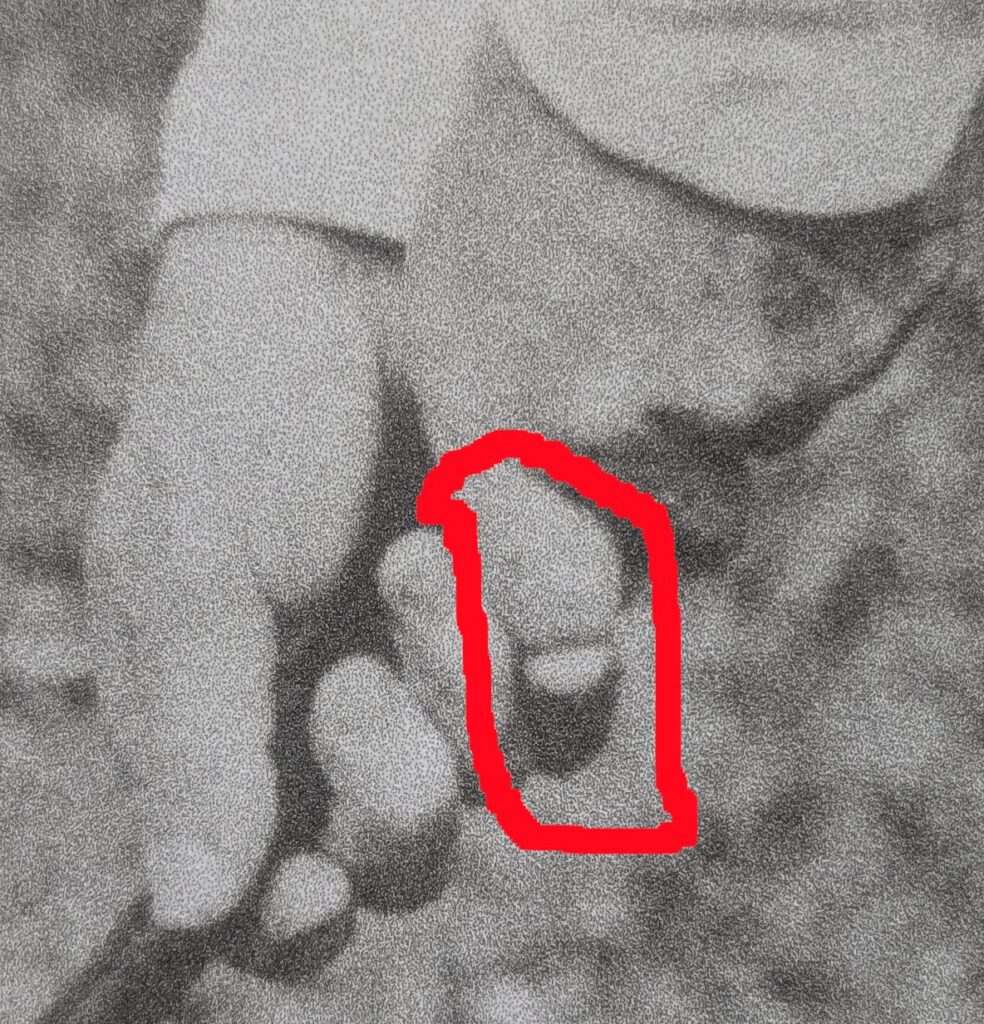
Diving deep into experimentation (not covered in the books), it becomes clear to me that he also engages the trail-hand thumb and forefinger as a pivot point. He actually USES this part of the grip that, for example, Ben Hogan considered complete poison for the swing. Well, they use different power protocols.
Furthermore, the lead hand is placed in a palmy position to create the lead-hand stability you want in a big motion.
Which leads us to Nicklaus…
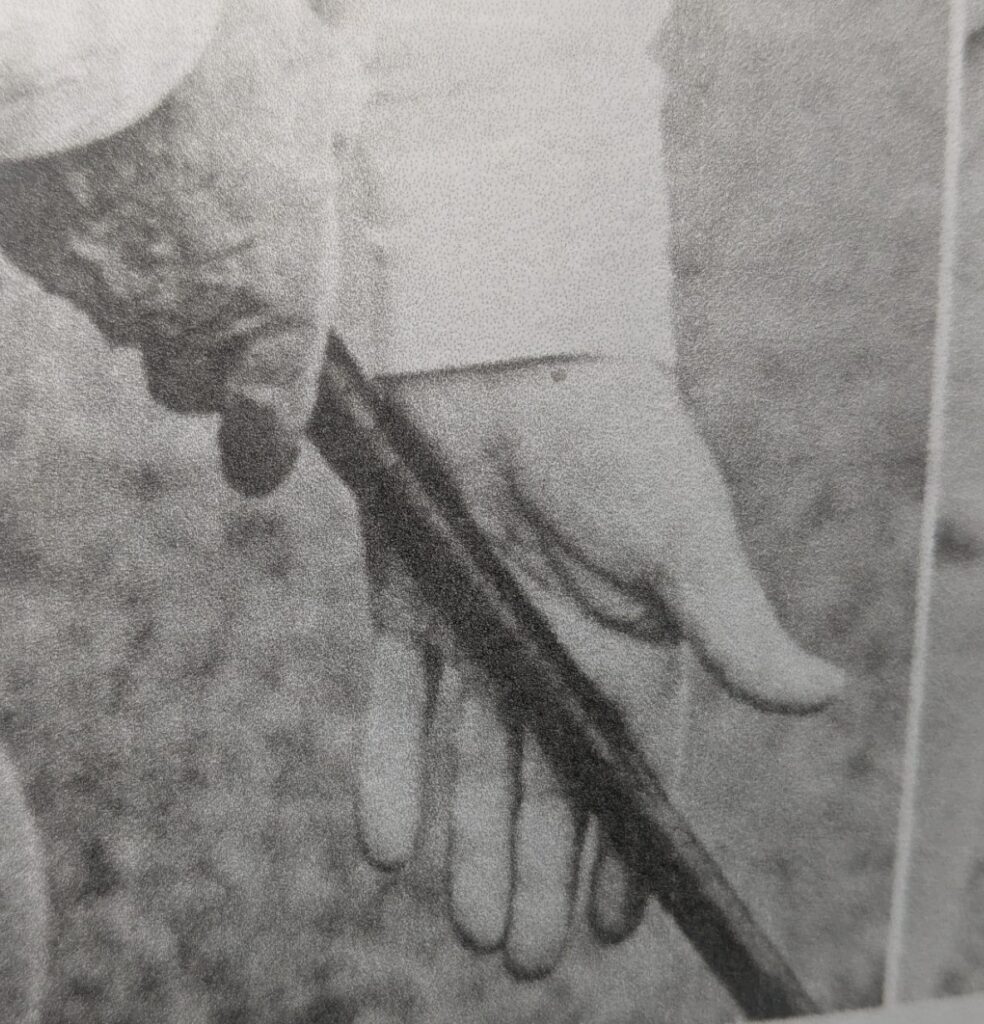
The Nicklaus Grip – showcased with Adam Scott
If Ernest Jones is all about swinging the clubhead, then Mr. Nicklaus is all about supercharging the swing to its maximum potential. It’s one (or perhaps two) steps further in power development compared to Mr. Jones.
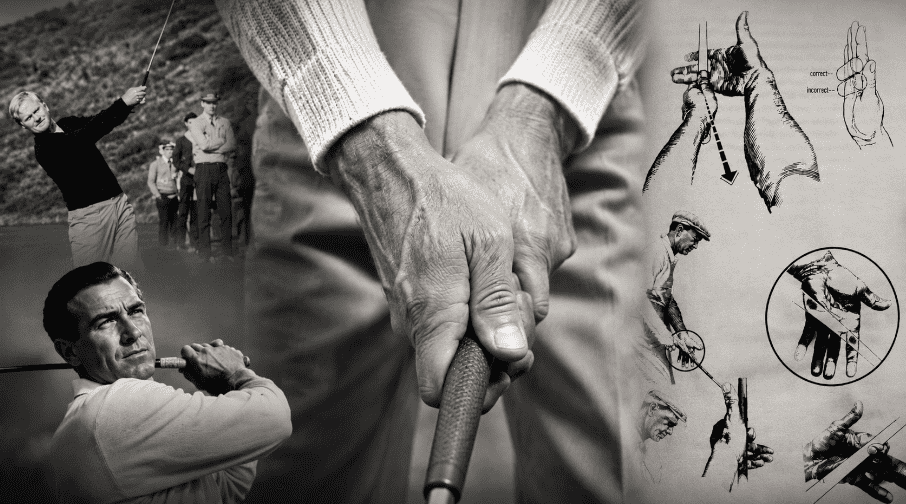
Here, the grip changes to an interlocking grip. This allows for greater trail-hand whipping potential, while the lead hand takes on the role of power supporter and control dominator. So it’s a fingery trail hand and a palmy lead hand grip.
One important note: the drawings in Mr. Nicklaus’s book Golf My Way don’t really give much away. But in other videos, you’ll see the Golden Bear gripping the club at the side of his body. Adam Scott also grips the club in a way that creates these same properties.
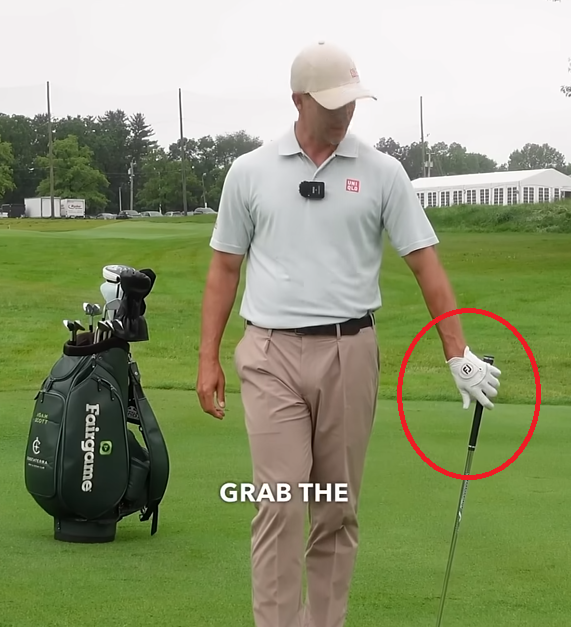
As mentioned in the beginning, it’s not only about the strength profile of the grip. It’s about which positions and which muscles are engaged.
In the Adam Scott grip above, the lead hand is preset into more ulnar deviation (wrist uncocking) from a pure forearm bone perspective. This helps create that flat left wrist while establishing a stronger lead-hand structure. The lead hand becomes the supporter of trail-hand power. This is slightly different from Mr. Hogan. More on that later.
Now, over to the trail-hand grip. Since keeping the club in the fingers makes it possible to unleash more radial-to-ulnar deviation, it makes sense that Mr. Nicklaus would feel his release as early as possible, right?
Well, this sits at the center of what I call the Big Arc Swinger pattern. You “release early” so that you can begin using the follow-through for your intended control. The release doesn’t actually happen in the literal sense, since there are many other things at play (weight shift, dynamic force interplay, and so on), but your feeling (IN TRAINING) is that you release early. You essentially create a downswing swoosh well before the golf ball, giving yourself power to organize and control in the follow-through.
Now, the follow-through is where the second swoosh happens—well after the golf ball.
Strange, right?
Not really.
We athletically react to future intentions, so what happens after the ball influences what happens before it.
Ernest Jones’s original “swing the clubhead” motion is really a one-swoosh swing. Nicklaus, Tiger, and other Big Arc Swingers utilize a passive first swoosh in the downswing (the club doesn’t simply fall) so they can aggressively move through impact and into the follow-through. Very much a two-swoosh motion.
Needless to say, the Big Arc Swinger pattern is one of my favorites in the golf world.
The lead hand supports.
The trail hand hits.
Now let’s talk about an almost inverse relationship.

The Hogan Grip – As Complex as it gets?
Mr. Hogan uses a completely different power protocol compared to Ernest Jones and the supercharged Jack Nicklaus. It’s much more of a “non-sexy” push-power protocol that is sustained from the top of the backswing all the way through to the finish.
One long, Aggressive Fluid Release.
This is also why I call my Hogan education the AFR Protocol.
Within this protocol, the lead hand has a more fingery grip, while the trail hand is more palmy—the opposite of Nicklaus.
But isn’t Hogan’s lead hand in the palm too?
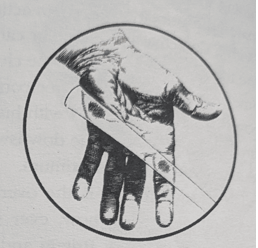
Let’s get a bit tin-foil for a second, shall we?
I sincerely believe that the Five Lessons drawings deliberately hide the good stuff. And here’s one of those gems (not fully explained since I really want to make a living from this…).
If you actually grip the club with the lead hand more in the fingers than the drawings suggest, you’ll naturally accomplish Hogan’s wrist positions at address. This creates full mobility in the lead hand and makes it much easier to move into the cupped backswing position that Mr. Hogan had.
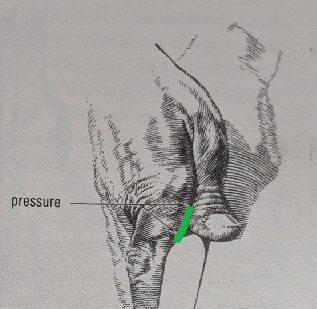
The trail hand isn’t a fingery, “snappy” grip. It’s more palmy. Sure, when you’re training for power input, you can make it more fingery. But when push comes to shove and you want to shoot sub-70 scores on great courses, you need control. It’s time to sacrifice roughly 5% distance for 50% less dispersion.
Long story short, the better your lead-hand grip is, the more aggressive you can be with your palmy trail hand. Since the trail hand is responsible for the initial power feel—and because it’s delivered with such an effortless sensation—you can actually remove your trail-hand forefinger and thumb from the shaft. They aren’t needed in this push-power protocol.
But mind you, this isn’t a full trail-arm push like, for example, MORAD. TGM-based grips generally utilize different wrist angles and strength profiles (you’ll see more knuckles in MORAD grips). Sticking my neck out a bit here, I actually think this is where Mac O’Grady went “wrong” compared to Mr. Hogan. That said, Mr. O’Grady may very well have created the coolest teaching system in history, so one disagreement certainly doesn’t diminish that.
Finally, I said that Mr. Hogan’s grip is almost the inverse of Mr. Nicklaus’s. If the latter hits with the trail hand, does that mean Hogan doesn’t?
No. They simply use the trail hand differently.
Nicklaus is more whippy. Hogan is more pushy.
The Grip, Swing Space and Power Application
With a proper grip and an understanding of the power protocol that coexists with that grip style, you can begin exploring how to stand and, very importantly, how to perform the backswing.
Get the grip right, get the backswing right, and your golf world opens up. Then simply train your skill within your power protocol—or, even more advantageously, the intention behind the power—and you’ve started your journey toward becoming a +handicap player.
Out of all these grips, I can never say I have a favorite. Rather, they’re suited to different swing styles.
The BAS (Big Arc Swinger – Nicklaus, Woods, etc.) and AFR (Aggressive Fluid Release – the Hogan pattern) are both built upon these different grip styles. As for Ernest Jones’s good old approach, I still use it in some of my base training—but then I take it a step further.
Training your grip – YOUR BIGGEST INVESTMENT
This sounds like the most boring training ever, but it may also be the most important.
Find a consistent routine for taking your grip. From now on, every single ball deserves a proper grip. Otherwise, you’re not allowed to hit it. That’s actually a rule I gave myself during last year’s long Hogan project.
For the Nicklaus grip, it’s fine to play larger grips. But for the Hogan grip, you need thinner grips so you can reach the proper positions.
These guys tinkered with their grips forever, and the advice they give is pure golf. Too few golfers—almost no one—spend enough time practicing how they take their grip, and they certainly don’t pay enough attention to it on the course.
Make it an integral part of your routine.
You’ll likely shave 3–4 shots off your score just from that.
My biggest advice when it comes to swing development is to actually understand your motion. Your fit. Your pattern. That’s what I share in my Academy. Your ability to own your own swing whether it’s Nicklaus, Ernest Jones or Hogan. Welcome.
START THE JOURney – FIND YOUR OLD SChool PATTERN
Your inspirations and your subconscious view of the golf swing matter more than anything when it comes to making a lasting swing change. The goal is to find the pattern that fits you best. Take the quiz and check out the best choice for you below:
FMM EDUCATIONAL PATTERN PAGES
-
Trail Power Hitter Pattern: The Invisible Vertical Power
THE GOLF SWING IS INVISIBLE You can’t see what I really do. I…
-
Aggressive Fluid Release Pattern: Cracking the Hogan Enigma
Cracking THE IMPOSSIBLE ENIGMA? First attempt: seven years ago. There I failed with…
-
Big Arc Swinger Pattern: From Nicklaus to Woods to Scheffler
What’s a big arc golfer? You see that person with a swing that…



More FMM Project Articles
-
The Swinging Protocol – In the Core of all Great Golfers?
I have a special interest in the golf world, and that is to understand what actually built the best swings of all time. Not just how they look, but what truly built them. What…
-
A Powerful Golf Swing Clips It – Stop Chasing Divots
We are all performing golf swings based on inner images, muscle memory, and athleticism. These different subconscious images will shape how we perform our motion. A powerful golf swing clips it in a shallow,…
-
Perform Your Backswing in Front of Yourself – The Vertical Lift
The backswing might be the most difficult part of golf. Do it right, and while there are no guarantees of a perfect result, do it wrong and you’ve almost certainly ruined your chances of…


General Article Collection Pages
-
FMM Video Articles — See It. Read It. Understand It.
In early 2025, I started my YouTube channel (find it here), and the format has really…
-
All Articles Library – All Creations in One Place
Everything I’ve created over the years. You have different filterings according to the list below. Wish…
-
FMM Academy – Which Pattern Fits You?
Golf instruction has never suffered from a lack of information. It has suffered from a lack…
-
Swing Styles Articles – Explaining Old School Variations
I categorize golf swings into different styles for the sake of clarity and understanding. No golfer…



Video Based Articles
-
FMM Swing Technique Blog | Posts – Aggressive Fluid Release (Hogan) | Posts – My Top Picks | Posts – Popular Drivers | Posts – Swing Tech & Patterns
Ben Hogan Swing: 7 Coin Drops That Made Me Understand It
Ben Hogan Swing: 7 Coin Drops That Made Me Understand It Few golfers have inspired as much discussion as Ben Hogan. For decades, golfers have tried to decode his swing, searching for the one…
-
Big Arc Swing Pattern: Nicklaus, Woods & Scheffler
Big Arc Swing Pattern: Nicklaus, Woods & Scheffler There are certain golf swings that immediately stand out. Jack Nicklaus. Tiger Woods. Scottie Scheffler. Different eras. Different personalities. Yet they all share something remarkably similar….
-
Is Power Punctual? The Truth About Golf Speed
Is Power Punctual? Why Great Golf Swings Accelerate Instead of Hit When most golfers think about power, they imagine a single explosive moment. A whip. An axe. A hammer striking a nail. One instant…


Old School General Articles
-
How Lee Trevino Built One of Golf’s Most Accurate Swings
Most golfers trying to hack the golf swing just ruin it, and some, like Lee Trevino, win six majors. From an accuracy perspective, I would say that his motion is the most efficient I’ve…
-
Why Jack Nicklaus Swing Work – Free of Modern “Rules”
Most people have Ben Hogan as their swing god, and sure, he’s awesome, but my personal favorite will always be Jack Nicklaus Swing. The Golden Bear. It’s the simplicity and effortless feel of it…
-
Ben Hogan 1940s Pre-Accident Swing Change – Power Updated
Nothing in golf quite compares to Ben Hogan’s ball striking induced dominance in the 1940s and 1950s. In 1948 alone he would win 10 titles including 2 majors. The 1940s pre-accident swing rebuild I…