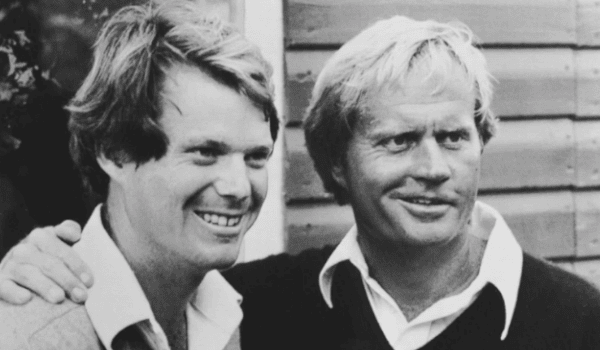
Natural Swinging Power – Learning from Jack Nicklaus & Tom Watson
I won’t lie – I’m a huge fan. Growing up, my dad’s VHS tapes of Jack Nicklaus and Tom Watson were like treasures. I watched their countless duels and the 1986 Masters back nine so many times, I’ve lost count. It might even border on obsession. There was something about their natural swinging power that captivated me then, and my fascination has never faded.
Today I actually understand some of their greatness and it will be my pleasure to share some of what I’ve picked up.
This article relates to the Big Arc Swinger style that I teach in my FMM Swing Academy.
Simplistic Movements breaks the Catch 22 – Trust vs Mechanics
Tom Watson claims that he figured out the golf swing in the mid 90s but I could swear he swings exactly the same in 2010 as he did in 1975. The engine is always the same. For Jack? I basically see no difference whatsoever over the years. 18 majors kind of proves that as well right…
There lies a huge victory in performing the same motion over and over again EVEN if the motion is somewhat flawed. To quote Bob Rotella: trusting your own swing might be the biggest asset that you have. But here is kind of a catch 22 situation – how do you trust something that you actually know is too flawed to not make it a lie? I spent the last 10 years trying to figure out how to create a simplistic swing that I actually can trust and build upon. It’s only the last 2 years I’ve started trusting it for real.
Using simple dynamics in your swing leads to simple intentions which leads to the ability to play zero swing thought golf with trust. Using advanced mechanical swing thoughts (inspired by weird drills etc) will never allow you to trust. Some claim that you shouldn’t see the golf swing as an intellectual task. I agree BUT you need to intellectually understand it (how its components fit toghether) to have the luxury to not see it as something complex.
Mr Nicklaus and Mr Watson trusted their motions even when they were out of their perfect zone and my opinion is that they could only trust due to sufficent practice and solid inner simplistic swing workings.
The Post Impact Afterlife – A Longer Journey with Natural Swinging Power
Both these champions appear to not “hit the ball” but rather use the entire travel from the backswing top position to the finish to inspire the strike. It’s quite the opposite to e.g. hitting the ball with an ax och trying to whip after the ball. They indeed did something different from most instructions today.
I’d even go as far as saying that they were much more active from the strike to the finish than todays tour pros. Check out the below:
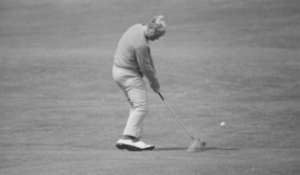
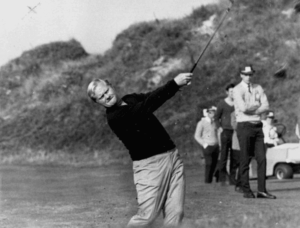
Nicklaus hitting Driver in rather early days.
Tom Watson hitting one of the best shots of all time (4 wood from 230y on 15 Augusta on final day master in the lead..)
Example of more current players. Tommy Fleetwood driver. Lee Westwood Driver. This ins’t critique against these modern golf geniuses – I’m simply saying that mr Nicklaus and mr Watson had a longer journey and made more use of the post impact swing.
A Different Relationship to Power
Jack Nicklaus stated that he released as early as possible. After studying countless players and my own experimentation, I can just say that the relationship to power was different compared to today. In my opinion, power was created much earlier back in the day and then this power could be controlled and accelerated on a longer journey. Today I really see much more activity in the ball region but less past the ball (obviously all golfers on tour are absolute golf beasts but my bias is towards the old greats).
Let’s dig into mr Nicklaus statement above. Release can mean so many things but my interpretation is that Jack let the club use the full downswing arc and started to create power already from the backswing top position. Isn’t this casting? Sure it is, if you don’t know how to do it. If you actually learn to harmonize with the club in the early downswing you can put speed into the system earlier and then harness the longer journey. It’s one of my major teaching elements of my swing system and it’s just amazing.
What it does is that it allows you to “have a steep” plane and still be shallow towards the ball. Tom Watson did exactly the same thing. Justin Thomas does the same thing today along with Scottie Scheffler, Bubba Watson, Xander Schauffele and Ludvig Åberg. Tiger used to do it (and has now started again in later age). Rory used to do it.
Synchronized Body Rotation with Natural Club Movement
When you watch these old geniuses you get a feeling of complete harmony in the movement. That the body acts in unison with the power.
This is a huge difference from e.g. the modern baseball swing where you deliberately create x-factor (separation between hips and chest) and even separation between the arms and the body. All in the name of speed. This is absolutely a way of doing it but it’s not what the old guys did.
Another interesting point here is to consider that both Mr Nicklaus and Mr Watson are lead hand (left) dominant playing golf as righties. Does this have anything to do with their great synchronized rotation? Yes, DEFINITELY. If you teach yourself to move your lead hand the proper way it actually stimulates synchronized chest rotation. Just try to make a lead arm only swing and you will feel your body rotate without you trying to do anything.
So the big learning here is that the lead hand can be used like in old times but it demands a couple of factors: 1) a slightly weaker lead hand grip and 2) keeping the arm pretty close to the body (the opposite of e.g. Dustin Johnson’s impact position)
Weaker Lead Hand Grips and Lead Arm Close to Body
I’m not that into talking positions and other observations but this one is important.
Jack Nicklaus states “strong grip = weak swing” as a reference to the lead hand grip and the ability to create a powerful motion. Now, there are definitely idiosyncrasies in the way that we grip a golf club but most old timers played their stock shots with a weaker grip style. This matches up with keeping their lead arms relatively close to their bodies in the through swing if you compare to today’s more “pushed arms”.
Again, not the worst idea to train the lead arm skillset very diligently..
What About Trail Hand Dominant Natural Swing Power Styles?
So, if you are trail hand dominant you are scr*wed (e.g. a right hand dominant righty players)? Rory McIlroy, Sir Nick Faldo, Seve Ballesteros etc begs to differ. Using your trail hand more than your lead hand will influence where you prefer your ball position and also how you feel your shots but you can still work with your lead hand skill set..
As mentioned: I’m a very trail hand dominant player (right hand righty) but I train my lead hand (left hand) like crazy to reek the muscular benefits of this skill set . You can read more about hand dominance here (an article from my FMM Swing Page).

Summary Natural Swinging Power – Major Learnings
- The “hit” can be a collision on a longer journey if you allow yourself to swing the club. The post impact afterlife gives you the potential to deliver huge amounts of power with less stress since you are using the longer swing arc.
- Figure out your true golf motor/engine and how you develop power. If you are in tune with this you will adapt every single part of your golf swing to make it fit this style. My solution (among other solutions) is the FMM Swing.
- Training the lead arm (left for a righty player) is extremely potent to understand synchronized automatic body rotation in the follow through.
- Hand dominance will affect how you prefer to play the ball, e.g. trail handed players are more secure with a more backed up ball position.
START THE JOURney – FIND YOUR OLD SChool PATTERN
Your inspirations and your subconscious view of the golf swing matter more than anything when it comes to making a lasting swing change. The goal is to find the pattern that fits you best. Take the quiz and check out the best choice for you below:
FMM EDUCATIONAL PATTERN PAGES
-
Trail Power Hitter Pattern: The Invisible Vertical Power
THE GOLF SWING IS INVISIBLE You can’t see what I really do. I…
-
Aggressive Fluid Release Pattern: Cracking the Hogan Enigma
Cracking THE IMPOSSIBLE ENIGMA? First attempt: seven years ago. There I failed with…
-
Big Arc Swinger Pattern: From Nicklaus to Woods to Scheffler
What’s a big arc golfer? You see that person with a swing that…



Articles Closely Related
-
Golf’s Greatest Swingers – Natural Flow Trumps Manipulation
The debate whether the golf motion is a swing or a hit has been around forever. My absolute bias for this article is that the golf swing is a motion where the hit becomes…
-
Ben Hogan vs Jack Nicklaus Grip: What’s the Real Difference?
All the old-timers cared about one thing first and foremost. Almost as if it were the gatekeeper to their swing worlds. The grip. Why is it so important? Because it directly connects to how…
-
Why Jack Nicklaus Swing Work – Free of Modern “Rules”
Most people have Ben Hogan as their swing god, and sure, he’s awesome, but my personal favorite will always be Jack Nicklaus Swing. The Golden Bear. It’s the simplicity and effortless feel of it…
FMM Swing Technique Posts (with Videos)
-
Old School Golf Swing: Comparing Two Different Styles
Old School Golf Swing: Comparing Two Different Styles The old school golf swing really comes in two versions — and it’s all about finding the one that fits you. Old School Golf Swing 1…
-
Flat Golf Clubs = Magic Cheat Code for Power & Accuracy?
Flat Golf Clubs = Magic Cheat Code for Power & Accuracy? I play 4-degree flat golf clubs despite being 5’11” (181 cm) with normal arm length. Why? Because the old-school golf swing relies on…
-
Shallow Through Impact – Woosnam & O’Grady Release Exit
Shallow Through Impact – Woosnam & O’Grady Release Exit “Shallowing the club” has become one of the most discussed topics in modern golf instruction. Many golfers spend a lot of time trying to shallow…


FMM Project Articles
-
The Golf Swing Timing – Allowing Natural Forces To Shine?
When you’ve played your best golf, it probably felt like nothing. Your golf swing timing was so on point that you could simply play the game without overthinking. You’ve likely hit 5–10 shots in your life that stand out—maybe a drive that flew 20 yards farther than usual. It came and went, but at the…
-
The Obstacles of Your Golf Swing – Why Swings Get Limited
Why don’t you swing as well as you want to? What’s in the way? I call the gap between your current state and your desired motion the obstacles of your golf swing. My conclusions are derived from a decade of coaching and, more importantly, from self-exploration across basically every swing style in golf. I’ve conducted…
-
Clubface Closure – How to Square Up for an Effortless Swing
The golf swing can in its raw form be described as a challenge of balancing power output and clubface closure. Failing to conquer this challenge lies behind most swing faults in golf. I’ll walk through different styles of closing down the clubface in an attempt to explain that most do something different than the best…