Your Golf Brain is Stupid – It Demands Simple Coordinates
I’ve played golf for 35+ years and have been deeply researching the golf swing for at least 12–13 years at this point. One of the few statements I can make with absolute certainty is this: your golf brain is stupid when you stand over the golf ball. It’s so dumb that you can only inspire it with the simplest instruction if you wish to use it to your advantage.
Another very clear takeaway from dabbling with this is that your athletic ability is way bigger than you think. I can barely brush my teeth with my lead hand, yet I taught myself to hit lead-hand-only shots within a thousand golf balls. You can do basically anything—even with just medium talent, like I have myself.
Flipped the other way around: what I know NEVER works in golf is standing over the ball with deep mechanical thoughts. It creates a negative spiral of tension, confusion, and blocks athleticism.
Long story short about my coaching career: I started out understanding, performing, and coaching deep mechanical concepts. With enough reps and guidance, it works—but it’s not the road forward. For the past 6–7 years, I’ve only really cared about achievability in a golf swing. I call this the inner layer of coaching and the inner layer of our swings.
Change this inner core, and all other stuff starts changing by itself. Find the leader of the show, and all the followers start doing exactly what you’d expect—following.
Foundations – Swing Goals: “See Target, Hit Target”
The goal of a golf swing change is to create a motion so simple that you can perform your swing without any real mental guidance. You can execute what I call “simple golf swings,” and eventually you reach the level of “I see target, I hit to target” mode of golf. This is the holy grail from a course play perspective.
The problem is—how do you get there? What stands in the way of reaching that level? Most likely, it’s how you see your motion, the lack of a clear leader in the motion, the brain instructions you give, and how you train your boundaryless athleticism.
Foundations – Your Swing Perception
I’ve written a long article about how most golf swings are pure misunderstandings, and that the best of the best portray their motion in a completely different way than a struggling golfer.
This is the base layer for how good you are at golf: how do you perceive your motion?
I perceive mine as a big Paris wheel in front of my body, and I let my body completely react to the very long motion I’m trying to achieve. We probably differ quite a bit here, right?
I can never say what great golf swingers like Nicklaus, Weiskopf, Miller, Watson, Els, Singh, Stewart, Couples, and Tiger Woods have been thinking—since it’s likely ingrained into them from their youth—but I’d be damned if a big motion isn’t at the absolute center of it all.
I stopped being “small” about my motion years ago, and guess what—my golf swing has never been easier. Test it. Just make your perception big, and you’ll get loads of goodness for free.
For extreme clarity about brain coordinates and my “good golf mode”: I see my golf swing as a journey from A → B → C, and I want to make it as big as possible for my stock base swing. That’s it.
A = The Starting Motion
B = Top Backswing Checkpoint
C = Follow-Through Destination
Now, that leaves quite a bit of a void, doesn’t it? Well, that’s where your athleticism steps in. More about that later.
Foundations – Clarity in Mechanics, Calm in Mind
So I’m biased toward old-school golf since I like to really use the golf club. This is facilitated by allowing the club to rotate, since this is a huge inspirer of downswing shallowness, centrifugal force outlet, and—most importantly—a body that reacts to the forces in the swing arc.
When you understand some fundamental mechanics and what drives what, you can actually start to not care about pointless “outer layer” mechanics invented by different programs designed for repeat business.
The “not caring” is directly linked to your ability to focus and actually become much more tension-free. It works something like this:
Conscious mind: Hey, you’ve got enough info now?
Subconscious mind: Nope, want some more.
Conscious mind: Four hours of study. What about now?
Subconscious mind: Nope, need you to repeat it two more times.
Conscious mind: Thanks, buddy. So I can focus on the important stuff?
Subconscious mind: Maybe, let’s see.
Body: So I can be tension-free now?
Subconscious mind: Kind of. I still need something to focus on.
Conscious mind: What about some very simple coordinates on a journey?
Subconscious mind: Makes sense. Go ahead.
Body: Tension-free and athleticism mode engaged.
Obviously this is an exaggeration but you get the point.
There’s an old saying that the optimal student is a non-thinking golfer with big hands. From the perspective of achieving consistent course swings, I couldn’t agree more. In other words: be smart in your studies so you can be dumb on the course.
Gaining enough knowledge allows you to shut down your subconscious analytics computer and start focusing on the stuff that actually matters for the outcome.
Foundations – Finding Drivers of Mechanics
So you want chest rotation in the backswing. Well, what drives chest rotation? Lifting from an already somewhat turned body.
So you want full body rotation during impact and in the follow-through? What drives full body rotation? Extension.
So you want to enhance the potency of your swing? What drives that? Ground pressure. Well, get over to your lead side then. This stuff isn’t hard—it’s just super basic old-school fundamentals.
So you want to create lag, unleash lag in the downswing, and square up the blade? What drives this? How you put force into the golf club in relation to direction and grip pressure. This interplay with centrifugal force makes stuff happen.
The hard part about swing technique is actually accepting that 90% of all instruction is completely pointless. When you find the drivers and train the drivers, you are training your athleticism.
Foundations – Appoint Your SWING LEADER
After more than a decade of doing this, I can just say this: the power in your golf club, in combination with your hand positions, will make your body athletically react. The swing arc and your intentions inside the swing arc will create all of the above for you. This entire article is about it.
Sure, you need to train some athleticism—but that’s the easy part.
When you’ve trained your athletic ability in the backswing, downswing, and follow-through, it all connects together with the swing arc as the leader. It’s almost like a string where you can attach your athleticism.
Some people will say the pivot is the leader, so the body swings the arms—or whatever. As long as you select your leader, you’ve won more than half the battle. You’ve created the hierarchy where you can inspire the leader to make the followers follow.
Solutions – Void Actions = Athleticism Training
I’ll connect you back to the feeling of my golf swing: a big journey with checkpoints A (start), B (top backswing), and C (follow-through position). This is how I play golf, which means the void between these points needs to be traversed somehow.
This is where our athleticism comes into play.
You need to train it so you can care less about it later.
And you don’t train it the way that 98% of the golf world goes about swing change. Honest to God, I think the golf world would be better off without driving ranges when it comes to swing change. (For fun and target practice, that’s another story.)
A short story to paint a picture: in my local soccer club, we signed a big star who had played for Ajax, Barcelona, etc.—a former Champions League winner wearing the #10 jersey (for you non-soccer fans, basically the playmaker). We went to see his first training session, but to our disappointment, we couldn’t spot him. It wasn’t until several minutes later that a buddy saw him on an adjoining training field. He was running around, making martial arts–like movements with a blindfold on. No ball, no nothing. Just him and his sense of spatial awareness as a training exercise. The next game, he was directly responsible for all four goals and appeared in all the free spaces on the field that no one else had even thought about.
Swing change in golf is a little like that, to be honest. You gain nothing—and I mean nothing—from hitting balls on a driving range if you want to develop your athletic abilities. You need to find the “other field” and the blindfold.
In golf, this is about body movement and stimulating the drivers of your motion through deliberate and smart training:
- I train my general swing arc feel and grip pressure by swinging longer clubs one-handed.
- I train my body’s rotational movement by swinging a scythe around.
- I train my backswing arm positions using a linked golf club.
- I train my downswing by pretending I dump an ax in midair and want to hook the golf ball.
- I train my follow-through with complete focus on my finish position.
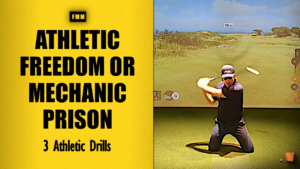
- I train chest rotation by hitting balls on my knees.
- I train my weight shift by almost step-dancing laterally.
Athleticism trains the void between the brain-coordinate checkpoints, and it’s trained best away from the range, in a net, or even without a golf ball.
Solutions – Brain Coordinates Described
So let’s take some actual examples of my brain coordinates and what it looks like. Keep in mind that I always train my athleticism and have made the “journey of a big swing arc” the leader of the show.
I make some small swing arc inspired practice swings to feel my starting point and athletically what moves the swing. Check out this “Scottie Scheffler” mini swing video to show what I mean. This is how I give clarity to coordinate A = the start of the swing.
Secondly I image placing my hands 3 meters above myself at three o’clock. Since the start of the motion creates a “swing back” I know that this will make all the joints bend, flex and hinge in the proper way. This is as Nicklaus describes = all folds naturally because of the weight of the club. This becomes coordinate B = The top backswing position.
Finally I wish to provide clarity for my brain where the club is supposed to finish because this unlocks athletic ability more than anything I know about in golf. And it also places the coordinate outside of the “very fast and unthinkable” region of the golf swing. I usually place this coordinate above my lead shoulder in my follow through. Mechanically this makes sense since it’s a centripetally swing arc stimulating position. This becomes coordinate C = the top follow through position.
I repeat it in some practice swings and then just go to work with the following swing goal. Trust my athleticism and simply achieve the big motion I’ve coordinated my brain to follow. Not “trying,” but actually performing it gives me the best chance to achieve the most sought-after trait in golf: consistency in striking.
Case Study – A Good Ball striker
If you have a solid golf swing, it’s more than likely the outcome of perceiving your motion positively in combination with training key driving mechanics—often through athleticism-connected concepts—so that you deliver a fully functioning motion.
You’ve accomplished what most golfers seek without even saying it: a simple motion that demands very little from you to execute.
Most “talented” golfers achieve this by starting young and intuitively understanding the rather unintuitive instructions you need to give yourself.
The good ball striker maintains a clear perception of their swing while developing athletic ability over time. For example, Scottie Scheffler has had essentially the same swing for 18 years. That makes it quite reliable, doesn’t it?
For clarity, using the “bigness” of the motion as your perception of the swing—and making the swing arc the leader—comes with massive mechanical advantages:
- It becomes easier to create a fully loaded backswing position, since the size itself inspires all kinds of body rotation.
- The downswing now travels a longer pathway, which gives the athletic task of squaring the clubface more space. It’s almost like “slowing down” the motion from a rotational perspective.
- The follow-through size inspires synchronized body rotation and creates a harmonized motion.
Case Study – A Struggling Golfer
If you’ve got a non-satisfactory motion, it’s likely due to a limited and shackled perception of your swing.
On top of that, you’ve probably misunderstood the unintuitive nature of golf and are performing non-satisfactory mechanics as an outcome of this.
For you, the change starts with how you perceive your motion. Compared to an old-school swinging protocol, your motion is likely too small, and the tightness limits the mechanics. You’re having to fight for things that more advanced golfers get for free.
Your way forward is to make a choice: what style of swing do you want? I, myself, after more than a decade of study, see more advantages than ever in the old-school swinging motion. It provides an easier level of achievability while retaining the traits of both power and control.
Once your direction is clear, the path forward is simple: allow the blade to rotate in the backswing, which fuels the power systems, and then ignite your downswing with abstract concepts in training.
Got the juices flowing in the downswing? Great. Now you can start enjoying the benefits of focusing your follow-through for power acceleration and dispersion-tightening properties.
It’s really not harder than that (takes 2-5000 reps ish) —and it all begins with admitting that your perception of the golf swing has likely been limited.
Repetition & Summary – Applied on Myself
Let’s bring all of the above into a case study on myself to paint a picture.
I see my swing as a big motion—almost like a Paris wheel in front of my body. I perceive the motion on this big Paris wheel as a long, long journey where the strike becomes incidental. In my simplest golf swing (and my best course golf), I give my brain simple coordinates to the top of the backswing and to the top of the follow-through. The void in between? I trust that my athleticism will take care of it.
Very importantly, I’ve made the swing arc and the pure size of it the absolute leader of the show. This makes my entire body react and opens up the ability to use my athleticism.
I train, mostly without a ball, the void between the starting position and the top of the backswing. I want certain things to happen to support my big swing arc—for example, opening the blade in the backswing and rotating my body roughly 45 degrees. The lifting of the arms actually takes care of the chest rotation (remember: find the drivers of mechanics). I also want to feel my body as a centered core, but I don’t try to stand still. In practice, I move the way I need to move to achieve the best possible backswing. At the end of each backswing training session, I go into “trust mode” and make it all happen using only the brain coordinates of placing my hands in the desired positions.
The downswing I train deliberately to make as automatic as possible. Again, my best golf is played with the A->B->C checkpoint system, which leaves a huge void. I use feelings like a whip, a dump, or an ax and leave space for momentum to do its work. The downswing needs to accomplish multiple things: create lag, rerotate the arms, and unleash lag and speed. In the early stages of a downswing change, I perform these downswing athletic drills until I hook the ball severely. I call this “unleashing the beast,” and it’s achieved by understanding how the club should feel to generate power and speed.
Finally, I train the follow-through in athletic terms so the body knows what to do with the awesome downswing power that was created. This has multiple benefits:
- It takes the input centrifugal force and accelerates it.
- It allows mastery of the blade depending on how the follow-through is performed.
In other words, this style of training gives you both more speed and more control.
Maybe you’ve picked up on this—I don’t talk about the body at all. I don’t talk about rotations or ground force usage. I make the swing arc the leader of the show, because then the followers naturally start to follow.
Most importantly, all athletic training is performed so I can return to my simplest golf swing, where I give my “stupid golf brain” simple coordinates when it’s “real golf time.” This way, I take my swing to the course, and it’s a damn good feeling. With a mind free of mechanics, you can actually enjoy the game, and the more I play, the closer I get to the feel of “I see target, I hit to target.”
Summary and Coaching Sales Pitch
This is really what separates me from 95% of all coaches worldwide. I work exactly in the below order:
- The first meeting is about understanding what you think about your motion in relation to what you do today.
- The Knowledge Material (which takes 1.5–2 hours to work through) is designed to put your mind at rest so you can focus on the important stuff.
- Swing change is created through a combination of athletic work and brain coordinate work.
- Your course play becomes you giving yourself simple coordinates and at your best you enter “I see target, I hit to target” mode.
Together, this makes everything in the FMM Swing Academy achievable and gives you a fighting chance to reach your potential.
I’m proud to say that 50% of my students have never taken a lesson before. And that’s exactly the point. I don’t give “lessons.” I give you the tools to change yourself.
More FMM Project Articles
-
The Swinging Protocol – In the Core of all Great Golfers?
I have a special interest in the golf world, and that is to understand what actually built the best swings of all time. Not just how they look, but what truly built them. What…
-
A Powerful Golf Swing Clips It – Stop Chasing Divots
We are all performing golf swings based on inner images, muscle memory, and athleticism. These different subconscious images will shape how we perform our motion. A powerful golf swing clips it in a shallow,…
-
Perform Your Backswing in Front of Yourself – The Vertical Lift
The backswing might be the most difficult part of golf. Do it right, and while there are no guarantees of a perfect result, do it wrong and you’ve almost certainly ruined your chances of…



General Article Collection Pages
-
All Articles Library – All Creations in One Place
Everything I’ve created over the years. You have different filterings according to the list below. Wish…
-
DIY Swing Change – Advice on How to Successfully Change
Do It Yourself, DIY Swing Change, is what has driven me the last decade in my…
-
FMM Academy – Which Pattern Fits You?
My best live lessons are ten minutes long. Eight minutes of dialogue.5–10 balls struck. Because swing…
-
Golf Swing Styles – Categorization for Context
I categorize golf motion styles into systems for the sake of clarity and understanding. No golfer…




Video Based Articles
-
Low Downswing Hands — 2 Ways Without Letting the Club Fall
Low Downswing Hands – Two Ways Without Letting the Club Fall Many golfers are told that the downswing should begin by simply letting the club fall. For some players that idea works well, but…
-
Shallow Through Impact – Woosnam & O’Grady Release Exit
Shallow Through Impact – Woosnam & O’Grady Release Exit “Shallowing the club” has become one of the most discussed topics in modern golf instruction. Many golfers spend a lot of time trying to shallow…
-
Mechanical vs Athletic Drilling — When the Centipede Fell Down
Mechanical vs Athletic Drilling — When the Centipede Fell Down When the Centipede Fell Down “A centipede was happy quite,Until someone asked which leg goes after which…” The moment it started thinking about mechanics,…

Old School General Articles
-
How Lee Trevino Built One of Golf’s Most Accurate Swings
Most golfers trying to hack the golf swing just ruin it, and some, like Lee Trevino, win six majors. From an accuracy perspective, I would say that his motion is the most efficient I’ve…
-
Why Jack Nicklaus Swing Work – Free of Modern “Rules”
Most people have Ben Hogan as their swing god, and sure, he’s awesome, but my personal favorite will always be Jack Nicklaus Swing. The Golden Bear. It’s the simplicity and effortless feel of it…
-
Ben Hogan 1940s Pre-Accident Swing Change – Power Updated
Nothing in golf quite compares to Ben Hogan’s ball striking induced dominance in the 1940s and 1950s. In 1948 alone he would win 10 titles including 2 majors. The 1940s pre-accident swing rebuild I…