
The Swinging Protocol – At the Core of All Great Golfers?
I have a special interest in the golf world, and that is to understand what actually built the best swings of all time. Not just how they look, but what truly built them. What constituted the foundational golf swing of the best of the best? What did they do before they adapted their master-level layer that propelled them to become tour winners and major champions?
I genuinely believe that uncovering this base level has the biggest possible impact I can have on the golf world. Ultimately, I’m in this to help golfers everywhere enjoy the feeling of great ball striking.
I want to go to the roots of it all, and that’s why I talk so much about the brain—our intentions, brain coordinates, and similar topics—because this is what’s behind it all. Our thinking patterns are what drive our movements. They are what shape how we develop our muscle memories, and so on.
Furthermore, I like to think about it from both a layered building perspective and a strategic driver perspective—which pieces move other pieces? What’s the foundation? What are the bearing walls? This method, refined and developed over time, has started to yield some very interesting results.
Right now, after doing this for 10+ years, I’m starting to “get it.” One of my absolute conclusions is this:
The swinging motion (think Bobby Jones) exists within every single great player out there, no matter how hitty, rotational, or otherwise quirky they might appear.
You need to start by learning the rather unintuitive ability to stimulate the forces in the club inside of the swing arc.
For me, this is the absolute foundation in the house metaphor. And from a strategic driver perspective, it’s about finding the key movements that inspire other movements. Learning to make the club work will, quite amazingly, make your body react to the forces.
Learning how to stimulate the club to its maximum centrifugal force (in relation to effort), and adding a layer of blade control through intentional centripetal action within the swing arc, constitutes the inner core of all great ball strikers.
If you have this—and this only—you have a motion that can take you under ball-striking par in a heartbeat. Why? Because you’ll eliminate most of your misses, produce a healthy amount of power, and, most importantly, because it’s achievable. It’s doable. It’s possible.
A Foundational Golf S W I N G
If your best rounds include fewer than 10 Greens in Regulation, you’ve most likely misunderstood something about the golf swing. You probably have a perception of the motion that limits you at your core.
In my opinion, a proper golf swing has the following requirements:
- It needs to deliver both Power and Control
- It needs to be Non–Injury Inducing (even though golf is one-sided, so no guarantees)
- It needs to be Achievable from a brain perspective
If you check these boxes, there’s nothing stopping you from moving into the lower single digits from a ball-striking perspective.
The power and control part took me 6–7 years to understand from an old-school perspective, and I’ll just tell it like it is:
- You need to not mess up your backswing. (Here’s an article about it.)
- You need to stimulate healthy amounts of centrifugal force in the downswing (I call it the downswing ignition) by understanding how to intend the golf club.
- Then you need to accelerate the club while inspiring it (without strangling it) for blade control.
(Please note that I’m not talking about mechanical positions, body rotation, or anything like that. These are all followers to your carefully selected leaders of the show.)
That’s it. Nothing else. If you do this and make the complete motion your goal, you’ll go from missing 4 out of 10 shots to missing 2 out of 20—just like that. (Sure, you’ll still miss plenty, but they’ll be acceptable misses.)
The Non–Injury-Inducing part is about avoiding harmful body angles and not producing too much force away from the body. These, in my opinion, are the main culprits behind injury—and I’ve injured myself more than most experimenting with the modern swing.
The Achievability factor was the hardest to crack, and it’s really wha’s unique about my FMM coaching. I only care about movements that are actually doable. That’s why I’ve written so many articles about choosing your swing leader and related topics.
The Swinging Protocol – Youth Learning for All?
Most great ball strikers start out young, which means they need to get it early on—because at a young age, you don’t have the muscles to cheat. Most adult players never “get it.” And “it” means understanding how the swing, through intentions in the club, is actually stimulated to create the base-level motion needed for a fully functional golf swing.
So, do you need to start young or it’s over? Not at all. You can absolutely tune your brain for new perceptions and intentions, and tie these together with simple coordinates. You just need to—quoting Steve Jobs—think different.
This opens the door for real change. If you can step into how kids actually learn to swing a club, then everyone can change. And you don’t need any fancy equipment or technology—just knowledge, commitment, and belief.
I have 70-year-old students who’ve had ok swings, with moments of greatness, but otherwise unsatisfying swings for 50 years, and after hitting about a thousand golf balls, they start producing results and swing motions they’ve never been close to before. I’m not referring to some small wrist-angle tweak at P5.5 here but rather foundationally improved swinging motions. This doesn’t mean they’ll become all-stars and win the state finals overnight, but it brings them tremendous joy (and me too).
Sorry for the brag—but I’m onto something here.
Understanding the Base Swinging Motion = Big Hook Gone?
In the Flaghunters Podcast (scroll down to August 2025), I made a case for a “base-level swing”—and that it’s good enough for + handicap ball striking (let’s say 12–13 GIR to make it tangible). That’s really it. If you figure out how to truly swing the club—which is actually pretty darn easy—you’ll eradicate most of the big misses in golf.
Again, if you have fewer than 10 GIR per round, you’re likely operating under the influence of a major misunderstanding of the golf swing.
I’m medium talent myself (made the teams but was no star) and can have 15–16 GIR on a good day.
When you start getting the swing arc going and continue the motion all the way to the follow-through, you eliminate most of the big mistakes in golf.
To get a bit technical—the biggest and most detrimental miss in golf is the big hook. If you develop a swing where your hands carry momentum (while maintaining the relative braking mechanism) through the impact area, this miss is history. It’s gone.
Try Out the Foundational Swinging Protocol Yourself
All you need to do is grab a longer golf club, e.g. a 5-wood or something similar. Put one hand on it and start swinging. Or even better, grab one of your old steel-shafted clubs and go to work. What do you need to do to create speed and carry (and even accelerate that speed) all the way to the follow-through?
Do you need to lead with your hips, get into the ground, exit low and left, buy a HackMotion device, put on a 3D vest—or do you just need to swing it?
Power in the golf swing is gravely misunderstood, in my opinion. If you’re a 3-handicapper with 105 mph clubhead speed with the driver, then you’ve understood it. If you’re a 12-handicapper with 88 mph, then you haven’t.
Just be fair to yourself. Do you actually know how to swing the club or not?
In my early PGA education, I had the pleasure of studying with one of Europe’s longest hitters. I’ve never felt so talentless standing next to someone on the range when it came to power. He hit his 3-iron longer than my driver—and I’m not a short hitter. (He also sprayed it quite a bit, but from a power perspective it was just mind-blowing.)
So we asked him why he hit it so long, and he said he used to sit outside his dad’s work for 30 minutes each day. While waiting, he skipped rocks on the nearby river. How cool is that? He also said he only feels “up and down” in his swing—yet he rotated more than anyone I’d ever seen.
The point is this: inside a foundational golf swing lies the ability to make the club work. I’ve already explained it above, but I’ll say it again. Make a backswing, create foundational centrifugal force in the downswing, and then accelerate that through to the finish. Use one hand, because that makes it much harder to cheat. And you don’t need to think about lag or anything else—just get speed into the swing arc. Your athleticism will take care of the mechanics.
That’s why I’m so big on one-handed hitting. It’s not to show off or anything—it’s because training one-handed forces me not to cheat and to do it right. Fifty one-handed shots in swing change are worth a thousand normal shots. At least.
Base Level to Master Level
As mentioned, I believe the swing is learned first—and then you can adapt it to your feels and preferences.
In my coaching, I teach the base level using the FMM toolbox (basically giving you all the info so you can teach yourself) first, and then I’m in the process of developing master-level courses for different routes.
In the Nicklaus variation (the first one I’ll take on), it’s really not that hard to step from a nice, fluid swing arc to something much more potent. What’s needed is a slight grip adaptation, a ball position adjustment, together with the “dance of the body.” You don’t need the exact knee shuffle of Mr. Nicklaus, but you do need to start sequencing the body for more potency in your swing arc. All of the old sayings WORK if you’ve got the foundational inner layer of the swing. For example, Nicklaus said, “I get over to my lead side and release as early as possible.”
Isn’t that an oversimplification? No, actually not. The best of the best didn’t (with the possible exception of Ben Hogan) do something very difficult. They simplified and found the leaders of the show to make their motion so simple that they could do it in their sleep.
The foundational inner-layer swing arc is the “hard” part to train, since it likely forces you to think a bit differently about the motion than you do today.
The first master level course is probably available in Q4 2025 or early Q1 2026.
Swinging Protocol or Hitting – Why Choose?
I’ve stated before that I’ve deliberately not walked down the road of The Golfing Machine, since its outcome isn’t how I see the golf swing or how the great players I grew up with performed their motions.
As you’ve probably read between the lines in this article, I believe that all great motions have the actual swing as the foundational layer for it all.
Then you can adapt a more hitting-like concept on top of this if you like. For me, a more hitty style of shot would be a punch shot, while a more swingy shot would be a towering, standard, big-motion golf swing. Why choose when you can do both?
Many great players have talked about dropping the club in transition and making the whole downswing a slight wait before the accelerating impact and follow-through action. But if you look at their motions, it’s more than just a gravitational drop from the top of the backswing. They’ve already, often in their youth, ignited their downswing with swinging juices. This makes them feel a drop—but in reality, it’s a swing and a drop in unison.
Learn the Club’s Inner Layer Movements – Sales Pitch
I believe in you understanding the task you’re supposed to perform. In my case, it all starts with the foundational movement of the club. How do you make it work? How do you perform a decent backswing, ignite the downswing, and accelerate the speed (together with blade control) in the follow-through? And how does it all connect?
I teach through the FMM Swing Academy which makes you own your own motion (I wish to give you all info and not “keep you coming back for more”). It all starts with a free meeting, and we take it from there. My students are “forced” to study for 4–5 hours before it all begins. Most of the time, it takes about a month to get comfortable building your inner golf swing. Check it out here.
More FMM Project Articles

A Powerful Golf Swing Clips It – Stop Chasing Divots
We are all performing golf swings based on inner images, muscle memory, and athleticism. These different subconscious images will shape how we perform our motion. A powerful golf swing clips it in a shallow,…

Perform Your Backswing in Front of Yourself – The Vertical Lift
The backswing might be the most difficult part of golf. Do it right, and while there are no guarantees of a perfect result, do it wrong and you’ve almost certainly ruined your chances of…

The Obstacles of Your Golf Swing – Why Swings Get Limited
Why don’t you swing as well as you want to? What’s in the way? I call the gap between your current state and your desired motion the obstacles of your golf swing. My conclusions…
General Article Collection Pages

All Articles Library – All Creations in One Place
Everything I’ve created over the years. You have different filterings according to the list below. Wish…

DIY Swing Change – Advice on How to Successfully Change
Do It Yourself, DIY Swing Change, is what has driven me the last decade in my…

FMM Academy – Which Pattern Fits You?
My best live lessons are ten minutes long.Nine minutes of dialogue. One or two balls hit…
Golf Swing Styles – Categorization for Context
I categorize golf motion styles into systems for the sake of clarity and understanding. No golfer…
Video Based Articles
Jack Nicklaus’s Swing – The Inner Layer of his Motion
Jack Nicklaus’s Swing – The Inner Layer of his Motion Golf history is full of great swings, but few have stood the test of time like Jack Nicklaus’s. His technique wasn’t just effective —…
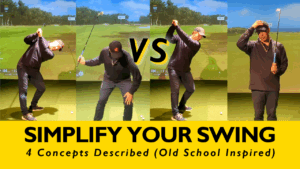
The Simple Golf Swing: Four Key Concepts Explained
The Simple Golf Swing: Four Key Concepts Explained Does the simple golf swing actually exist? It’s a reasonable question and my answer is this. There are definitely simplifications of the motion available for you…

Pre-Shot Routine: Learn from Scottie Scheffler’s Mini Swings
Pre-Shot Routine: Learn from Scottie Scheffler’s Mini Swings The pre-shot routine is the most underrated performance booster of your score in golf. Looking at Scottie Scheffler’s routine, the most consistent player for decades, makes…
Old School General Articles
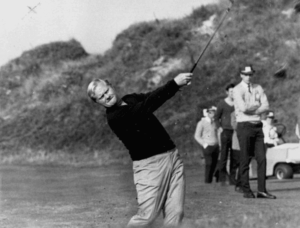
Why Jack Nicklaus Swing Work – Free of Modern “Rules”
Most people have Ben Hogan as their swing god, and sure, he’s awesome, but my personal favorite will always be Jack Nicklaus Swing. The Golden Bear. It’s the simplicity and effortless feel of it…
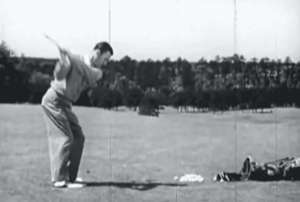
Ben Hogan 1940s Pre-Accident Swing Change – Power Updated
Nothing in golf quite compares to Ben Hogan’s ball striking induced dominance in the 1940s and 1950s. In 1948 alone he would win 10 titles including 2 majors. The 1940s pre-accident swing rebuild I…
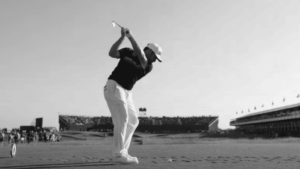
Old School Swinging Elements on Tour – A Modern Case Study
Modern top tier golfers definitely display old school swinging elements of the old greats. These swing styles are making their way back to the leaderboards today. This article relates to my teaching style of…