
Most Golf Swings Are Misunderstandings — Perception Problems
What’s the difference between a good ball striker and a struggling golfer? Is it some kind of unique skill set reserved for the most athletic or talented? Heck no. It’s all about how we see and perceive our motions. Most golf swings are misunderstandings from a perception perspective.
Your perception of what a motion really is will either limit you or set you free. The good ball striker sees it one way, and the struggler sees it in a completely different—and much more limiting—way.
To be honest the good golfer plays a much simpler game than the golfer struggling on most shots. It’s not based in talent, it’s based on what you try to achieve.
I’ll do my best to unveil these perceptions of a golf swing and show how they affect our development.
The good news is that ANYONE can change if they change perception.
Valid Perceptions that Creates Possibilities
In my coaching, I have something that I call the Execution layer—almost like a wrapping around your entire motion, if you will.
Many times, especially with students whose swings are way off anything “good,” this is what I address first.
Some of the strongest mind concepts here come from pretending to be something completely different. Some of my students—though it feels weird when it’s happening—pretend to have my swing, and voila, they’ve changed 25% in just 100 golf balls. My swing isn’t anything special, but it’s also not bad. It’s a big, fluid motion that works well enough to shoot way under 70 on a good short-game day. It’s kind of “free” from big mistakes, if you will.
The point isn’t about my swing—it’s about the power of the mind and how you can inspire it to create a completely different action for yourself.
Many times, I’ve actually envisioned the bigness of Bryson DeChambeau’s motion—even though I’m not a huge fan. It has always made everything better. I’ve envisioned the fluidity of Fred Couples to create tranquility, and so on.
I call this Execution layer “The Pretender”—and it’s a damn good one.
To be a bit more tangible, I also talk a LOT about the bigness of the motion and making the swing arc the leader of the show. I must have mentioned it a hundred times by now. This perception is exactly what I use myself in my motion. I picture my swing as a big Paris wheel and fuse it with a feeling of a very long swing-arc journey.
The point is: when you challenge your perception and replace it with something else, you’ve just laid down the foundation for swing change.
Perception Fault 1 – The Driver behind Over the Top
So let’s jump into what’s happening behind the scenes for a suboptimal golf swing. Let’s use the “standard” student as an example, with the following issues:
- Lack of power
- Hits the 5-iron (if they have one) like a 7-iron
- Spinny drives
- Out-to-in path
This describes roughly 90% of golfers. Do you really think this comes from thin air? Nope. It comes from a limited perception.
I can swear that, from a subconscious perspective, almost every single golfer with these issues perceives the motion as striking the golf ball. They don’t cater to a big swing arc or a long journey—they just strike the ball.
How do I know this? Well, if I take the same perception in my own mind and perform it, I become steep, over the top, and lose power. Or even better—if I ask a beginner to make a backswing and strike the ball, this is exactly what happens. It’s natural, and that’s the “problem.”
Someone starting to play golf at a weak muscular age, e.g., 10 years old, needs to figure out another perception; otherwise, they won’t make it to the 50-yard mark. Adults can cheat a little and muscle the ball within the limited perception of “just hitting a ball”. We free ourselves or limit ourselves with our mind.
Perception Fault 2 – The “Controlled” Impact
So you’ve conquered the earlier challenge but have started trying to really zero in on consistency, and you do it through a subconscious feeling of control.
You close your blade in the backswing (so it matches your spine), since that’s the status quo of modern instruction, and you maintain the trail hand angle through the ball.
You hit nice, tight shots with low dispersion—but at the cost of taxing body movements and losing distance. Your hands rise up at impact, and the journey is basically over just a couple of decimeters after the golf ball.
But what if this perception of control isn’t how the best of the best actually achieved control? What if control is something completely different? Again, this is a limiting perception—and it will only take you so far.
Positive Spiral of a Good Perception
The more I know and the more I teach, the more I understand that the size of the swing arc and the weight of completing your motion are the most positive influencers of a golf swing I’ve ever come across.
When you change your perception to something bigger and longer, you automatically create brain leadership and unlock your athletic ability.
I wrote another very deep article about how “the brain is stupid and demands simple coordinates”, which touches upon this paragraph.
Long story short—when you find your perception, the athletic task of trying to square the clubface consistently becomes much, much easier. It’s easier to shallow in the downswing, easier to time your closing, easier to create input power, and easier to accelerate that power into the follow-through position. You make the hitting of the golf ball incidental instead of active.
Put quite differently, it makes the golf swing a lot easier to perform. You play a much simpler game. The positive spiral from this is that your training becomes much more fun, your athletic drills create more effect, and you can take it to the course since everything has become simplified.
Negative Spiral of a Limited Perception
On the other end of the spectrum is a limited perception, and I’ll use the “hit a golf ball limitation” as an example.
So you start becoming way too steep in the downswing.
You figure out that it’s likely the open blade in the backswing that’s the issue. After all, that’s the common conclusion from decades of coaching, right? It “makes” you chop across the ball.
So you start closing the blade. Now you lose all form of power because the moment you release it, you’ll send it as a hook. And you’re still too steep.
You self-instruct to start shallowing the golf club in the downswing, which in itself isn’t just difficult—it may actually take away even more power.
You start seeking power from rotational use of your body, stimulated by ground pressure in your lead foot.
Congrats. You now have a low-powered, hard-to-achieve golf swing that, if you train enough, may take you down to a 5–10 handicap—but you’ll never feel free. It’s a struggle to play because you need deep mechanical concepts in your mind in difficult-to-think regions of the golf swing.
It ALL STARTED with a limiting perception.
I don’t write this because it’s fun. I write it because it’s the truth for 80% of the swings sent to me.
Sure, you can go the modern route, continue your development here, and fight through it with 50–60,000 reps to turn it into an intentional rotational-based golf swing—but my way is different. I make the swing arc the leader, and it’s a lot easier. After all, I’ve performed the above-mentioned swing change on myself multiple times in different variations. There’s a much simpler way.
Summary and Tangible Task
If you find yourself struggling in the swing, lacking power and just can’t make it work, you are likely seeing your golf swing in a very limited way.
Use someone as inspiration and try to copy them from an overall perspective. Look at your idol and try to create the same feel for the motion, and I guarantee that you will change your motion slightly.
If you wish to take my more tangible advice into play, then do this: envision the swing arc as the dominant leader of your motion. Make it as big as you can and make sure to complete the journey on every single swing that you make. Allow the hit of the golf ball to become incidental instead of an active goal. This, together with old simplified movement fundamentals, is at the core of what and how I teach in the FMM Swing Academy.
More FMM Project Articles

The Swinging Protocol – In the Core of all Great Golfers?
I have a special interest in the golf world, and that is to understand what actually built the best swings of all time. Not just how they look, but what truly built them. What…

A Powerful Golf Swing Clips It – Stop Chasing Divots
We are all performing golf swings based on inner images, muscle memory, and athleticism. These different subconscious images will shape how we perform our motion. A powerful golf swing clips it in a shallow,…

Perform Your Backswing in Front of Yourself – The Vertical Lift
The backswing might be the most difficult part of golf. Do it right, and while there are no guarantees of a perfect result, do it wrong and you’ve almost certainly ruined your chances of…
General Article Collection Pages

All Articles Library – All Creations in One Place
Everything I’ve created over the years. You have different filterings according to the list below. Wish…

DIY Swing Change – Advice on How to Successfully Change
Do It Yourself, DIY Swing Change, is what has driven me the last decade in my…

FMM Academy – Which Pattern Fits You?
My best live lessons are ten minutes long.Nine minutes of dialogue. One or two balls hit…

Golf Swing Styles – Categorization for Context
I categorize golf motion styles into systems for the sake of clarity and understanding. No golfer…
Video Based Articles

Jack Nicklaus’s Swing – The Inner Layer of his Motion
Jack Nicklaus’s Swing – The Inner Layer of his Motion Golf history is full of great swings, but few have stood the test of time like Jack Nicklaus’s. His technique wasn’t just effective —…

The Simple Golf Swing: Four Key Concepts Explained
The Simple Golf Swing: Four Key Concepts Explained Does the simple golf swing actually exist? It’s a reasonable question and my answer is this. There are definitely simplifications of the motion available for you…

Pre-Shot Routine: Learn from Scottie Scheffler’s Mini Swings
Pre-Shot Routine: Learn from Scottie Scheffler’s Mini Swings The pre-shot routine is the most underrated performance booster of your score in golf. Looking at Scottie Scheffler’s routine, the most consistent player for decades, makes…
Old School General Articles
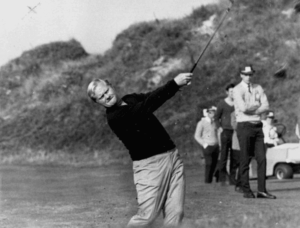
Why Jack Nicklaus Swing Work – Free of Modern “Rules”
Most people have Ben Hogan as their swing god, and sure, he’s awesome, but my personal favorite will always be Jack Nicklaus Swing. The Golden Bear. It’s the simplicity and effortless feel of it…
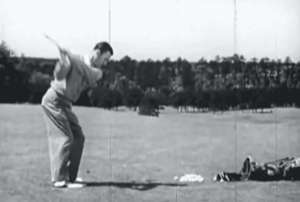
Ben Hogan 1940s Pre-Accident Swing Change – Power Updated
Nothing in golf quite compares to Ben Hogan’s ball striking induced dominance in the 1940s and 1950s. In 1948 alone he would win 10 titles including 2 majors. The 1940s pre-accident swing rebuild I…
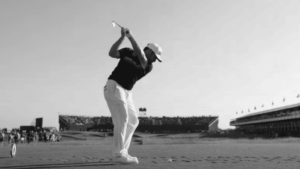
Old School Swinging Elements on Tour – A Modern Case Study
Modern top tier golfers definitely display old school swinging elements of the old greats. These swing styles are making their way back to the leaderboards today. This article relates to my teaching style of…