A Transition Free Golf Swing – Is this Possible?
The transition part of the golf swing can be tough to master since it happens relatively quickly and it has such big effects on your striking.
To answer the question directly: No, you need a transition. However, there’s a massive difference of creating the transition as a byproduct of a pretty simple athletic intention and having a deep mechanical pattern you need to accomplish.
The Need for Shallowness
Let’s go to the roots of the issure. You need to get shallow into the golf ball to perform nice striking. If you are e.g. 10 degrees in attack angle you will destroy your ability to produce efficient long club shots. It just doesn’t work.
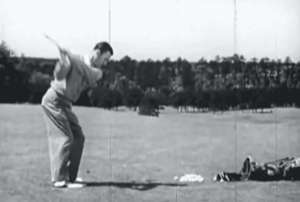
Another very important point is that most of the swing “good stuff” creates a lot of steepness. For instance, I’m a big fan of the swing of the 50-60s because of their impact area synchronized aggressive body rotation. This rotation is a massive steepener of the motion (sure the extension adds some shallowness but..) which then demands an entry into the golf ball that’s very shallow.
Or put the other way around. Most golfers lack so much shallowness that they can never use the follow through properly in their motions. Their steepness forbids it (since they will hit massive weak slices if they rotate)
In all honesty. 95% of the golfing population (even single digit hcps) straight up pull slice the ball, pull fade it, pull it or pull draw it. They never get shallow enough for performing scratch potential impact conditions.
So, let’s look on two differnt style of solutions.
The Standard “Hard for the Brain” Move
Most golfers lack backswing width and often come from stuck backswing positions. This more often than not forces them to swipe their arms across the body which is often performed together with a relatively shut clubface. Voila, you’ve got a steep downswing and now need a transition move.
The solution becomes a mechanical extension and lowering of the arms. It’s nothing wrong with it from a theoretical perspective. It works. IF you can do it and my experience is that most can’t.
A shut face in the downswing in relation to old school principles now also means that you have to delay the relay since you otherwise will send the ball dead left. So this means a transition move AND an intentional body rotation (to support the shut face) to accomplish a straight shot. Again, nothing wrong in theory. Only in execution.
So why is it so difficult to do? Well, most golfers have a quite potent drive to hit the golf ball in them which means that they don’t create the chronological space needed to perform these very needed movements.
Ahtletic Intentions with Shallowness as Byproduct
When you “get” the below paragraphs your golf life will be changed forever.
You aren’t supposed to perform a difficult mechanical shallowing move. You are supposed to utilize the golf club for it’s inherent shallowing properties and use the blade rotation to your advantage. Read that twice please.
I’ll describe, in terms of shallowness, the three release styles / swing patters I educate and teach in the FMM Academy here below:
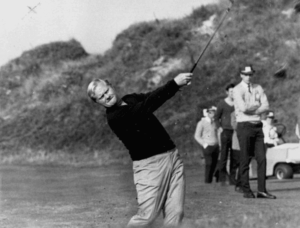
In the Big Arc Swinger (Nicklaus, Woods, Scheffler etc) release pattern you open your blade in the backswing and use a VERY ACHIEVABLE downswing arc intention to boost your downswing speed. To ignite your engine. You then get rid of grip pressure and carry the momentum all the way to the finish. That’s your swing in a nut shell. The shallowing being provided by downswing width and a gravity drop of the hands (inspired by release of grip pressure) comes as a byproduct. You ignite it in training and then you play golf with an aggressive follow through feeling. Even the follow through can aid in the quest for shallowness. Did you read transition anywhere in that segment?
In the Trail Power Hitter (early Mac, Stadler, Langer, Woosnam etc) you use your trail arm, inspired by your club intention, in a very deliberate power action vertically towards the ground where you use a power build up in the trail side of your body as power assistance. You power the entire motion from an open backswing blade position (not the modern shut as the spine position) which in turn aggressively forces the hands downwards (shallowness) together with the club slotting in an interplay between your intentions and momentum of the shaft. When you actually perform this early enough your body starts reacting and you’ve created a shallow strike within the blink of an eye. Transition move or byproduct?
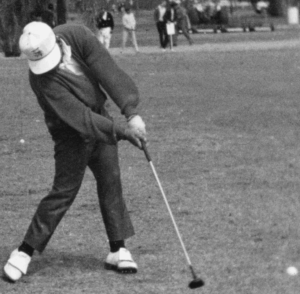
In the Backside Releaser (Vardon, Hagen, Snead, Hogan, Player, Trevino etc) you actually dump the backside of your club which in turn creates maybe the most shallowing and most unintuitive way of striking a golf ball. This creates so much shallowness that you can even perform mr Hogan’s “start with the hips” advice without over slicing the golf ball. This would be the closest to a “shallowing move” of the three but the difference is that you aim the intentions into the club and bypass the mechanical mindset.
There’s no doubt that shallowness into impact is one of the keys for great golf. I prefer it as a byproduct of clear athletic intention focusing the entire motion than just a mechanical “hard to perform” move being taken out context.
Please click here to reach the FMM Swing Academy.
More FMM Project Articles
-
The Swinging Protocol – In the Core of all Great Golfers?
I have a special interest in the golf world, and that is to understand what actually built the best swings of all time. Not just how they look, but what truly built them. What…
-
A Powerful Golf Swing Clips It – Stop Chasing Divots
We are all performing golf swings based on inner images, muscle memory, and athleticism. These different subconscious images will shape how we perform our motion. A powerful golf swing clips it in a shallow,…
-
Perform Your Backswing in Front of Yourself – The Vertical Lift
The backswing might be the most difficult part of golf. Do it right, and while there are no guarantees of a perfect result, do it wrong and you’ve almost certainly ruined your chances of…



Some General Swing Tech Posts (with Videos)
-
Flipping in Golf – Good or Bad? It Depends
Flipping in Golf – A Misunderstanding? There are many ways to execute a golf swing. In the old-school style, where the swing arc drives the motion, allowing the club to overtake the hands, aka…
-
Swing Arc Power – A Simpler, More Effortless Golf Swing
Swing Arc Power – The key to simpler golf? You don’t need to manipulate the golf swing. By relying on swing arc power, you can bypass many difficult and unnecessary moves. You’ve likely figured…
-
The Golf Swing Engine – What Truly Drives the Swing
What’s the Golf Swing Engine? What truly drives it? The answer depends on the swing system you follow. In the FMM Swing—rooted in the timeless motion of the old greats—the golf swing engine is…


General Article Collection Pages
-
All Articles Library – All Creations in One Place
Everything I’ve created over the years. You have different filterings according to the list below. Wish to watch Youtube videos instead? Then click here to open Wish to visit my Skillest Profile (coach app)?…
-
DIY Swing Change – Advice on How to Successfully Change
Do It Yourself, DIY Swing Change, is what has driven me the last decade in my golf swing development. The absolute enjoyment of figuring out a swing change myself. To all of you out…
-
FMM Academy – Which Pattern Fits You?
My best live lessons are ten minutes long. Eight minutes of dialogue.5–10 balls struck. Because swing development isn’t about collecting reps — it’s about understanding what you’re actually doing and then executing your strengths…
-
Golf Swing Styles – Categorization for Context
I categorize golf motion styles into systems for the sake of clarity and understanding. No golfer fits perfectly into a single swing style, but without a structured framework, you’re essentially shooting in the dark….




Old School General Articles
-
How Lee Trevino Built One of Golf’s Most Accurate Swings
Most golfers trying to hack the golf swing just ruin it, and some, like Lee Trevino, win six majors. From an accuracy perspective, I would say that his motion is the most efficient I’ve…
-
Why Jack Nicklaus Swing Work – Free of Modern “Rules”
Most people have Ben Hogan as their swing god, and sure, he’s awesome, but my personal favorite will always be Jack Nicklaus Swing. The Golden Bear. It’s the simplicity and effortless feel of it…
-
Ben Hogan 1940s Pre-Accident Swing Change – Power Updated
Nothing in golf quite compares to Ben Hogan’s ball striking induced dominance in the 1940s and 1950s. In 1948 alone he would win 10 titles including 2 majors. The 1940s pre-accident swing rebuild I…