A Powerful Golf Swing Clips It – Stop Chasing Divots
We are all performing golf swings based on inner images, muscle memory, and athleticism. These different subconscious images will shape how we perform our motion. A powerful golf swing clips it in a shallow, momentum-driven swing arc, where the ball simply gets in the way.
In other words, a flowy, big motion that makes it easy to play golf actually clips the ball from the surface in its base form. (This article relates mostly to what I call the Big Arc Swing pattern in the FMM Swing Academy.)
Other styles of golf shots—for example, hitting a punch shot with a mile-long divot—are a pure manipulation of the impact area at the cost of follow-through power potential. It actually hinders your natural movement.
So, is it wrong to hit a big divot? Of course not! But if a big divot is in your mind as a subconscious goal, you are likely limiting your motion.
An example: In my own game, I hit about 70% of my shots on the course with my big, flowy motion—usually high, neat shots. For the remaining 30% of shots, especially in headwind situations, I intentionally manipulate my base motion into something else.
Tiger Woods said somewhere in the 2000s that he needed to learn to hit down to be able to perform. Really? He had already won the Masters in 1997 by 12 shots and was the most dominant player in history from 2000–2005. The point: we often study the mastery level of great players to be the best of the best, but where did they come from?
What facilitated their base motions?
Simplify Everything = Make the Swing Arc the Leader
The golf swing is massively over-taught and over-complicated. In reality, creating a great motion is much simpler than most think.
- Decide on a perception. See your swing as a big arc that you wish to populate with your body’s movements. This will naturally trigger athletic responses without overthinking.
- Treat it as a journey. Perform the swing as a motion from A → B → C:
- A: The start of your motion
- B: The top of the backswing
- C: The follow-through position
- A: The start of your motion
- Focus on completing the journey. Make your goal to start at A and finish at C, letting your body handle the strike naturally. This is how you unlock true athleticism. (For a deeper dive, read my article on this.)
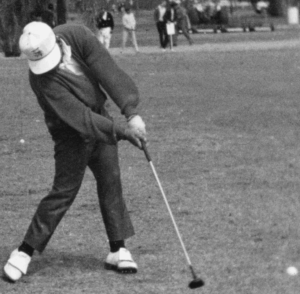
When you swing this way, you’ll notice something important: you aren’t digging divots down to the earth’s core—you’re clipping the grass lightly in front of you.
This is how a normal, functional base motion works. (For more on limited swing perceptions, see my other article.)
But be aware: without a deeper understanding, this can still feel vague and non-dynamic.
Athleticism 1 – Figure out the Backswing Creation
I personally prefer the old school backswing over the modern interpretation (big surprise, right?). Here’s the essence:
Open the blade in the backswing and place yourself in a non-stuck, high, “awesome” position. By doing this, you’ve created the potential to perform the next steps in the swing naturally.
Train this relentlessly. Dry-land it until your brain can reach the top backswing position automatically using just your simple coordinate system.
Athleticism 2 – Filling the Downswing Void
Now you’ve got the ability to actually start using the downswing for power creation and to add dynamics into your motion.
Just performing a fictional swing arc with straight arms and no dynamics will barely get your drive 100 yards—so let’s do something right.
Here’s the thing: you use simple brain concepts—athletic drills like swinging an ax or a whip, or something similar—to make stuff happen. This, in turn, creates all kinds of mechanical byproducts: re-rotating your arms, extending the trail arm, creating and unleashing lag, and more. The trick is to leave enough space for the interplay between the club’s momentum and your body.
I describe it differently depending on the person (since our brain wirings differ). For some, it’s a vertical feeling straight down at the right foot. For others, it’s swinging an ax in mid-air. For others, it’s a gravitational drop.
The point is, you just need to ignite your downswing in some way, because that’s when you unlock all the benefits of pure striking. This creates shallow striking conditions slightly from the inside. It’s what makes it possible, for instance, to hit a 3-iron off the deck—something most golfers can’t do because they’re too steep in the downswing.
All of this is trained in specially designed downswing ignition drills where you care absolutely nothing about the result.
In fact, I encourage you to get the juices flowing so much in the downswing that you start hooking the ball severely—what I call “power through snap hooks.”
Mind you, this isn’t the end result—it’s only half the journey.
Athleticism 3 – The Follow Through Action
If you do the downswing ignition correctly, you’ve opened the door to actually use the follow-through to your advantage.
Most of the golf world can’t take advantage of the follow-through like the old greats did. Why? Because their swings are too steep, often caused by a limited perception of the motion combined with a shut backswing blade.
When you train the follow-through athletically, it actually creates a centripetal counterpart to the centrifugal force.
In layman’s terms, the correct follow-through stimulates an acceleration of the club’s centrifugal force.
The really cool part: this action also enhances the braking mechanism of your hands relative to the club, but the feeling from a performance perspective is acceleration, not braking. This sensation of accelerating hands is one of the nicest feelings you can have when playing golf.
Swing Arc + Athleticism = Incidental Shallow Divot Striking
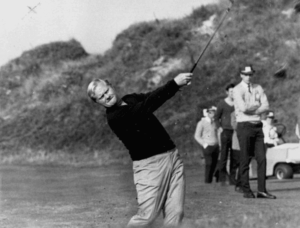
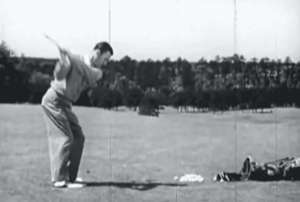
So here’s the essence: you see a big swing arc as the leader and train your athletic abilities so that the difficult parts of the golf swing “just happen.”
This is what training is for. It’s not about mechanical master classes—it’s about unlocking your athletic potential and harnessing it.
Checkpoint A = Start of the swing
Checkpoint B = Top of the backswing
Checkpoint C = Top of the follow-through
All of this creates a base motion (an inner-layer description) of what most great golfers do—from my biased, old-school perspective. This base motion doesn’t carve a divot thick as a brick; it more clips the grass lightly.
In other words: you perceive the golf swing as a huge journey along the swing arc, and you’re the captain of that journey. You give simple coordinates, and these instructions create a flowy, effortless motion where the actual strike of the golf ball becomes incidental.
The ball just happens to lie in the way.Or, as Wild Bill Melhorn said: “Clip the grass please, and once you put the ball there, pretend it’s a dandelion.”
Advantages of a “Clipping” Base Motion?
I think I’ve made myself pretty clear by now, but I’ll just provide another perspective, if you will. A big clipping base motion comes with the following advantages from a mechanical perspective:
- It provides a shallow entry and a shallow exit of the striking area. This makes it possible to hit the longer, “difficult” clubs with ease. Or, as Tiger Woods said, “I’m pretty ‘sweepy’ in my swing.”
- It creates a continued (in the feeling, accelerated) hand momentum journey through the impact area. For those of you who play at a better level, this is basically what takes the snap hook out of your repertoire.
- It allows for a continued journey in the follow-through, and it will make the body react to the verticality and provide synchronized, reactive body rotation as a result.
- The hands’ continued momentum actually provides pretty low shots if you allow low enough grip pressure.
Not bad, right?
Manipulations for Shot Making?
Does this mean you always need to hit high, towering shots? Heck no, you can do whatever you want to manipulate this.
My point is that the base motion will deliver nice, high shots since this is how we stimulate the circle in the most natural and optimal way (preferably with athletic drilling on the sidelines).
Most old timers, from the 7-iron and down, just performed half swings or “chopped-off circles,” if you will.
If you play into a gale-force headwind, it’s probably better to opt for a semi-optimal circle that trades clubhead speed for shaft lean and “keeps it under the wind,” right?
The best of the best had 5–6 (or more) different shots in their quivers, but the base motion is supposed to be the optimal usage of the swing circle for power and control.
Brick Thick Divots = Swing Arc Demolisher?
If you think that you are supposed to deliver a brick-thick divot on every 5-iron, you are likely diminishing the potential of your swing arc.
Most great mid-iron players who can’t hit a drive are likely trading a bit of their swing arc potential for vertical compression, though.
I switched over to making the swing arc the leader of the show a long time ago, and my feeling of a motion has never been easier.
Since at least 10 years ago, I’ve dabbled with the notion that the best of the best did something much simpler than we think—and that was really right.
I’m really proud that more than 50% of my students have never taken a lesson before. And that’s the thing. I don’t “give lessons”. I revive and explain old movement fundamentals so that you can be your own coach.
Read more about it the FMM Swing Academy here.
More FMM Project Articles
-
The Swinging Protocol – In the Core of all Great Golfers?
I have a special interest in the golf world, and that is to understand what actually built the best swings of all time. Not just how they look, but what truly built them. What…
-
Perform Your Backswing in Front of Yourself – The Vertical Lift
The backswing might be the most difficult part of golf. Do it right, and while there are no guarantees of a perfect result, do it wrong and you’ve almost certainly ruined your chances of…
-
The Obstacles of Your Golf Swing – Why Swings Get Limited
Why don’t you swing as well as you want to? What’s in the way? I call the gap between your current state and your desired motion the obstacles of your golf swing. My conclusions…



General Article Collection Pages
-
All Articles Library – All Creations in One Place
Everything I’ve created over the years. You have different filterings according to the list below. Wish…
-
DIY Swing Change – Advice on How to Successfully Change
Do It Yourself, DIY Swing Change, is what has driven me the last decade in my…
-
FMM Academy – Which Pattern Fits You?
My best live lessons are ten minutes long. Eight minutes of dialogue.5–10 balls struck. Because swing…
-
Golf Swing Styles – Categorization for Context
I categorize golf motion styles into systems for the sake of clarity and understanding. No golfer…




Video Based Articles
-
Low Downswing Hands — 2 Ways Without Letting the Club Fall
Low Downswing Hands – Two Ways Without Letting the Club Fall Many golfers are told that the downswing should begin by simply letting the club fall. For some players that idea works well, but…
-
Shallow Through Impact – Woosnam & O’Grady Release Exit
Shallow Through Impact – Woosnam & O’Grady Release Exit “Shallowing the club” has become one of the most discussed topics in modern golf instruction. Many golfers spend a lot of time trying to shallow…
-
Mechanical vs Athletic Drilling — When the Centipede Fell Down
Mechanical vs Athletic Drilling — When the Centipede Fell Down When the Centipede Fell Down “A centipede was happy quite,Until someone asked which leg goes after which…” The moment it started thinking about mechanics,…


Old School General Articles
-
How Lee Trevino Built One of Golf’s Most Accurate Swings
Most golfers trying to hack the golf swing just ruin it, and some, like Lee Trevino, win six majors. From an accuracy perspective, I would say that his motion is the most efficient I’ve…
-
Why Jack Nicklaus Swing Work – Free of Modern “Rules”
Most people have Ben Hogan as their swing god, and sure, he’s awesome, but my personal favorite will always be Jack Nicklaus Swing. The Golden Bear. It’s the simplicity and effortless feel of it…
-
Ben Hogan 1940s Pre-Accident Swing Change – Power Updated
Nothing in golf quite compares to Ben Hogan’s ball striking induced dominance in the 1940s and 1950s. In 1948 alone he would win 10 titles including 2 majors. The 1940s pre-accident swing rebuild I…