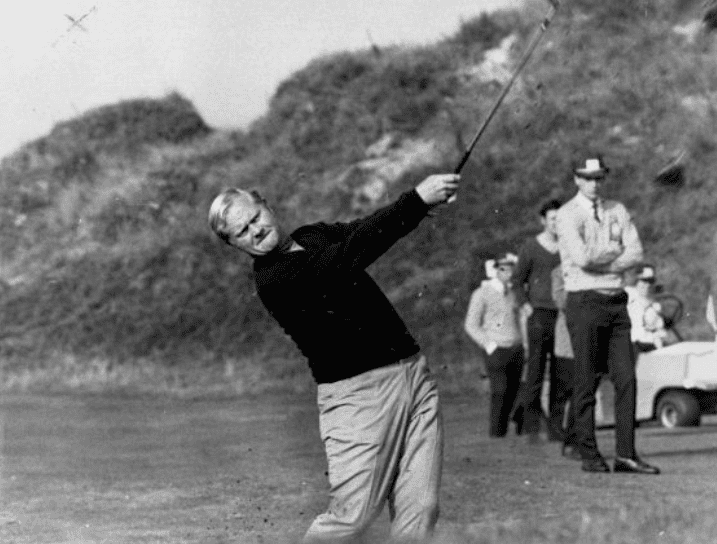
Why Jack Nicklaus Swing Work – Free of Modern “Rules”
Most people have Ben Hogan as their swing god, and sure, he’s awesome, but my personal favorite will always be Jack Nicklaus Swing.
The Golden Bear.
It’s the simplicity and effortless feel of it that I truly like. Don’t get me wrong—most of the time Mr. Nicklaus wasn’t effortless at all—but the soul of the swing of it is. I actually made a long deep youtube video about this as well that you can check out here.
The relationship to centrifugal force and using the body to propel this force is just spectacular.
I really think that modern instruction has been, for three decades, plagued by different agendas to bring in the big bucks. One of the goals of this website is to share the decent amount of knowledge I’ve gathered to explain what I see, what I do, and what I perceive the best of the best did.
Since seven or eight years back (written in 2025), I’ve had the thesis that the golf swing isn’t difficult, but rather simple—and most likely something different than what we see in plain sight.
This mindset and thesis have managed to unlock certain understandings, some of which I will display in this article.
So what makes Jack Nicklaus’s swing actually work, even though it pretty much breaks many of the “modern rules”?
Let’s see the forest for all the trees, shall we?
Jack Nicklaus Swing Key Factor #1 – The Bigness of the Motion
This sounds vague but is more important than you might think. When you see and perceive Mr. Nicklaus’s motion, I’m quite certain that at some point he adapted a mindset of creating the biggest possible motion.
The pure size of it—like the takeaway description from Golf My Way—leads to other benefits, such as the mechanics happening more automatically and the longer pathway making the athletic task of squaring up the clubface much easier.
Other old-schoolers showing similar behavior are Tom Weiskopf, Johnny Miller, Seve Ballesteros, Tom Watson, and somewhat Bobby Jones.
Some modern players utilizing similar perceptions (in my opinion) would be Scottie Scheffler and Justin Thomas, to mention a few.
But it’s not only the takeaway that delivers a big movement—it’s everything: backswing, downswing, and follow-through. All of it is performed within the concept of something big.
Vague? I know. But just apply it once to your motion and you’ll see what I mean. The swing becomes athletically easier to accomplish. I teach this all the time, and the results are honestly mind-blowing.
Simple tasks in our minds, correctly used, will unlock loads of free athleticism.
Another player who basically made his entire golf swing about size (before being over-coached): Tiger Woods.
Jack Nicklaus Swing Key Factor #2 – The Vertical Swing Plane
In unison with many other players of that time, Mr. Nicklaus utilized a higher hand position at the top of the backswing, which not only allowed for free power through the added influence of gravity but also enabled a bigger shoulder turn.
In the downswing, it’s still “steep” if you look from a first-level analytical perspective of a down-the-line view. In reality, it’s perfect in relation to the other factors that influence his motion—e.g. body rotation and extension, club exit, etc.
Some will say that having a vertical swing plane is too difficult because it’s harder to slot the club, BUT they live under the assumption that you need some kind of complicated transition move. Again—the best of the best simplified, not the other way around. (See more at factor downswing usage and it will clarify.)
This gives the ability to naturally come from the inside, even though the top-of-backswing hand position might suggest otherwise.
Golden Bear Key Factor #3 – The Freeness of the Body
You don’t need to replicate Mr. Nicklaus’ knee shuffle to deliver awesome golf. Take two copycats as examples — Tiger Woods and Rory McIlroy. Neither of them has that crazy leg move, and both are still pretty good ball strikers, right?
But there’s one common denominator between the three: their bodies are free and uninhibited. They’re following along for the ride, if you will.
They’re not rigid or “forced-centered” in shackles — they’re set free. The centeredness of a motion actually happens by itself once you start applying power. When you get the forces going, the body will naturally try to optimize how it uses itself as a response.
For instance, Mr. McIlroy has never expressed rotation, yet he rotates more than most.
I myself (not comparing to these geniuses) feel that the club simply pulls my rotation.
The body is free and can respond to whatever it needs to respond to.
Jack Nicklaus Key Factor #4 – Clear Hand Roles & “Fingery” Trail Grip
Mr. Nicklaus is dead straight about the roles of his hands. The lead hand is his stability and control hand; the trail hand is his power hand.
This not only creates clarity in the mind but also translates into how he takes his grip.
The lead hand is gripped in the palm for added stability, while the trail hand has a fingery grip to unleash the power potential of the hinging motion (flexion/extension).
This is no small feat, because most protocols I’ve ventured into treat the hands as a single unit.
Mr. Nicklaus has the roles clear — and this is huge. If you’ve ever tried one-handed swings, you know what I mean: the trail-shot is often the most difficult (especially at first) and naturally has the most dispersion, while the lead-handed shot gives you a bit more control over the direction.
Once you allow the trail-hand grip pressure to loosen, you’ll slowly see what that does for distance. My free trail hand only 6-iron can fly 140-160 yards, while a grip-pressure-strangled trail-hand shot will only fly roughly 110.
Jack Nicklaus Swing Factor #5 – Weak Lead Palm Grip for Power Support
Let’s dig into the lead-hand grip for a second, shall we.
Nicklaus himself says this is an attempt to eliminate the left side of the golf course. When he misses, it’s usually a thin hit to the right—and he can live with that.
In my own pursuit of consistently breaking par, eliminating the left side of the course (for a right-handed player) was the biggest mental factor in being able to change gears and become a better player. Ben Hogan (article about his swing rebuild here) had the same reasoning for his swing changes.
Let’s look at this factor from another perspective. Mr. Nicklaus has mentioned that a strong grip produces a weak swing, and here’s my take on it:
By having a weaker lead-hand grip, he allows the centrifugal force to release earlier than most, which results in a bigger rotation of the lead-arm humerus bone. In other words, he lets the swing happen more because of the weaker grip. Once you start understanding centrifugal force a bit more you know that one of the stimulators is club rotation. Again, these guys applied more genius moves than most understand..
For contrast, in modern golf you often see a stronger lead-hand grip, which more often than not comes with a push manipulation of the swing arc (to secure low point) combined with sidebend. The the power source is different and stimulated with either a sling style power build up (more of a modern baseball motion) or through very intentful body rotation (in the area of the swing where it’s hard to think…).
Jack Nicklaus Swing Key Factor #6 – Downswing Usage and Input Speed
I mentioned the “bigness” factor, and in the downswing this is where it differentiates a lot from, for example, Ben Hogan, Trevino, or even George Knudsen. Mr. Nicklaus, along with Miller, Weiskopf, and Watson, lets go of centrifugal force earlier, which in itself creates shallowness on an otherwise “steep” downswing plane.
(Even though I would argue that this style of “getting centrifugal force going early” is in the DNA of even the more “hitty” players.)
There’s more to the story than down-the-line observations from a shaft plane.
The downswing width makes it possible to utilize the high hands.
The downswing width and its input speed create a foundational power base that can now be used in the follow-through.
I have no data on Mr. Nicklaus’s swing speed in the ’60s, but I would be amazed if it was under 130 mph with a persimmon-steel-shafted driver. The man was a complete power monster.
Also, not to be underestimated—as with all old-timers—Mr. Nicklaus opens his blade in the backswing to stimulate the shaft plane needed for creating an inside strike (together with the blade’s rotational effects on centrifugal force outlet).
Swing Key Factor #7 – Club Exit and Follow Through Completion
So this is where the magic happens in all of these old-school swingers. In modern teaching, we are told to rotate our bodies hard (actively using the lead foot ground force) and go low and left. Did Mr. Nicklaus, Weiskopf, Miller, Watson, Jones, etc., do that? Did more modern players (before over-coaching), like Woods or McIlroy, do that?
Not a chance. Look at this picture to support the statement:
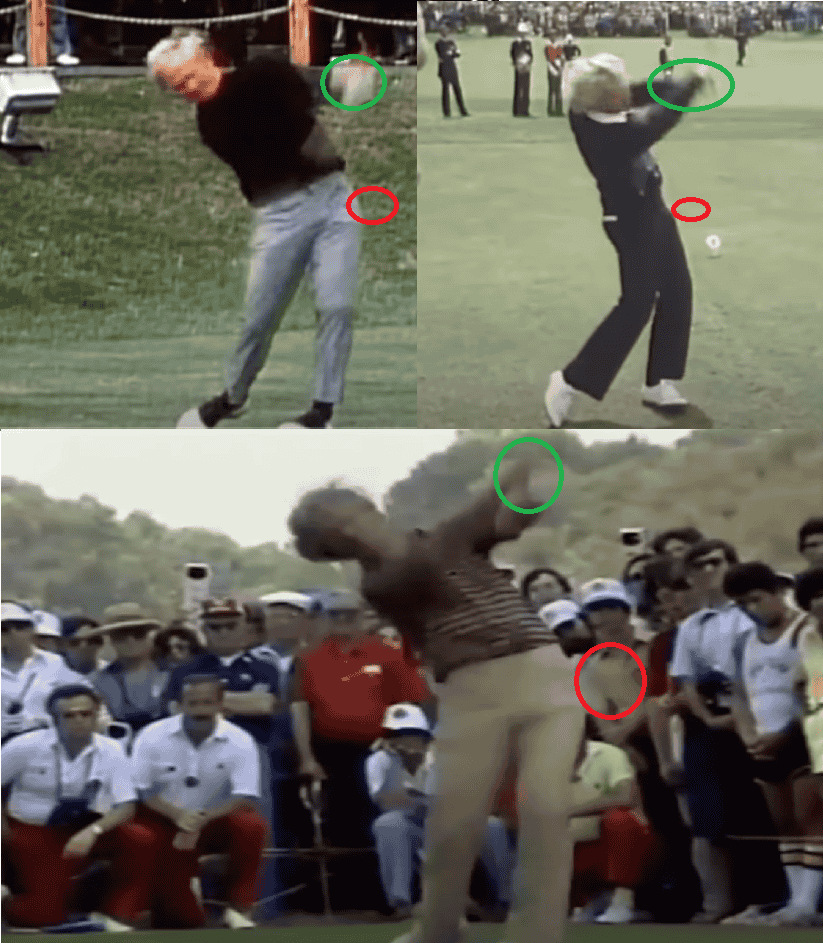
The club moves in the intention more straight upwards than anything else. Add a bit of body rotation and force twist in the shaft, and it looks like left—but that’s not what they did.
Remember—take the left side out of play? This is one of the key components for guiding the club in a non chaotic impact zone release style.
But it doesn’t stop there. The body rotates as a direct reaction to the club’s intentions and the continued upwards motion of the hands (following the club).
This is also, in itself, a relative braking mechanism in relation to the club. It makes the hands—since they’re performing a directional shift—go way slower than the club, so that the final bits of centrifugal force can be released. It fits with the more upright swing and is a heck of a lot easier to perform than some tight, hairpin-left intention.
This additional bit of power is what drags the body into the nice follow-through position.
Is that all? Did they not rotate intentionally? These guys are masters for a reason. At the core of their motion, centrifugal and centripetal force handling reigns supreme—but, of course, they added a layer of additional masterful characteristics, such as rotation, BUT it comes from something else (in my opinion).
Moving to the final two key factors of Mr. Nicklaus’s swing…
Nicklaus Swing Key Factor #8 – Early Extension for the Win
If analyzed with modern methods, Mr. Nicklaus would be accused of early extension. This leads me to pause and ask: are we seeing the forest for all the trees here? I mean—18 majors, countless tour wins, and the GOAT movement of all time. Is that wrong?
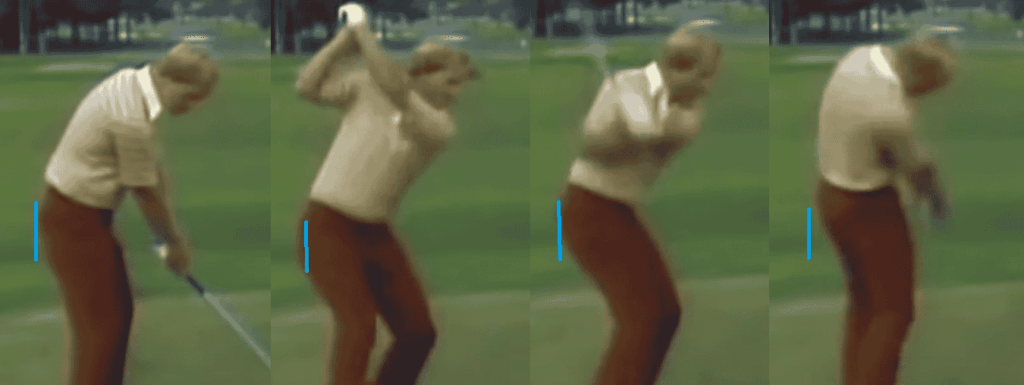
Let’s take a step back and look at this clearly.
The stimulated extension of Mr. Nicklaus’s body allowed him to enjoy a higher hand position (a steepener of the plane), since extension acts as a massive shallower. On top of that, full body extension facilitates synchronized body rotation—synchronized, not the forced sling rotation of modern golf.
This little cocktail of mechanics, inspired in my opinion by simpler thought patterns, creates the masterpiece swing that delivers a fully released golf club with a fade bias and efficiently takes the left side out of play.
To quote Brandon Chamblee: why does no one teach Mr. Nicklaus’s swing? Because they don’t understand it.
I don’t fully (no one ever will) understand it, but I get enough to be able to use many of its core components to take my relatively mediocre talent and display a game that takes me under par more often than not. AND I’ve actually unlocked the ability to teach it—after spending 10 years on this.
The geniuses don’t make it difficult. They make it simple—and then they train and grind for decades. The simplicity lies in focusing on the key concepts behind the movements, rather than the movements themselves.
Final Nicklaus Swing Factor #9 – The Open Stance = Early Centrifugal Release
So all of the above creates more or less a base motion: a high swing with loads of shallowness. In fact, too much shallowness—even though it’s not supposed to be possible, right?
Well, this introduces a cool mechanical option for Mr. Nicklaus that he, along with a few other players in history (e.g., Lee Trevino), uses to simplify even further.
He plays the open stance. This adds a bit more steepness through path alteration and stimulates additional “free” body rotation through the ball.
It actually shortens his path a little bit toward the golf ball, which means he can go ahead and release even earlier. Releasing here represents the centrifugal force outlet in the downswing. In fact, he needs to release it to make the club catch up to a body that will spin more. Complete genius move.
Another player using the same release style and describing it similarly is Mike Austin. Even though his motion is slightly different, he explains that he needs to “throw the club” to make it catch up with his body.
Of course, both Mr. Nicklaus and Mr. Austin’s statements have been taken out of context and completely misunderstood. It’s not about casting—it’s about propelling your motion chronologically earlier than you think to create the correct sequencing and timing.
Again—let’s step back and see the bigger picture here…
Other Interesting Factors
I would love to share some other cool components of Mr. Nicklaus’s motion that are definitely influencers, but maybe not key factors, for the GOAT’s swing.
- Finally, just think about this: the snap hook doesn’t exist, and his miss is a weak, somewhat okay fade shot. That’s so damn simple. Will that make you more or less confident on the golf course? All of these factors combined—and the miss factor especially—I think form the bedrock of Mr. Nicklaus’s clutch performance. He plays an easier game.
- The flying elbow is an interesting feature. Although it helps with the shoulder turn, etc., I would say it’s more idiosyncratic than anything else.
- Nicklaus always set up to the left of the target—partly because of his philosophy of taking the left side out of play and partly because of eye dominance. Most of us “normies” have a different perception of the golf world and will often aim to the right. Already here, we are outperformed by Mr. Nicklaus. Check out this video post about aiming if you will.
- Furthermore, I believe that Jack Grout’s statement—that you should have the same swing with all clubs—is close to god-tier in smartness. Mr. Nicklaus uses the same grip, the same ball position, and the same motor pattern for every single club in his bag. Is that harder or easier than having four different swings?
Summary and Self Application
To wrap it up: I love Mr. Nicklaus’s swing, and you should too. You don’t need to perform the crazy foot shuffle or swing as hard as he did in the ’60s.
You just need to apply the soul of his motion. Enjoy the bigness of the motion, the verticality with its free gravitational power benefit, and also emulate the way he grips the club—with a palmy, weak lead hand and a fingery trail hand. Train a load of one-handed motion and package it in the big feeling.
To sum it up, I’d like to share my favorite quote from Jack Nicklaus:
“This is a game. That’s all it is. It’s not a war.”
If you wish to dive deep into the moves of the old greats, you can just contact me, and we’ll take it from there. I use many of what I perceive as key moves of Mr. Nicklaus in my teaching of the Big Arc Swinger pattern.
More FMM Project Articles

The Swinging Protocol – In the Core of all Great Golfers?
I have a special interest in the golf world, and that is to understand what actually built the best swings of all time. Not just how they look, but what truly built them. What…

A Powerful Golf Swing Clips It – Stop Chasing Divots
We are all performing golf swings based on inner images, muscle memory, and athleticism. These different subconscious images will shape how we perform our motion. A powerful golf swing clips it in a shallow,…
Perform Your Backswing in Front of Yourself – The Vertical Lift
The backswing might be the most difficult part of golf. Do it right, and while there are no guarantees of a perfect result, do it wrong and you’ve almost certainly ruined your chances of…
General Article Collection Pages

All Articles Library – All Creations in One Place
Everything I’ve created over the years. You have different filterings according to the list below. Wish…

DIY Swing Change – Advice on How to Successfully Change
Do It Yourself, DIY Swing Change, is what has driven me the last decade in my…

FMM Academy – Which Pattern Fits You?
My best live lessons are ten minutes long.Nine minutes of dialogue. One or two balls hit…

Golf Swing Styles – Categorization for Context
I categorize golf motion styles into systems for the sake of clarity and understanding. No golfer…
Video Based Articles
Jack Nicklaus’s Swing – The Inner Layer of his Motion
Jack Nicklaus’s Swing – The Inner Layer of his Motion Golf history is full of great swings, but few have stood the test of time like Jack Nicklaus’s. His technique wasn’t just effective —…
The Simple Golf Swing: Four Key Concepts Explained
The Simple Golf Swing: Four Key Concepts Explained Does the simple golf swing actually exist? It’s a reasonable question and my answer is this. There are definitely simplifications of the motion available for you…

Pre-Shot Routine: Learn from Scottie Scheffler’s Mini Swings
Pre-Shot Routine: Learn from Scottie Scheffler’s Mini Swings The pre-shot routine is the most underrated performance booster of your score in golf. Looking at Scottie Scheffler’s routine, the most consistent player for decades, makes…
Old School General Articles
Ben Hogan 1940s Pre-Accident Swing Change – Power Updated
Nothing in golf quite compares to Ben Hogan’s ball striking induced dominance in the 1940s and 1950s. In 1948 alone he would win 10 titles including 2 majors. The 1940s pre-accident swing rebuild I…
Old School Swinging Elements on Tour – A Modern Case Study
Modern top tier golfers definitely display old school swinging elements of the old greats. These swing styles are making their way back to the leaderboards today. This article relates to my teaching style of…
NOT the golfing machine Swinging – Separation from TGM
I’m not into the golfing machine system since thinking of the swing as pure geometrical idea where the picture align with the inner intention is very far from how I see the golf swing….