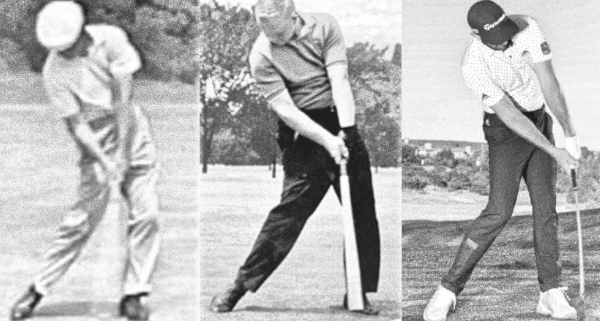
Deciphering Swing Styles – The Best Component of Golf Development?
Why is it a good thing to decipher different golf swing styles? How can deeper understanding help your own development?
Understanding your, our your student’s, swing style will give you many nice benefits:
- It makes it less likely to “take someone else’s medicine”. In other words it helps you not to “harm” yourself with wrongly chosen advice.
- It gives you the ability to spring clean your mind and gain focus in your development (spend less time on irrelevant stuff).
- It provides the foundation for finding information and concepts that actually aid you.
- And the golf nerd one: It’s just fun to know stuff 🙂
In other words, this is all about creating clear contextual knowledge. You’ve likely heard me write “what you see isn’t what you do” which is basically a reference to that golf swings are the outcomes of inner driving intentions. Understanding your swing style can aid you in your search for how you can alter these intentions if needed.
Obviously these are all subjective analysis from my own point of view (the outcome of 10+ years research in golf). Even though I know that not every single information line in this articles is 100% factually correct, I know that it provides enough context to achieve the four mentioned points.
Perspective 1 – Knowing (or not) your power source
Ultimately everything in golf boils down to power in one way or another. I have a deeper article about power about it here. The power styles I’ve come across over the years are the following::
- Not knowing your power source and delivering bad golf. This is usually all over the top players and in general inconsistent strikers. The power journey isn’t clear and the body just reacts to an undefined task. In my opinion, you don’t swing over the top because you want it, but because that’s the option you’ve given yourself. This is the realm of most major swing flaws in golf.
- Not knowing your power source and being pretty good. Most of these golfers started golf early and learned to create natural power when they were pretty weak. They had no other choice but to create a decent power mechanism. I used to be this player and it took me down to 1 in hcp. Here you also have a bunch of swing flaws readily observable.
- Knowing your power through an Ax / Whip / Dump. The concept is that you utilize the abstract concept of dumping your angles at the golf ball. This is an abstract concept that solves a lot of mechanics. Let’s use the trail arm as an example. In the top backswing position the humeros and forearm bone has rotated, the arm has flexed and your wrist has cocked and hinged. The abstract intention gets rid of all of this.
- Knowing your power through Tire Smashing. This old school technique was pioneered by English coaches (I think) and is about shutting down the face with the forearms together with stimulating centrifugal force. This is a potent skill set that has a very clear training form (tire smashing..). This also emphasizes the usage of lag to store power.
- Knowing your power through a Sling. This I believe is the outcome of trying to never fully release the club but to block out the shot with a massive body inspired sling action. Think Dustin Johnson and you’ve got it. It’s a very baseball inspired motion. The sling power mechanic doesn’t utilize lag as a key component.
- Knowing your power through Using the Swing Arc. This is what the old timers did before equipment made it possible to use other styles of power. It’s, in my opinion, the smoothest, most consistent and easiest to learn power style (if you know what to do). The swing arc power also uses some lag and mechanics to make it happen but primarily uses the pure size of the arc to generate a longer path for the clubhead to travel.
If you start thinking about your power style it can really help you to navigate which advice to listen to and which not to. Fundamentally all tips involving the skill set of developing your power mechanism will trump any e.g. “biomechanics” golf tip out there.
Perspective 2 – Downswing Arc Usage
How you use the swing arc can also be a dead give away to which style of swing you are performing (with or without clear intentional targets). The goal of the downswing arc is to present a shallow enough strike to harness the goodies of an optimal impact (for your above mentioned power source).
- Narrow 2 plane over the top swinger. This is you that actually go ahead and steepen your downswing plane without shallowing out the golf club. Most of these golfers will hit big slices or in the general pull region of golf shots. Most of the time they will, over time, work in a very strong lead hand grip to accommodate the swing path (out to in) and eventually start aiming loads to the right (for a righty player). This mostly lines up with the “not knowing your power” perspective in the previous segment.
- Narrow 2 plane plane swinger – dumping the upper body. Most of these golfers have solved their over the top problem through letting the upper body fall too much in the downswing. This would be most 2 way miss players and this aligns very much with not having a defined power source.
- Narrow 2 plane swing – shallowing the club. This swing style can take you to the tour if you’re good enough. It’s basically solving the “shallowing need” in the difficult-to-navigate-mentally-transition and presents a nice impact opportunity once successful. It can be solved with either early transition forearm rotation which then matches up with a more “tire smashing” power focus. You can also try to extend your trail arm manually which would match much better with an ax motion. Lastly if you actually go ahead and shallow the club whilst also closing it the matching can be made towards the whip concept. Either motions, in my opinion, are hard to perform.
- Wide 2 plane wide swinger. This is the realm of the baseball inspired motion that made its way into golf the last 20 years (read this article about swing evolution). When you go ahead and keep a wide arm structure in the downswing whilst heavily manipulating the club with your forearms and wrists to set up the following: That you outrace your arms with your body and create a stretch in all relevant muscles. The sling is then inspired by the massive rotational effects of the body.
- Wide 1 plane swinger. There is a much easier way. You actually don’t have to manipulate your swing plane at all if you actually go ahead and use the downswing arc to your advantage. This style is what the old timers used and it’s simply about creating power with the arc instead of another source. This creates the advantage of “free shallowness” and limited swing plane manipulation. Hence, it’s the easiest form of downswing arc usage and it originates from actually intentionally knowing and using your downsizing arc power source. (and I’m not talking about Moe Norman’s version here but a more “normal downswing arc usage”)
An example of the benefit of looking here for answers is: If you are a narrow 2 plane over the top swinger and you take the advice that you “need to rotate your body more” you’ve taken medicine from the wide 2 plane swinger bracket and you will become worse at ball striking.
Perspective 3 – Hit, Sling or Swing
What I’m after here is the separation of golf motions in relation to a more holistic feel perspective where you as an observer can start thinking about if you have a motion that hits, slings or swings. Why is this important? Again, it’s all about knowing who you are so that you can start digging down the rabbit holes of the swing style that symbolizes your movement.
(for you that have a TGM interest and knowledge I’m not talking about this the TGM hitter or swing terminology here)
- A hitter in golf is someone that performs a motion that seems to have a very clear ending point way before the finish position. It feels a little bit like there is a lot of wasted potential in the movement. If you find yourself in this region and this is the way that you wish to play golf then you should look at development in an either ax or whip like motion where you train your 2 plane back-/downswing to become much more shallow. I will however say, and I’m VERY biased, that the 1 plane wide downswing arc and the swing arc power source is an easier development for you.
- Professional examples that showcase some of this would be e.g. Tommy Fleetwood or why not Alex Norén.
- The slinger is someone that goes ahead and uses their body primarily to really create huge separation and more “hit a baseball shot in golf”. You see this on TV all the time and you also see 23 year olds withdrawing from events with back injuries…
- Professional examples like DJ, Victor Hovland or Joaquin Niemann.
- The swinger is someone where you get the feeling that they are harmonic and in connection with the club throughout the entire swing. It feels like they are utilizing the complete downswing all the way to the follow through to accelerate the speed in a non chaotic fashion..
- Professional examples like Xander Schauffele or why not Scottie Scheffler. And basically everyone before the 1990s.
Summary – Deciphering Golf Swing Styles
This article is all about gaining knowledge of what you’re doing today. If you comprehend this then you can more easily go down the road where solutions are readily available. Having accomplish 5 swing changes the last 10 years (read my story here) has led me to many conclusions and this is one of the more important ones: Understand where you are today, where you want to go and why you want to go there. The mile high context I have written about can provide you answers for these questions.
Swing Knowledge and Flaw Articles

Minor Swing Fix: Intentions Makes AND Breaks Your Swing
Most golfers manipulate their motion in one way or another, which eventually leads to the need for minor swing fix. After all, most of your golf shots will be less than perfect. Or as…

The Lateral Slide in Golf – Why It’s a Game Changer
There are different styles of golf swings that you can perform, but if you are into using the swing arc as your engine (like most golfers do), then you need to use the lateral…

A Shallow Golf Swing – Which Move Creates the Magic?
How is it that many tour pros don’t visibly shallow their golf club early in the downswing, yet still deliver world-class impact conditions? How do they achieve such a naturally shallow golf swing? Could…
Main Content Pages

FMM Academy – Which Pattern Fits You?
My best live lessons are ten minutes long.Nine minutes of dialogue. One or two balls hit by the student. Because what matters in swing development is understanding and athletic execution — knowing what to…

DIY Swing Change – Advice on How to Successfully Change
Do It Yourself, DIY Swing Change, is what has driven me the last decade in my golf swing development. The absolute enjoyment of figuring out a swing change myself. To all of you out…

All Articles Library – All Creations in One Place
Everything I’ve created over the years. You have different filterings according to the list below. Wish to watch Youtube videos instead? Then click here to open Wish to visit my Skillest Profile (coach app)?…
Old School Swinging Articles (from Golf’s Best Systems)

Golf’s Greatest Swingers – Natural Flow Trumps Manipulation
The debate whether the golf motion is a swing or a hit has been around forever. My absolute bias for this article is that the golf swing is a motion where the hit becomes…
Natural Swinging Power – Learning from Jack Nicklaus & Tom Watson
I won’t lie – I’m a huge fan. Growing up, my dad’s VHS tapes of Jack Nicklaus and Tom Watson were like treasures. I watched their countless duels and the 1986 Masters back nine…
Ben Hogan 1940s Pre-Accident Swing Change – Power Updated
Nothing in golf quite compares to Ben Hogan’s ball striking induced dominance in the 1940s and 1950s. In 1948 alone he would win 10 titles including 2 majors. The 1940s pre-accident swing rebuild I…
The FMM Swing Video Posts

One Handed Swings = Golf’s Best Drilling?
One Handed Swings = Golf’s Best Drilling? If you practice one handed swings, I guarantee you’ll start swinging more synchronized over time. Allow me to explain. One Handed Swings Advantage 1 = No Cheating…
Do You Even NEED a Golf Swing TRANSITION MOVE?
Do You Even NEED a Golf Swing TRANSITION MOVE? The golf swing transition and the “Transition Move” is a highly debated topic. Should you drop and shallow the club in the downswing, should you…

Automatic Body Rotation – A Natural Result of the Right Intentions
Automatic Body Rotation – An Outcome of using the Swing Arc There are many different swing styles, but the classic golf swing was built around one key principle—utilizing the swing arc. If you are…
The FMM Swing Articles

Understanding Hand Dominance Advantage – Magic for Your Golf
Are you right or left hand dominant? Are you swinging from the right or the left? Hand dominance in the golf swing is extremely important yet it has almost zero space in the golf…

Your Golf Brain Is Stupid — It Demands Simple Coordinates
I’ve played golf for 35+ years and have been deeply researching the golf swing for at least 12–13 years at this point. One of the few statements I can make with absolute certainty is…

Flipping in the Golf Swing? Understand and Utilize the Dynamics
“I flipped it, that was a crap shot” has to be in the hall of fame for the most commonly heard phrases on any golf course. Understanding flipping in the golf swing — what…