How Lee Trevino Built One of Golf’s Most Accurate Swings
Most golfers trying to hack the golf swing just ruin it, and some, like Lee Trevino, win six majors.
From an accuracy perspective, I would say that his motion is the most efficient I’ve come across. And even more importantly, from an achievability perspective, it’s actually doable without being superhuman.
In I Can Help Your Game, published in 1972, Mr. Trevino actually describes almost everything you need to know.
He sort of “forgets” to mention what goes on with the club, though.
With that said, this book is a piece of art. Except for the club part, it says exactly what you need to know to emulate what he is doing.
Let’s break down the key elements and round it off with my key success factors for this beautiful pattern.
Power Application in its Pure Form
This isn’t a long, flowy swing motion. It’s an intense vertical power application in the downswing that creates so much inherent shallowness that you can enjoy the benefit of added steepening elements.
Mr. Trevino would many times show a very early ball position in his demonstrations, which just further proves the vertical point.
You hit down since the ball is on the ground, right?
Sliding for Power Counterbalance
So, with some kind of power application in place, you have fundamental speed, but it’s not “fun” yet. You need something to apply from. In this pattern, that’s the established pressure in the lead foot.
Lee Trevino calls it his Hula move, and it’s a thing of beauty. It has quite possibly inspired the whole Stack and Tilt slide as well (performed with a different power protocol, in my opinion).
With more power application counterbalanced by lead-foot ground pressure, you immediately start improving speed. But we are not done.
Pushing the Power Forward
The real benefit of the power is in the trail-foot push forward, in unity with the forces in the club. You guide the power toward the target quite easily using the trail foot (basically the opposite of early extension).
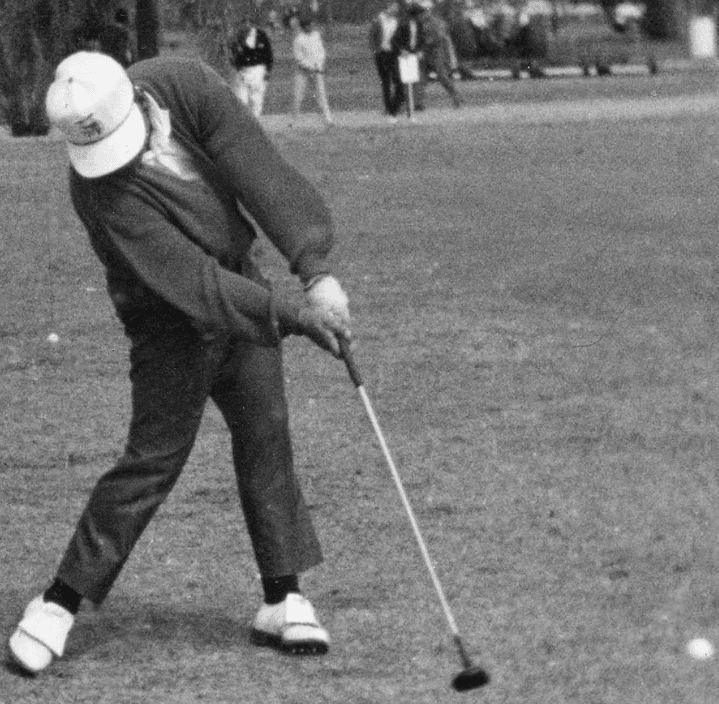
When you do this, you start building a mental (and physical) connection to the trajectory at hand.
You tune in with the shot shape.
And let me tell you, the stock shot shape is what most seek — dead straight.
Nothing happens to the shot. No wonder players like Moe Norman (who shares many common denominators with Mr. Trevino) would talk about a feeling of greatness.
So, back to the opening paragraphs: Mr. Trevino’s pattern isn’t just a straight shot; it’s as accurate as you can get.
Hacking the golf swing done right.
The Forgotten Detail — Backside Club Action
Okay, back to the important forgotten detail. What the heck is going on with the golf club?
Well, it’s not a conventional modern release protocol. This is a backside entry into the release which, in companionship with centrifugal force, creates a very easy athletic task.
You shut down, for example, 20 degrees of club rotation in a short while, and although that sounds like quite a lot, it’s actually nothing. If you fit it, it becomes a highly trainable athletic task that you can master rather quickly.
From a simplified explanatory perspective, you dump it backside and then push the energies forward (first without ground-pressure support and then with the full Hula power boost).

By the way — No Manual Rotation Whatsoever
This sounds strange, but it’s really true: the swing style doesn’t have any manual rotation in it. All rotation happens as a reaction to the power application and its supporting ground pressure.
You feel very linear in the downswing and impact area, and this contributes to the feeling of becoming accurate quickly.
Matching it up — why Lee Trevino looks like he looks
I’ll mention this again: the power protocol is a massive shallower. Mr. Trevino, who favored the fade, not only uses a looped backswing (which takes him a little less deep) but also an open stance to counter the shallowness.
This opens up the body for reactive steepening elements.
In other words, the backswing and the stance turn, for example, five degrees from the inside into zero.
Another typical Trevino look is the very “toward-the-target” clubhead after impact. I think it’s borderline too much, since it forces a slightly excessive side bend to match it up. But then again, maybe it’s worth a bit of wear and tear if you want to win big. (I perform it with a much more limited forward push compared to Trevino.)
So Mr. Trevino’s (and Norman’s, and Thompson’s, and Knudsen’s) “kneeling through the shot” comes from the forward push.
Key Success Factors — Execution Perspective
I think it’s highly beneficial to be trail-arm dominant in your fit here. Learning the power protocol is mainly done with the trail hand, in my opinion, and the shift from vertical to forward involves body awareness with this arm.
With that said, maybe you, as a lead-arm golfer, can get by as well.
Educating About This – Backside Chop & Push Pattern
Long story short, studying swing technique for more than a decade has given me the opportunity to “crack this code” to the best of my abilities.
I teach a protocol heavily inspired by this that I call the Backside Chop-to-Push Pattern. It’s 80% Trevino and 20% other inspirations.
Or watch my Youtube Channel here
More FMM Project Articles
-
The Swinging Protocol – In the Core of all Great Golfers?
I have a special interest in the golf world, and that is to understand what actually built the best swings of all time. Not just how they look, but what truly built them. What…
-
A Powerful Golf Swing Clips It – Stop Chasing Divots
We are all performing golf swings based on inner images, muscle memory, and athleticism. These different subconscious images will shape how we perform our motion. A powerful golf swing clips it in a shallow,…
-
Perform Your Backswing in Front of Yourself – The Vertical Lift
The backswing might be the most difficult part of golf. Do it right, and while there are no guarantees of a perfect result, do it wrong and you’ve almost certainly ruined your chances of…


General Article Collection Pages
-
FMM Video Articles — See It. Read It. Understand It.
In early 2025, I started my YouTube channel (find it here), and the format has really…
-
All Articles Library – All Creations in One Place
Everything I’ve created over the years. You have different filterings according to the list below. Wish…
-
FMM Academy – Which Pattern Fits You?
Golf instruction has never suffered from a lack of information. It has suffered from a lack…
-
Swing Styles Articles – Explaining Old School Variations
I categorize golf swings into different styles for the sake of clarity and understanding. No golfer…



Video Based Articles
-
FMM Swing Technique Blog | Posts – Aggressive Fluid Release (Hogan) | Posts – My Top Picks | Posts – Popular Drivers | Posts – Swing Tech & Patterns
Building a Golf Swing from Scratch – Introduction
Building a Golf Swing from Scratch – Introduction Welcome to my experimentation pit, where I explore golf swing mechanics, uncover forgotten concepts, and work to understand what truly drives a golf swing. Building a…
-
FMM Swing Technique Blog | Posts – Aggressive Fluid Release (Hogan) | Posts – My Top Picks | Posts – Popular Drivers | Posts – Swing Tech & Patterns
Why I DON’T Like SHALLOWING MOVES in the Golf Swing
Why I Don’t Like Shallowing Moves in the Golf Swing Why do golfers feel the need to make deliberate shallowing moves in the downswing? You see them everywhere on social media: shallow the club,…
-
FMM Swing Technique Blog | Posts – My Top Picks | Posts – Popular Drivers | Posts – Swing Tech & Patterns
Why Most Golfers Fail Swing Change (Not THEIR FAULT)
Why Most Golfers Never Change Most golfers who set out to change their swing never truly change. It is rarely a lack of effort. The problem may lie in how we approach the task…

Old School General Articles
-
Building a Golf Swing from Scratch – Understand to Change
Building a Golf Swing from Scratch Building a golf swing from scratch is one of the subjects I find most interesting in golf. There are countless variables involved: the wrists and forearms, the arms…
-
Ben Hogan vs Jack Nicklaus Grip: What’s the Real Difference?
All the old-timers cared about one thing first and foremost. Almost as if it were the gatekeeper to their swing worlds. The grip. Why is it so important? Because it directly connects to how…
-
Why Jack Nicklaus Swing Work – Free of Modern “Rules”
Most people have Ben Hogan as their swing god, and sure, he’s awesome, but my personal favorite will always be Jack Nicklaus Swing. The Golden Bear. It’s the simplicity and effortless feel of it…