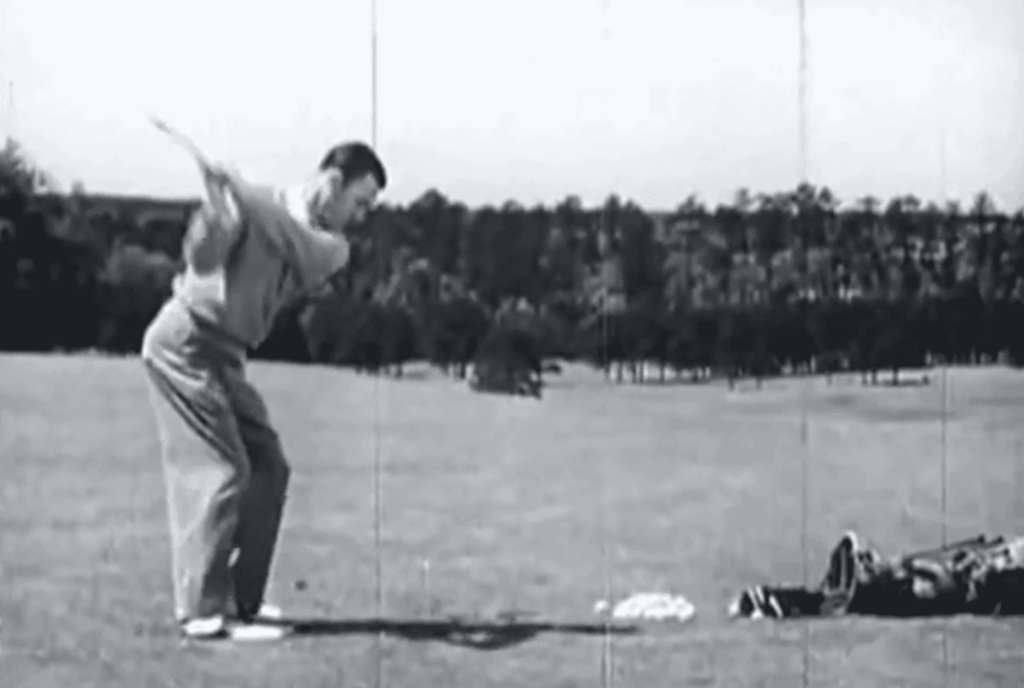
Ben Hogan 1940s Pre-Accident Swing Change – Power Updated
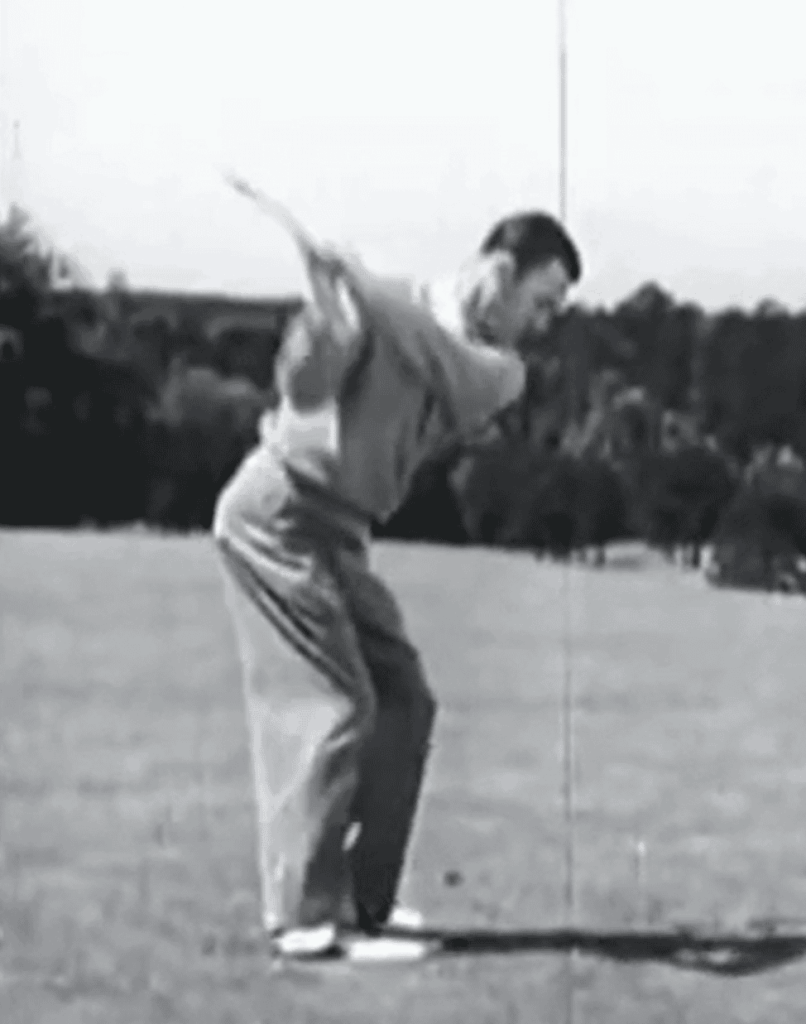
Ben Hogan 1940s Pre-Accident Swing Change – Power Updated
Nothing in golf quite compares to Ben Hogan’s ball striking induced dominance in the 1940s and 1950s. In 1948 alone he would win 10 titles including 2 majors.
The 1940s pre-accident swing rebuild I believe has possibly the most learnings potentials so this is where I start with my Hogan coverage.
For clarity, this is a subjective article containing interpretations from my inner layer achievability perspective and aim to provide some kind of tangible insights that further your knowledge.
(I will create way more articles about Hogan down the stretch. Post Accident Coverage. Power Golf breakdowns. Five Lesson breakdowns and much more. Coming in Q1-Q2 2026)
The 1930s Struggling Swing – Input Value
So the thing is this – most golfers would give almost anything to have the motion that mr Hogan had in the 30s. No, it wasn’t good enough for major wins. No, it wasn’t optimal and as good as his later swings, BUT still it created fundamental juices in him that made it possible to adapt his later absolutely amazing changes.
In essence it has the following key features:
- A strong lead hand grip and a shut top backswing blade position in a a pretty “Phil Mickelson esque” overswinging state.
- Inside path striking with lag properties pretty much unseen in most modern golf swings.
- A “push forward handle dragging” which pushed his lead arm away from his body and created an athletically difficult square the face task. The lead arm away from the body you actually see in many modern swings as well but then you employ different power protocols which relies more on slinging than on the lag usage that early Hogan relied on for power.
I would assume most of the duck hooks would come from being stuck in the downswing and making the “hard to square task” even harder.
The key point here is. There’s so much wrist action going on and there’s so much power that he could actually sacrifice some of this power for control.
Swing Change Key – Lead Arm Behavior opens for another Power Protocol?
So, to deal with the whole duck hook problematic’s Mr Hogan incorporated several key “fade” elements into his swing::
- He weakened his lead hand grip in relation to the 30s and put the trail hand more covering.
- He spiraled the blade open in the backswing using the lead arm to rotate it.
But this isn’t all about fading the golf ball. It goes much deeper and actually changes the power protocol.
Let’s look on the from a very pragmatic perspective from e.g. late 40s and the struggling 30s motion.
- The backswing is tighter, shorter and on a more shallow swing plane.
- The chest rotation through the strikes is more synchronized. In the 30s the body opened earlier and then the arms caught up more.
- The lead arm has moved way closer to the body at impact taking away the big gap that was there in the 30s.
- The follow through appears more harmonic and the club has moved from being overrotated to pretty much square to the arc in the finish.
From a mental, subjective analysis perspective, the focus seems to have changed from a more downswing-oriented power application to a follow-through completion focus. This very much aligns with more controlled shot shapes and a connection to the result itself.
From a technical perspective, the club falls more naturally down in the downswing, and here’s the thing: in the 30s movement, I’m quite certain that the strong grip and the hand-push movement created a different release style. It was more “front-side,” if you wish, while in the 40s movement, I would argue that it’s taking the backside toward the release. Like the steering wheel has been turned so much that the centrifugal force pulls the lead hand into a rotation from the backside rather than from the front.
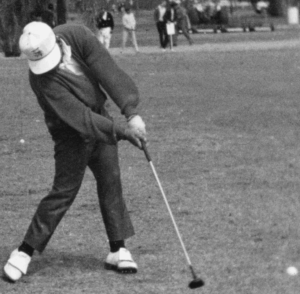
Look at the picture below and note the ulnar-to-radial deviation (wrist uncock) in particular. In the second image, you can see the lag angle disappearing, and this is the initiator of the backside-toward-the-release motion. It’s not possible from a more shut position because it would send the ball dead left.
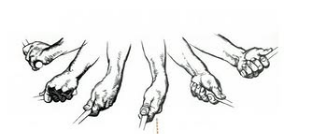
Put in other words (and sorry for not being good at explaining this yet), the more open you become, the closer you come to natural closure. This is a bit like the rock-on-a-string theory of the golf swing.
Long story short: through working the backside like this, the wrist angles in the lead hand can work more potently through the p6.5 → p7 area and present a lead arm that connects to the body. This aligns with the weaker grip and the harmonic full-body feel through impact.
From another perspective: in the 30s, he would push the lead arm away from the body. In the 40s pre-accident swing, it became much tighter. Ultimately, this leads to another power protocol, especially from an application perspective.
No wonder his statement: “Do the opposite of what you think…”

Learnings & Take Aways (Written Dec 2025)
I try to see common denominators between the best of the best for the purpose of being able to teach it.
It’s quite clear to me that the core of the release protocol that Mr. Hogan started to utilize in the mid-1940s is shared with, for example, Sam Snead (more tranquil and different body movement), George Knudsen (simplified, achievable), Peter Thompson (simplified), Gary Player, Lee Trevino, and so on. They all take the backside toward the release and, with this behavior, can present low, penetrating ball flights on command—something available to very few players in history.
Mr. Hogan will always be golf’s biggest enigma, but I’m getting closer and closer by the day. During early 2026, I will release numerous articles on the subject, showing how to make his core swing style actually achievable.
In the FMM Swing Academy I share all my discoveries to my students. This “crack the golf swing project” is more than a decade old and has the ultimate task: How can I make these movements achievable.
To be continued.
START THE JOURney – FIND YOUR OLD SChool PATTERN
Your inspirations and your subconscious view of the golf swing matter more than anything when it comes to making a lasting swing change. The goal is to find the pattern that fits you best. Take the quiz and check out the best choice for you below:
FMM EDUCATIONAL PATTERN PAGES
-
Trail Power Hitter Pattern: The Invisible Vertical Power
THE GOLF SWING IS INVISIBLE You can’t see what I really do. I…
-
Aggressive Fluid Release Pattern: Cracking the Hogan Enigma
Cracking THE IMPOSSIBLE ENIGMA? First attempt: seven years ago. There I failed with…
-
Big Arc Swinger Pattern: From Nicklaus to Woods to Scheffler
What’s a big arc golfer? You see that person with a swing that…



Closely Related Articles
-
Building a Golf Swing from Scratch – Understand to Change
Building a Golf Swing from Scratch Building a golf swing from scratch is one of the subjects I find most interesting in golf. There are countless variables involved: the wrists and forearms, the arms…
-
Ben Hogan vs Jack Nicklaus Grip: What’s the Real Difference?
All the old-timers cared about one thing first and foremost. Almost as if it were the gatekeeper to their swing worlds. The grip. Why is it so important? Because it directly connects to how…
-
How Lee Trevino Built One of Golf’s Most Accurate Swings
Most golfers trying to hack the golf swing just ruin it, and some, like Lee Trevino, win six majors. From an accuracy perspective, I would say that his motion is the most efficient I’ve…

Some General Swing Tech Posts (with Videos)
-
AIMING in Golf – Is EYE DOMINANCE Causing You to Miss?
AIMING in Golf – Is EYE DOMINANCE Causing You to Miss? Aiming in golf isn’t as easy as you might think. Aiming too much right as a right-handed golfer is the most common fault…
-
FMM Swing Technique Blog | Posts – Big Arc Swinger | Posts – Popular Drivers | Posts – Power Focus | Posts – Trail Power Hitter
Active DOWNSWING POWER – The Most Underrated Asset in Golf?
Active DOWNSWING POWER – The Most Underrated Asset in Golf? You’re not supposed to rush the downswing — you’re supposed to let it happen. But what if you can actually be intentional and active…
-
One Handed Swings = Golf’s Best Drilling?
One Handed Swings = Golf’s Best Drilling? If you practice one handed swings, I guarantee you’ll start swinging more synchronized over time. Allow me to explain. One Handed Swings Advantage 1 = No Cheating…



FMM Project Articles
-
Functional Swing Technique: What a Good Swing Achieves
When it comes to the golf motion, there’s one ultimate goal—and it isn’t perfect form or carrying the driver 320 yards. It’s achieving a functional swing technique. To bring clarity to what functional swing…
-
Why Simple Swing Feels Can Transform Your Golf Game
I’ve conducted 5 swing changes in the last 10 years because I’ve been on a mission to understand the swings of my idols and create a swing concept that allows injury-free, powerful, and easy-to-achieve…
-
The Golf Swing Plane and Circle: Natural or Manipulated?
The golf swing is a bit strange in that some of the observed behavior just happens, while other aspects are enforced or acted upon. You have the observed golf swing plane and the circle…